Remote joins CMU Portugal Program as industrial affiliated

The Carnegie Mellon Portugal Program is proud to announce the establishment of a new industrial collaboration with Remote, the company building the new foundation for global employment. Remote now joins the esteemed list of the Program’s industrial Affiliated partners
Remote’s mission is to simplify how companies employ top global talent. As a global employment platform, Remote takes care of payroll, benefits, taxes, and compliance, so businesses of all sizes can hire the best employees no matter where they live and work. By establishing its own local legal entities in countries across the globe, Remote offers the most robust solution in the global employment industry, guaranteeing compliance with local and international regulations while exceeding the highest standards of data privacy and security. 

Co-founded by Marcelo Lebre and Job van der Voort in 2019, Remote’s team today includes employees in Portugal, Italy, the Netherlands, the U.K, the U.S., and other countries around the world.

The Carnegie Mellon Portugal Program is highly committed to strengthening bonds with the Portuguese industry. The program aims to actively contribute towards advanced education, research, and innovation activities in a close relationship with its affiliated partners. The list includes renowned companies AlticeAccentureCEiiAFarfetchFeedzaiNOSOutsystems, TalkdeskTekeverThalesUnbabelUniplacesVeniam, and now Remote.


Summer School “Crypto Summer” under BEE2WASTECRYPTO – a CMU Portugal flagship project

Applications are open for “Crypto Summer by Bee2WasteCrypto”, a summer school within the Bee2WasteCrypto project, a CMU Portugal Flagship project. Twelve (12) research grants are available for selected participants.

From July 20, 2020, and for 12 weeks, selected candidates will attend a higher education course in blockchain and cryptocurrencies. The candidates will work in a co-creation process to generate new solutions for Regional Waste Management Utilities (RWMU) through the development of customized solutions capable of leverage behavioral changes. Mainly through positive discrimination in a model to generate and manage the creation of value, namely through PAYT and Digital Wallets models, in a holistic approach to the life cycle of solid urban waste.

Registration for Crypto Summer by Bee2WasteCrypto is open until 11:59 pm on July 15, 2020. Applications can be submitted by e-mail (novacidade@novaims.pt ) through a Motivation Letter -maximum of 500 words – and a short Curriculum Vitae – maximum of two pages.

Twelve (12) participants will be selected to receive Research Initiation Grants (BII) and Research Grants (BI), € 412 and € 798 per month, respectively, following paragraphs 3 and 4 of Appendix I of the FCT Scholarship Regulation, under the “Summer with Science” – FCT’s exceptional support for “Summer Schools” in Polytechnics and Universities in the summer of 2020. The BI and BII Scholarships are intended for students enrolled in a professional higher technical course, in a degree, in an integrated master’s degree, in a master’s or doctorate.

The Bee2WasteCrypto aims to create an innovative platform, using blockchain and cryptocurrency technology for Regional Waste Management Utilities (RWMU). The project is led by Compta in partnership with NOVA Information Management School, Instituto Superior Técnico, Carnegie Mellon Universities, and 3drivers.

Program available at https://novacidade.pt/formacao/crypto-summer/

CMU Portugal Program hosted the 2nd Board of Directors Meeting of the 3rd phase

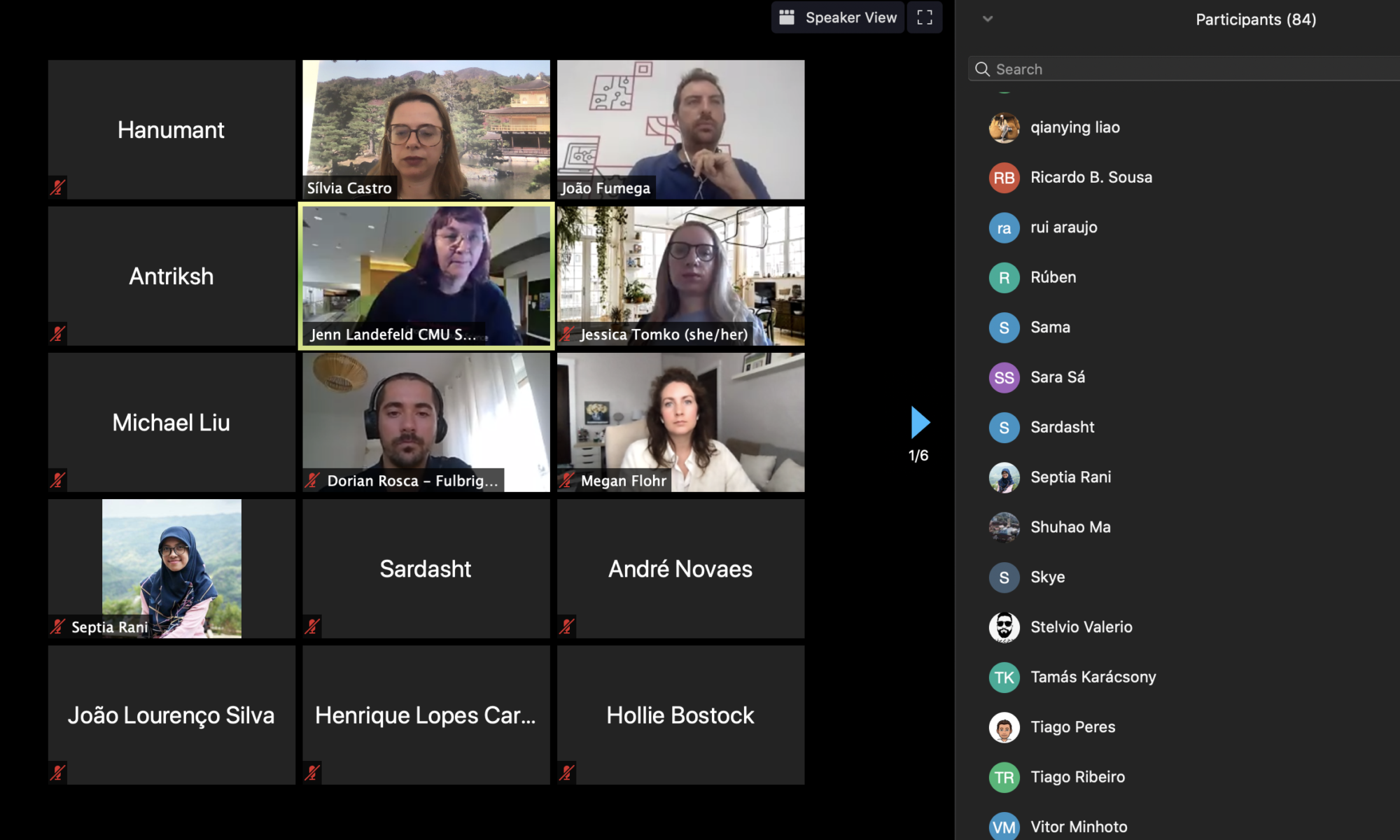
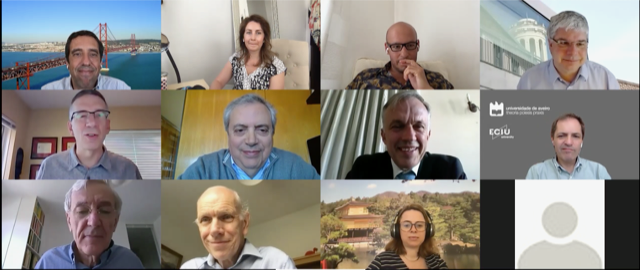
The Carnegie Mellon Portugal Program held its annual Board of Directors (BoD) Meeting on June 17th. The BoD is part of CMU Portugal’s governing structure and is responsible for policy oversight and discussion of the CMU Portugal Program plan of activities. The Meeting proceeded with the online presence of:

  • José Paulo Esperança, Chair of the Board of Directors, Vice-President, Fundação para a Ciência e a Tecnologia
  • James H. Garrett, Provost, Carnegie Mellon University
  • Paulo Jorge Ferreira, Rector, Universidade de Aveiro, Representative of the Council of Portuguese Rectors
  • William H. Sanders, Dean, Carnegie Mellon University, College of Engineering
  • Rogério Carapuça, President of the Portuguese Association for Development of Communications (APDC), Representative of Industry.

The Meeting’s agenda started with opening Remarks by José Paulo Esperança (FCT), James H. Garrett (CMU), and William H. Sanders (CMU), followed by the presentation of the CMU Portugal Progress Report (2018-2019) by the CMU Portugal Directors.

CMU Portugal strives to be the main data-economy driver promoting an ecosystem with a tight coupling between cutting-edge research, world-class graduate education, and highly innovative companies. During these past two years, the Program has addressed these goals by deploying a set of new instruments:

1. Talent Development – revamping the dual-degree Ph.D. programs and preparing a new generation of advanced executive training for companies, while also promoting the exchange of faculty and students with CMU.
a. 14 new Dual Degree Ph.D. students
b. 10 Visiting Faculty and Researchers in 2019
c. Advanced Training Courses

2. Knowledge Creation – by launching seed funding research projects that bootstrap small-scale research collaborations, in high-risk, frontier research topics.
a. 7 new Exploratory Projects will start this year and in 2021

3. Innovation and Entrepreneurship – establishing and renewing the industry affiliates program and launching a new call for industry co-funded flagship projects.
a. 14 new research Industry Affiliates
b. 10 new Large-Scale projects starting in 2020 led by innovative companies

4. Communication and Outreach – by renewing the Program’s image as a platform for international scientific collaboration that positions Portugal at the forefront of the Digital Economy, and raising awareness about the potential of the country, its scientific community, and the ecosystem of highly innovative companies in the digital domain.

The highlight of 2019 was launching an ambitious call for research projects under the CMU Portugal Program. The international evaluation panel recommended the funding of 10 Large-Scale Collaborative Research Projects with a total public and private investment of 21M€.

The Board of Directors learned and evaluated the initial ideas and progress of five of these projects (CAMELOT, GOLEM, iFetch, MAIA, WoW) and discussed the unique challenges and opportunities these projects represent. Due to time restrictions, it was not possible to discuss the remaining projects, but this was scheduled for a subsequent opportunity. In particular, the directors will soon hold individual meetings with each of the remaining teams (AIDA, BEE2WasteCrypto, lntelligentCare, Safeforest, TAMI).

The Board Meeting also counted with the participation of a Representative of the External Review Committee, Sir John O’Reilly; the CMU Portugal National Directors, Nuno Nunes and Rodrigo Rodrigues; the CMU Portugal Director at CMU, José M.F. Moura; the Executive Director in Portugal, Sílvia Castro; the Associate Director at CMU, Megan Flohr; and Ricardo Araújo from the International Partnerships Office at FCT.

Remembering Jaime Carbonell

Jaime Carbonell, Founder of the CMU’s Language Technologies Institute (LTI), has passed away on February 28th, 2020, following an extended illness. The Distinguished CMU University Professor was a pioneer in Language Technologies. He foresaw a world where people could freely communicate with each other, no matter what language they spoke. He knew that making this dream a reality would require automation, so he spent his career building machines that could understand human language.

Carbonell founded the Language Technologies Institute (LTI) at CMU and under his direction, LTI became the largest and best-known organization of its kind. It has been a leader in areas including natural language processing, question-answering systems, and speech recognition and synthesis, and now boasts five graduate degree programs.

Carbonell created the CMU Ph.D. program in language technologies and gave his full support as Head of the Languages Technology Institute to establishing a dual Ph.D. degree in language technologies of the CMU Portugal Program. The dual degree Ph.D. program benefited immensely from Jaime Carbonell’s experience. He worked together with CMU Portugal Director at CMU, José M.F. Moura, and Isabel Trancoso, Professor at INESC – ID and Instituto Superior Técnico, and Alan Black, Maxine Eskenazi, and Robert Frederking at LTI, among others, to create the LTI dual degree Ph.D. program that now runs at CMU and in Portugal at Universidade de Aveiro, Universidade do Minho, Universidade do Porto, Universidade de Lisboa, Universidade Nova de Lisboa, and Universidade de Coimbra.

When Isabel and I first approached Jaime, he immediately grasped the concept of a dual degree program and enthusiastically gave us his support. He put together an LTI team to develop with us the dual Ph.D. degree program, acting as a facilitator all the way to make sure it happened,” said José M.F. Moura. “Jaime remained a valued partner, collaborator, and friend of the Program and will be dearly missed.”

Jaime’s enthusiasm and suggestions really helped to overcome the many difficulties of setting up the dual degree Ph.D. program in language technologies, bureaucratic and otherwise”, said Isabel Trancoso. She adds that “his vision for the future of language technologies helped make CMU one of the leading centers in this area worldwide. It was a privilege to have known him personally, to have listened to his insightful feedback during these discussions, to have shared with him the initial steps of this program that already led to significant advances in the state of the art and launched many students in successful careers”.

“Jaime always had astounding levels of energy and creativity,” said Robert Frederking, now SCS associate dean of doctoral programs. “I have never understood how he could advise maybe a dozen Ph.D. students, run the LTI, personally be the principal investigator on several research projects, teach regularly and travel to DC frequently to work with funding agencies.”And with all that going on,” he added, “if you ran a new technical problem by him, he would usually come up with three good suggestions for solution paths to investigate.”

Carbonell also advised Manuela Veloso, University Professor of Computer Science at CMU, now on leave while she directs AI research at financial services giant J.P. Morgan and CMU Portugal Faculty. She remembers him as a fantastic educator and mentor. “With Jaime I learned a lot of AI, but I also learned how to advise,” she recalled. “I became a faculty member at Carnegie Mellon, and I embraced a lot of what I learned from Jaime. Even now, I still look at Jaime as my advisor, and throughout my career have turned to him for different types of advice. As of now, I have graduated 40 Ph.D. students. I will always thank Jaime for having graduated me.”

Carbonell, who joined CMU in 1979, led teams that developed knowledge-based machine translation of the text as well as speech-to-speech translation. He invented several well-known algorithms and methods, including maximal marginal relevance (MMR) for summarizing text and a type of machine learning call proactive learning.

Getting the right information to the right people at the right time in the right language in the right medium with the right level of detail” became his mantra.

This article was adapted from the original published by CMU’s School of Computer Science. Additional information can be found here.

CMU Portugal promotes at Porto and Braga the Program’s training initiatives in the USA

The CMU Portugal Program was part of two sessions promoted by the Luso-American Development Foundation (FLAD) – on February 18th in Porto and 19th at Universidade do Minho – addressed to all those interested in undertaking a period of academic training in the United States. The CMU Portugal Program, represented by the Program’s Executive director, Sílvia Castro and Education officer, João Fumega, presented the current training opportunities at Carnegie Mellon University under the scope of the CMU Portugal Program.

Currently, the CMU Portugal Program  has two regular initiatives for students that wish to go to Pittsburgh: the Visiting Students Program and Dual Degree Ph.D. Programs. The visiting students’ initiative is an intensive 6 months research experience for talented master students that want to spend a semester at CMU to develop their thesis. While the Dual Degree Ph.D. Programs, launched every year, are designated for students that wish to enroll in a 5 years Ph.D., which includes a 3 years in a Portuguese University and 2 years at CMU with scholarships available to qualified candidates.

Furthermore, CMU Portugal will launch 15+ projects in 2020 (Large scale and exploratory projects) that will offer plenty of new opportunities to work in straight collaboration with top research groups and ICT companies in Portugal and across  7 CMU departments.

Both sessions included representatives from other international Programs that support academic initiatives for students who want to to have an experience at an American university.

If you weren’t able to attend the sessions, you can watch it at:

Porto: https://youtu.be/YKMoK6bubNc
Universidade do Minho: https://www.facebook.com/eeuminho/posts/2681862655196305


CMU Portugal exploratory project eCSAAP results presented in a Seminar hosted at UTAD

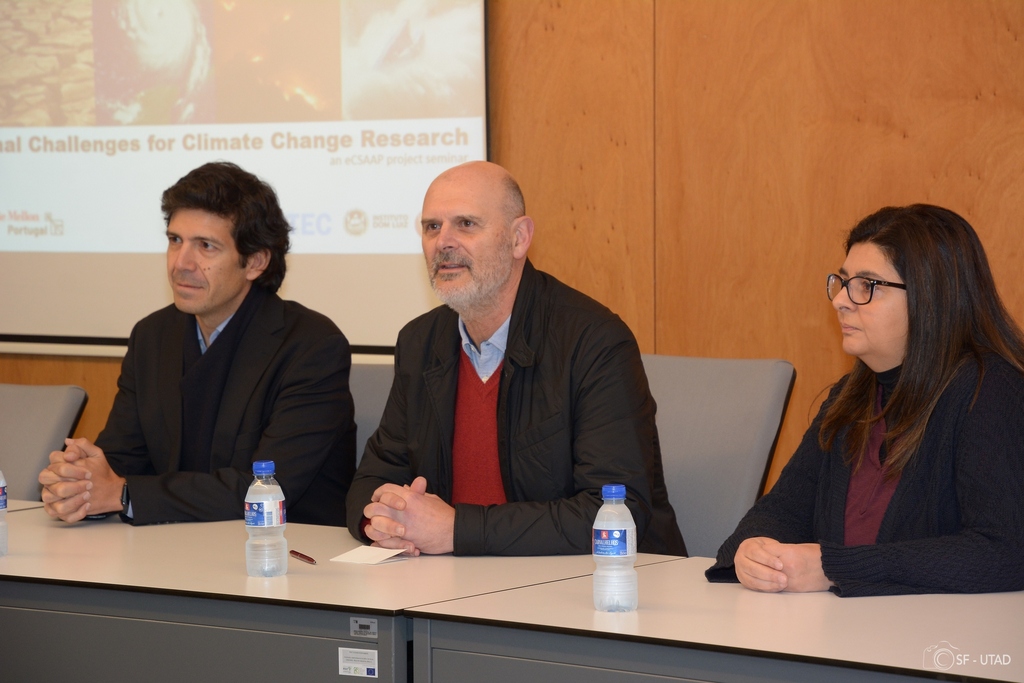
University of Trás-os Montes e Alto Douro (UTAD) hosted on January 24, 2020 the seminar “Computational Challenges for Climate Change Research” to discuss the impacts of artificial intelligence and human computation on climate change. The seminar joined the academic community and had as invited guests Professor Jeffrey Bigham from the Human Computer Interaction Institute at Carnegie Mellon University (CMU), USA and Professor Adriana Vivacqua from Federal University of Rio de Janeiro (UFRJ), Brazil.

The opening session was chaired by Professor Artur Cristovão, UTAD Vice-Rector for Planning and Internationalization. The panel “Initiatives and Opportunities” introduced the CMU Portugal partnership and the education, research and innovation opportunities to foster the collaboration between CMU and Portuguese universities. Participants in the program under the CMU Portugal exploratory project “expert Crowdsourcing for Semantic Annotation of Atmospheric Phenomena – eCSAAP” and the Visiting Faculty and Researchers Program shared their mobility experience at CMU.

During the afternoon session took place the panels “Human Computation for Climate Change – eCSAAP Project results and exploitation” and “Climate Change Research: What’s Next?”.

The panels featured short communications from the researchers, presenting the current state of the art and the achieved advances with the research projects. The panel “Human Computation for Climate Change” included the presentation of the results of the exploratory project “expert Crowdsourcing for Semantic Annotation of Atmospheric Phenomena – eCSAAP”, carried out by a consortium led by INESC TEC with Instituto Dom Luiz and Carnegie Mellon University as partners and funded by the CMU Portugal program. The panel “Climate Change Research: What’s Next?” hosted the kickoff of the project “Citizens and experts cooperation flows for semantic annotation of extreme atmospheric phenomena using human computation” that will be carried out during 2020. The project is a partnership between UTAD and UFRJ, under the memorandum of understanding of FCT and FAPERJ.


CMU Portugal Scientific Directors visited Carnegie Mellon to foster research collaborations

A Portuguese delegation visited Carnegie Mellon University on December 12 and 13 for 2 days of networking with peers at CMU to strengthen cooperation initiatives for the third phase of the program. The delegation was composed of five CMU Portugal Scientific Directors from Portuguese Universities including Susana Sargento from the University of Aveiro, João Paulo Cunha from the University of Porto, Luís Caires from the NOVA University of Lisbon, and Rui Maranhão and Joana Mendonça both from Instituto Superior Técnico; and CMU Portugal Executive Director in Portugal, Sílvia Castro and the Head of Education João Fumega.

During the visit, organized by the CMU Portugal coordination office at CMU headed by Megan Flohr, the Portuguese committee had an opportunity to connect with CMU faculty leaders of strategic research areas of the CMU Portugal Program, heads of department and doctoral programs directors and managers of the CMU Portugal dual degree programs.

The visiting delegation had the opportunity to connect with 28 CMU faculty and researchers over the two-day visit. The CMU faculty and researchers represented 8 different departments including BioMedical Engineering, Civil and Environmental Engineering, Computer Science, Electrical and Computer Engineering, Engineering and Public Policy, the Institute for Software Research, Materials Science and Engineering, and the Robotics Institute.

The visit also aimed to provide awareness within the CMU community of the CMU Portugal initiatives that will be in place in early 2020 such as admission to the Dual PhD programs, visiting faculty and master students and future research initiatives.

During the visit a correspondent from LUSA, the Portuguese News Agency, interviewed two of CMU Portugal Scientific Directors for an overview of this visit to CMU. “I was pleased to see that CMU colleagues also consider the program as beneficial to them, and to learn that the students that we have drawn into the program are among the best candidates that they receive,” said Rui Maranhão.

He also added that in the United States, there is a really close connection between the business sector and academic research, which is beginning to happen more often in Portugal “but in a timid way” said Rui Maranhão. “In Portugal there is a long way to go, but it is possible, and the CMU Portugal Program is a good example of this effort that is confirmed by the several companies born from the previous phases of CMU Portugal.”

Susana Sargento, who was also interviewed by LUSA, considers that, “another important goal of this visit was to understand which scientific areas the program should be taken to and in which the upcoming Call for projects should be opened.”

News Article: Notícias ao Minuto

The CMU Portugal Program’s mission for Phase III is to foster industry-science relationships as agents of change with the focus on ICT research for social and economic impact. Initiatives like this last visit to CMU are an important way to promote a close bond between the two sides of the partnership and establish common ICT foundations for the future of the Program.

In the Media: Notícias ao Minuto, DNotícias, Bom dia Europa, Bom Dia Luxemburgo, Bom dia Suiça.


Yvonne Rogers from UCL and Jodi Forlizzi from CMU present the Lecture on “Beyond User-Centered Design” at Técnico

Jodi Forlizzi, Carnegie Mellon University School of Computer Science, and Yvonne Rogers, UCL, are two brilliant women that lead the top Human-Computer Interaction (HCI) Departments in the world of Computer Science. The designer and psychologist, respectively, gave a talk entitled “Beyond User-Centered Design” in front of a full audience at Instituto Superior Técnico on December 18th.  Nuno Nunes, CMU Portugal National Co-Director, opened the seminar, powered by LARSySINESC ID, and CMU Portugal.

Yvonne Rogers, Director of the Interaction Centre at UCL (UCLIC) and deputy head of the Computer Science department, is interested in how technology transforms the meaning of being human. Rogers approached topics such as the reach of voice interaction devices, their impact in everyday life, and their growing ability to do more than take orders. Much of her work is situated in the wild – concerned with informing, building, and evaluating novel user experiences through creating and assembling a diversity of technologies (e.g., tangibles, AR, IoT) that augment every day learning, community engagement and collaborative work activities.

Jodi Forlizzi, Director and Professor of the Human-Computer Interaction Institute at CMU’s School of Computer Science, is responsible for establishing design research as a legitimate form of research in HCI that is different from, but equally as crucial as, scientific and human science research. Forlizzi’s talk focused on the impact of design and where it is going not only in HCI but in a world that is continually changing and evolving. Jodi’s current research interests include: designing educational games that are engaging and effective, creating robots, AVs, and other technology services that use AI and ML to adapt to people’s needs, and designing for healthcare.

The session was a success with more than 150 participants who had the opportunity to pose questions to both speakers at the end of the Lecture in a Q&A, moderated by Professor Ana Paiva from InescID.

During her visit to Lisbon, Yvonne Rogers was interviewed by the Newspaper Público about her work. Read the full article here.

Watch the full Video of the Lecture on our youtube Channel.


Lenore and Manuel Blum discuss AI and Gender Balance at Portuguese Universities

Between October 23rd and 25th, Lenore and Manuel Blum, both Professors at Carnegie Mellon School of Computer Science, visited for the first time Portugal, under the CMU Portugal Program, to participate in two seminars on gender Balance and for the “duet-talk” “Towards a Conscious AI – A computer architecture inspired by cognitive neuroscience” in Lisbon (Instituto Superior Técnico) and Porto (INESC TEC and Faculdade de Ciências da Universidade do Porto).

In Lisbon, the Seminar on Gender Balance was hosted by Instituto Superior Técnico and organized by the University’s  Diversity and Gender Balance group  in partnership with the CMU Portugal Program.

The day started with an opening by the Minister of Science, Technology and Higher Education, Manuel Heitor, that spoke on the importance of promoting policies to support the role of Women in STEM.

After the presentation and introduction by the Minister, Lenore gave a talk on Gender Balance entitled “CMU: a case study promoting Computer Science in underrepresented groups” focusing on her experience at CMU.

Lenore Blum is highly recognized for her work in supporting the participation of girls and women in Science, Technology, Engineering and Math (STEM) fields. She was a founder of the Association for Women in Mathematics and the Expanding Your Horizons Network for middle and high school girls. At Carnegie Mellon she founded the Women@SCS program and supported innumerous initiatives to increase the number of women in Engineering Courses, both internally and externally.

During her stay in Lisbon she was interviewed by LUSA, the Portuguese News Agency and her testimony was shared by Público Newspaper.  “When there is a small percentage of women in institutions and businesses, they don’t have the same educational experience, like any other minority, and end up by not benefiting from the same professional and social advantages as the majority” – said Lenore-  “it´s always the same idea, it’s not rocket science but common sense. Maybe common sense is not that common, but basically my thesis is that we can change it on a microculture level”.

At Carnegie Mellon there’s currently 50% of girls enrolling in Computer Science courses, a great number of them due to the work developed by the CMU Professor: “I’ve always defended for example that there should be role models to follow in University, like an older sister/younger sister system to help in the integration of those who arrived and provide opportunities for all women to give lectures, stand as role models and be able to create good networks”, a measure that has proven to be very effective. Making life at campus more women friendly, so that they feel welcomed and supported throughout their academic experience and doing outreach programs for high school girls and teaching teachers activities to promote programming and computer sciences from an early age have proven to be very important initiatives in getting more girls at university levels: “We did not change the course curriculum to be women friendly, we changed cultural and social experience of being there. Role models, mentors, community, connections, experiential learning, leadership opportunities, those are the factors that make a difference”, adds Lenore Blum.

The talk was followed by two Roundtables, one about “Women in STEM: Breaking the Glass Ceiling” that counted with Catarina Carvalho from Diário de Notícias as moderator; Teresa Fragoso, President of the Portuguese Commission for Gender Equality; Mariana Araújo, Técnico Alumni and PhD Student; Isabel Sá Correia and Pedro Lima, Full Professors at Técnico and Cristina Fonseca, founder of Talkdesk, Instituto Superior Técnico Alumni.

The second roundtable discussion was on “Gender equality Policies in Lisbon Universities” with the Rector from Universidade de Lisboa António Cruz Serra; Instituto Superior Técnico President Arlindo Oliveira and ISCTE-IUL Vice Rector Maria das Dores Guerreiro.

Lenore and Manuel Blum ended their Lisbon visit with a distinguished lecture “Towards a Conscious AI – A computer architecture inspired by cognitive neuroscience”, that attracted an impressive audience to the Técnico Congress Center Auditorium.

This talk discussed consciousness from the perspective of theoretical computer science and presented various approaches to Consciousness based on the work developed by the cognitive neuroscientist Bernard Baars’ that proposed a Global Workspace Model (GWM) of the brain, sketched its computer architecture, and outlined its implications for understanding consciousness.

Dealing with consciousness formulates according to the authors, an easy problem that is to make a robot simulate feelings of pain and joy and a hard problem that is to make a robot that truly experiences feelings like pain and joy. These are the hardest feelings to explain scientifically.

One of the research major contributions lies in the precise formal definition of a Conscious Turing Machine (CTM), also called Conscious AI. The CTM is defined in the spirit of Alan Turing’s simple yet powerful definition of a computing machine, the Turing Machine (TM), as a way to formalize rigorously, explicitly, mathematically and simply Baars’ GWM.

On October 25th, Lenore Blum also participated in a Gender Balance Seminar at INESC TEC in the morning entitled “Raising awareness for Gender Balance”, promoted by the Gender Balance Group of INESC TEC, with the support of CMU Portugal Program. The opening was led by INESC TEC President Professor José Manuel Mendonça followed by Lenore’s Blum Talk “CMU: a case study promoting Computer Science in underrepresented groups”.

The Seminar continued with a discussion moderated by Prof. Mendonça with invited guests from FEUP, INEGI e FEP, who spoke about the work being done at their Institutions to increase diversity and what their perspectives for the future are. The primary goal of the session which was raising awareness in the institution and among other partners towards these issues was clearly achieved.

After lunch, the discussion continued on a work meeting with some INESC TEC members focused on concrete measures and actions to pursue gender balance at the Institution.

Later on the day, Faculdade de Ciências da Universidade do Porto also hosted the “duet talk” of  Manuel and Lenore Blum on “Towards a Conscious AI”, identical to the session in Lisbon.

News in the Media: LUSA, Público, Diário de Notícias, SIC Notícias, Notícias ao Minuto.