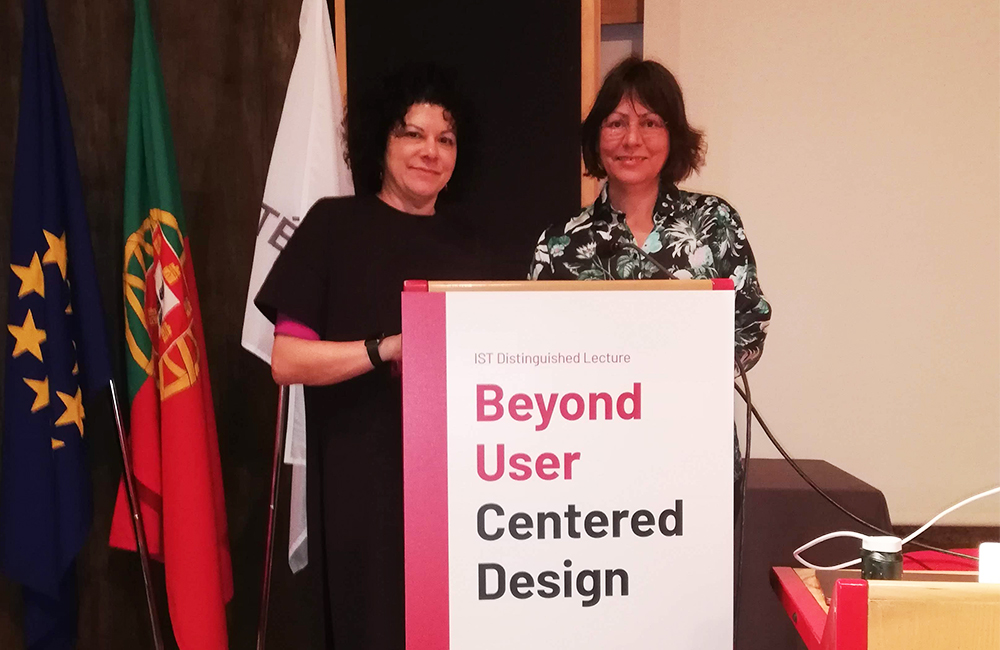
Yvonne Rogers from UCL and Jodi Forlizzi from CMU present the Lecture on “Beyond User-Centered Design” at Técnico

Jodi Forlizzi, Carnegie Mellon University School of Computer Science, and Yvonne Rogers, UCL, are two brilliant women that lead the top Human-Computer Interaction (HCI) Departments in the world of Computer Science. The designer and psychologist, respectively, gave a talk entitled “Beyond User-Centered Design” in front of a full audience at Instituto Superior Técnico on December 18th.  Nuno Nunes, CMU Portugal National Co-Director, opened the seminar, powered by LARSySINESC ID, and CMU Portugal.

Yvonne Rogers, Director of the Interaction Centre at UCL (UCLIC) and deputy head of the Computer Science department, is interested in how technology transforms the meaning of being human. Rogers approached topics such as the reach of voice interaction devices, their impact in everyday life, and their growing ability to do more than take orders. Much of her work is situated in the wild – concerned with informing, building, and evaluating novel user experiences through creating and assembling a diversity of technologies (e.g., tangibles, AR, IoT) that augment every day learning, community engagement and collaborative work activities.

Jodi Forlizzi, Director and Professor of the Human-Computer Interaction Institute at CMU’s School of Computer Science, is responsible for establishing design research as a legitimate form of research in HCI that is different from, but equally as crucial as, scientific and human science research. Forlizzi’s talk focused on the impact of design and where it is going not only in HCI but in a world that is continually changing and evolving. Jodi’s current research interests include: designing educational games that are engaging and effective, creating robots, AVs, and other technology services that use AI and ML to adapt to people’s needs, and designing for healthcare.

The session was a success with more than 150 participants who had the opportunity to pose questions to both speakers at the end of the Lecture in a Q&A, moderated by Professor Ana Paiva from InescID.

During her visit to Lisbon, Yvonne Rogers was interviewed by the Newspaper Público about her work. Read the full article here.

Watch the full Video of the Lecture on our youtube Channel.


Lenore and Manuel Blum discuss AI and Gender Balance at Portuguese Universities

Between October 23rd and 25th, Lenore and Manuel Blum, both Professors at Carnegie Mellon School of Computer Science, visited for the first time Portugal, under the CMU Portugal Program, to participate in two seminars on gender Balance and for the “duet-talk” “Towards a Conscious AI – A computer architecture inspired by cognitive neuroscience” in Lisbon (Instituto Superior Técnico) and Porto (INESC TEC and Faculdade de Ciências da Universidade do Porto).

In Lisbon, the Seminar on Gender Balance was hosted by Instituto Superior Técnico and organized by the University’s  Diversity and Gender Balance group  in partnership with the CMU Portugal Program.

The day started with an opening by the Minister of Science, Technology and Higher Education, Manuel Heitor, that spoke on the importance of promoting policies to support the role of Women in STEM.

After the presentation and introduction by the Minister, Lenore gave a talk on Gender Balance entitled “CMU: a case study promoting Computer Science in underrepresented groups” focusing on her experience at CMU.

Lenore Blum is highly recognized for her work in supporting the participation of girls and women in Science, Technology, Engineering and Math (STEM) fields. She was a founder of the Association for Women in Mathematics and the Expanding Your Horizons Network for middle and high school girls. At Carnegie Mellon she founded the Women@SCS program and supported innumerous initiatives to increase the number of women in Engineering Courses, both internally and externally.

During her stay in Lisbon she was interviewed by LUSA, the Portuguese News Agency and her testimony was shared by Público Newspaper.  “When there is a small percentage of women in institutions and businesses, they don’t have the same educational experience, like any other minority, and end up by not benefiting from the same professional and social advantages as the majority” – said Lenore-  “it´s always the same idea, it’s not rocket science but common sense. Maybe common sense is not that common, but basically my thesis is that we can change it on a microculture level”.

At Carnegie Mellon there’s currently 50% of girls enrolling in Computer Science courses, a great number of them due to the work developed by the CMU Professor: “I’ve always defended for example that there should be role models to follow in University, like an older sister/younger sister system to help in the integration of those who arrived and provide opportunities for all women to give lectures, stand as role models and be able to create good networks”, a measure that has proven to be very effective. Making life at campus more women friendly, so that they feel welcomed and supported throughout their academic experience and doing outreach programs for high school girls and teaching teachers activities to promote programming and computer sciences from an early age have proven to be very important initiatives in getting more girls at university levels: “We did not change the course curriculum to be women friendly, we changed cultural and social experience of being there. Role models, mentors, community, connections, experiential learning, leadership opportunities, those are the factors that make a difference”, adds Lenore Blum.

The talk was followed by two Roundtables, one about “Women in STEM: Breaking the Glass Ceiling” that counted with Catarina Carvalho from Diário de Notícias as moderator; Teresa Fragoso, President of the Portuguese Commission for Gender Equality; Mariana Araújo, Técnico Alumni and PhD Student; Isabel Sá Correia and Pedro Lima, Full Professors at Técnico and Cristina Fonseca, founder of Talkdesk, Instituto Superior Técnico Alumni.

The second roundtable discussion was on “Gender equality Policies in Lisbon Universities” with the Rector from Universidade de Lisboa António Cruz Serra; Instituto Superior Técnico President Arlindo Oliveira and ISCTE-IUL Vice Rector Maria das Dores Guerreiro.

Lenore and Manuel Blum ended their Lisbon visit with a distinguished lecture “Towards a Conscious AI – A computer architecture inspired by cognitive neuroscience”, that attracted an impressive audience to the Técnico Congress Center Auditorium.

This talk discussed consciousness from the perspective of theoretical computer science and presented various approaches to Consciousness based on the work developed by the cognitive neuroscientist Bernard Baars’ that proposed a Global Workspace Model (GWM) of the brain, sketched its computer architecture, and outlined its implications for understanding consciousness.

Dealing with consciousness formulates according to the authors, an easy problem that is to make a robot simulate feelings of pain and joy and a hard problem that is to make a robot that truly experiences feelings like pain and joy. These are the hardest feelings to explain scientifically.

One of the research major contributions lies in the precise formal definition of a Conscious Turing Machine (CTM), also called Conscious AI. The CTM is defined in the spirit of Alan Turing’s simple yet powerful definition of a computing machine, the Turing Machine (TM), as a way to formalize rigorously, explicitly, mathematically and simply Baars’ GWM.

On October 25th, Lenore Blum also participated in a Gender Balance Seminar at INESC TEC in the morning entitled “Raising awareness for Gender Balance”, promoted by the Gender Balance Group of INESC TEC, with the support of CMU Portugal Program. The opening was led by INESC TEC President Professor José Manuel Mendonça followed by Lenore’s Blum Talk “CMU: a case study promoting Computer Science in underrepresented groups”.

The Seminar continued with a discussion moderated by Prof. Mendonça with invited guests from FEUP, INEGI e FEP, who spoke about the work being done at their Institutions to increase diversity and what their perspectives for the future are. The primary goal of the session which was raising awareness in the institution and among other partners towards these issues was clearly achieved.

After lunch, the discussion continued on a work meeting with some INESC TEC members focused on concrete measures and actions to pursue gender balance at the Institution.

Later on the day, Faculdade de Ciências da Universidade do Porto also hosted the “duet talk” of  Manuel and Lenore Blum on “Towards a Conscious AI”, identical to the session in Lisbon.

News in the Media: LUSA, Público, Diário de Notícias, SIC Notícias, Notícias ao Minuto.

 

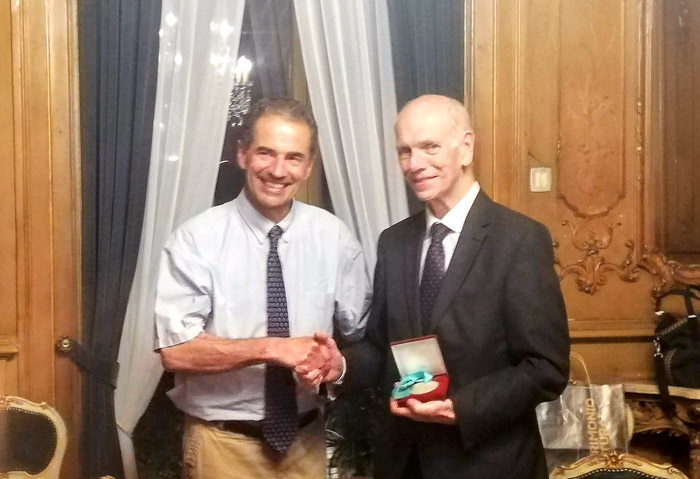
Minister Manuel Heitor distinguishes James H. Garrett and Sir John O’Reilly with the Medal of Scientific Merit

The 2019 CMU Portugal Board Meeting counted with the presence of James H. Garrett, Provost Carnegie Mellon University, and Sir John O’Reilly, Chair of CMU Portugal External Review Committee. On the occasion, the Minister of Science, Technology and Higher Education, Manuel Heitor, distinguished both with a Medal of Scientific Merit (Medalha de Mérito Científico) that  is intended to reward national or foreign individuals who, by virtue of their high professional and performance duties, have been recognized by their exceptional contributions to the development of science or scientific culture.

James H. Garrett Jr., Provost at Carnegie Mellon University since January 1, 2019, has been following the progress of the Carnegie Mellon Portugal Program since its foundation and has been one of its major drivers since 2012 and especially in its renewal. He has been a member of the American Association for the Advancement of Science (AAAS) and has distinguished himself in the development of adaptable and efficient urban systems. In 2012 he received the research Award “Alexander von Humboldt”, added Minister Manuel Heitor emphasizing the now CMU Provost’s contribution to the development of the CMU Portugal Program since its beginning in 2006.

During the ceremony, the Minister also highlighted Sir John O´Reilly’s role with the development of ICT in Portugal during the past 30 years: “Sir John O´Reilly, Visiting Professor of Telecommunications at University College of London and Chairman of the Science and Engineering Research Council (SERC) in Singapore, has been the Chair of the Carnegie Mellon Portugal Program External Review Committee since its beginning in 2007. He has followed and supported Portuguese scientific progress over the past 30 years, especially in the areas of Information and Communication technologies, having participated in several FCT evaluation Committees and in evaluation panels of Portuguese scientific institutions».

The CMU Portugal Program hosted its annual Board of Directors Meeting in Lisbon

The Carnegie Mellon Portugal Program held its annual Board of Directors (BoD) Meeting at Fundação para a Ciência e Tecnologia (FCT) Headquarters in Lisbon on September 20th. The BoD is part of CMU Portugal’s governing structure and is responsible for policy oversight and discussion of the CMU Portugal Program plan of activities.

The BoD was represented by the following five members:

  • José Paulo Esperança, Chair of the Board of Directors, Vice-President, Fundação para a Ciência e a Tecnologia
  • James H. Garrett, Provost, Carnegie Mellon University
  • Paulo Jorge Ferreira, Rector, Universidade de Aveiro, Representative of the Council of Portuguese Rectors
  • Shelley L. Anna, Interim Associate Dean for Graduate and Faculty Affairs, Carnegie Mellon College of Engineering
  • Rogério Carapuça, President of the Portuguese Association for Development of Communications (APDC), Representative of Industry.

The meeting’s agenda started with opening Remarks by José Paulo Esperança (FCT) and James Garrett (CMU) and was followed by the presentation of the CMU Portugal Progress Report (2018-2019) by the CMU Portugal Directors. The session ended with the proposed activities for 2020.

After the meeting, representatives from the industry joined the BoD for a working lunch which included Pedro Bizarro (Feedzai), Jorge Graça (NOS), João Mira (Thales), João Afonso (REN), João Conceição (REN), Pedro Carvalho (Altice Labs), José Alegria (Altice). The lunch was an excellent opportunity to share ground for future collaborations in the areas of reseach, collaboration and Higher Education.

This was the first BoD meeting of the 3rd phase of the CMU Portugal Program, engaging the CMU Portugal Program stakeholders from both sides of the Atlantic into a reflection of the initiatives developed since 2018 and also to re-evaluate the strategy for the future, especially in what concerns capturing talent for research and development in the areas of ICT, always in synergy with Portuguese universities and companies, and with the Carnegie Mellon University.

The Board Meeting also counted on the participation of a Representative of the External Review Committee, Sir John O’Reilly; the CMU Portugal National Directors, Nuno Nunes and Rodrigo Rodrigues; the CMU Portugal Director at CMU, José Fonseca de Moura; the Executive Director in Portugal, Sílvia Castro; the Associate Director at CMU, Megan Flohr and Ana Reis from the International Partnerships office at FCT.


CMU Portugal organized a Welcome Reception in Pittsburgh

The CMU Portugal program hosted a Welcome Reception in Pittsburgh on Wednesday, September 25th at Lucca Ristorante. The reception connected a number of current CMU Portugal students living in Pittsburgh, including Alex Gaudio, Rudolph Santarromanaand and Maria Casimiro and CMU Faculty members including Daniel Siewiorek from the Human-Computer Interaction Institute, Asim Smailagic from the Electrical and Computer Engineering Department, Frank Pfenning, Ruben Martins and Justine Sherry from the Computer Science Department, Marcel Just from the Department of Psychology and Carmel Majidi from the Mechanical Engineering Department.

The meeting also counted on the participation of Visiting faculty from Portugal (colocar link notícia) comprising Pedro Moura, Vania Silvério, Bongkeum Jeong, Vasco Manquinho, Andreia Mordido, Bruno Leitão, Élvio Gouveia and Thomas Durieux.

The main goal of this event was to connect the CMU students, CMU faculty members and Visiting Faculty from Portugal. The event was also an opportunity to share information about upcoming CMU Portugal initiatives for the Fall semester and the goal is to host a similar event similar at the beginning of each semester to continue to foster the collaboration within the CMU Portugal community.

CMU Portugal Program at the Ciência 2019 Summit

Between July 8th and 10th, the CMU Portugal Program participated at the Ciência 2019 Summit to promote its latest initiatives to the general public and present some of the research projects developed under the Program. Ciência 2019 is a major Science Conference organized by the Portuguese Government through the Ministry of Science Technology and Higher Education (MCTES) and FCT, which is held annually in Lisbon to highlight the main achievements in science and technology in Portugal.

In order to discuss some future challenges in the broad area of Information and Communication Technologies (ICT), CMU Portugal hosted the session “CMU Portugal – Exploring New Research Frontiers in ICT” in which stakeholders from different areas of ICT, including representatives from Academia and Industry, shared their vision for the future.

The session started with a brief presentation from Isabel Trancoso – CMU Portugal Faculty member, Full Professor in Electrical and Computer Engineering at Instituto Superior Técnico and senior researcher at INESC ID Lisbon. Since the founding of CMU Portugal in 2006, Trancoso has been one of the main supporters of the Language Technologies area, supervising students and creating a network of Alumni and researchers that actively contribute to the Portuguese R&D system.

  • Rodrigo Rodrigues, CMU Portugal National Co-Director, launched the debate by briefly introducing the Program’s currently open initiatives, Call for Exploratory projects (link) and Demonstration of Interest for Visiting Master students (link). The discussion panel also included the participation of:
  • Joana Mendonça, CMU Portugal Scientific Director and researcher at Instituto Superior Técnico/IN+ center in the field of Public Policy, highlighted the importance of  the relationships established through the CMU Portugal international partnership, fostering collaborations not only between Portugal and CMU, but also among PhD students, researchers and other stakeholders from the Industry.
  • João Graça, CEO at Unbabel, one of CMU Portugal Affiliated partners, shared with the audience his experience as founder of a successful startup and his vision for the future. Unbabel provides translation services that combine neural Machine Translation with professional human editing and has participated in previous CMU Portugal projects. According to João Graça, the best outcomes of these collaborations are the relationships that are kept even when projects are over.
  • Hugo Gamboa, Founder and CEO from PLUX – Wireless Biosignals, presented the company’s work and goals for the future. Established in 2007, PLUX offers innovative products for researchers and physical therapists and has developed an advanced biosignal-monitoring platform. Gamboa explained how the company was able to established itself by producing low cost Biosensors and how the projects in which PLUX has had a partner under the Program helped them to carry the company further into developing new lines of research in wearable body sensors. The company was one of the CMU Portugal project INSIDE key partners.
  • João Paulo Cunha, is a CMU Portugal Scientific Director and researcher at INESC TEC (Universidade do Porto). He was the principal investigator of the CMU Portugal VR2Market project that recently concluded. J.P. Cunha has been involved in several areas of the CMU Portugal program since its foundation, leading research projects, supervising PhD students, participating in the CMU Portugal business acceleration program for entrepreneurial teams in the area of ICT (inRES ) and also by visiting CMU under the Visiting Faculty Mobility Program.

The session was a great platform to share ideas and launch new objectives for the future of the Program, but also to understand the importance of having a network of stakeholders both from Academia and Industry, interested in supporting the Program’s initiatives.

During the event, the CMU Portugal Program held a stand to promote its initiatives to the general public and show some demonstrations of its ERIs and Exploratory projects:

Day 1: INSIDE project with robot ASTRO.

Astro was developed within the framework of the CMU Portugal financed project INSIDE. During the first day, x, y, x (nomes) from Francisco Melo research team at INESC ID/IST assisted the conference’s participants in interacting with Astro’s activities.  The INSIDE project has developed an autonomous mobile robot to engage children with Autism Spectrum Disorder (ASD) during therapy sessions.
More at: http://www.project-inside.pt/  ; https://cmuportugal.org/inside/

Day 2: Feedbot and its robotic arm

The robotic arm developed under the CMU Portugal Exploratory project, Feedbot, enables people with motor disabilities to eat independently. Professor Manuel Marques, the project PI at ISR-Lisboa and researcher Alexandre Candeias were at the stand explaining and showing to the public how the arm works.
More at: http://users.isr.ist.utl.pt/~manuel/FeedBot/; https://cmuportugal.org/entrepreneurial-research-initiatives/

Day 3: BioVisualSpeech develops games that support children during speech therapy sessions

Interactive games are a great way to motivate children during speech therapy sessions. At the event, researcher Ivo Anjos  and xxx (confirm name) , both member sof Sofia Cavaco team at FCT NOVA, showed to the public how these games work. Children have to repeat some specific sounds such as “sssssssss” and if reproduced correctly, the game is successful. Watch the video!
More at: https://cmuportugal.org/biovisualspeech/

Finally, during the whole event the SCREEN DR Project Exhibition was at the Access Hall to Pavilion 4 with synthesized images, portraits of the retinas of INESC TEC researchers and self-portraits of  photographer Renato Roque.

The “Look and See. Sense and Live” and “Other Portraits and Self-portraits” exhibit was developed under the Carnegie Mellon Portugal Program project SCREEN DR, led by Professor Aurélio Campilho from INESC TEC’s  C-BER Center  in collaboration with photographer Renato Roque. The main objective of the project was to develop a computational platform for screening diabetic retinopathy.

More information is provided in the booklet of the exhibit.

Additionally, Alex Gaudio, a CMU Portugal Program supported PhD Student in Electrical and Computer Engineering (ECE) at FEUP and Carnegie Mellon, submitted the Poster “OMedAL: Online Active Deep Learning for Medical Image Analysis” that was exhibited at Ciência 2019 digital screens.


Nuno Nunes presents the new Call for ERPs and Phase III Initiatives at Carnegie Mellon University

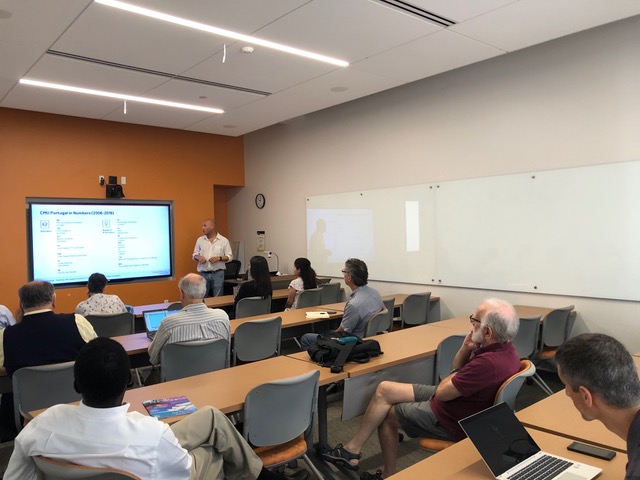
On Wednesday, July 10th National Co-Director of CMU Portugal, Nuno Nunes, presented on the new Call for Exploratory Research Programs (ERPs) and Phase III Initiatives at Carnegie Mellon University.  ERPs are designed to assist teams of researchers from Portuguese institutions, Carnegie Mellon University and industry partners, to bootstrap high-impact potential research activities of strategic relevance for the Carnegie Mellon Portugal Program. Professor Nunes discussed the timeline of the ERP Call, the applicable research areas, and connecting with collaborators in Portugal. Nuno also gave an overview of the recently closed Large-scale Collaborative Research Project Call, the Dual Degree PhD Programs, the Mobility Programs, and the Executive Program Initiative.

The session was well attended by faculty members from several different CMU departments including: Civil and Environmental Engineering, Human- Computer Interaction Institute, Entertainment Technology Center, Information Communication Technology Institute, and Materials Science and Engineering. Questions and comments from Faculty were answered following the presentation.

The Call for ERPs is currently open and will close later this month on July 30th at 5:00 pm GMT. For more information, please visit https://cmuportugal.org/exploratory-research-projects/.

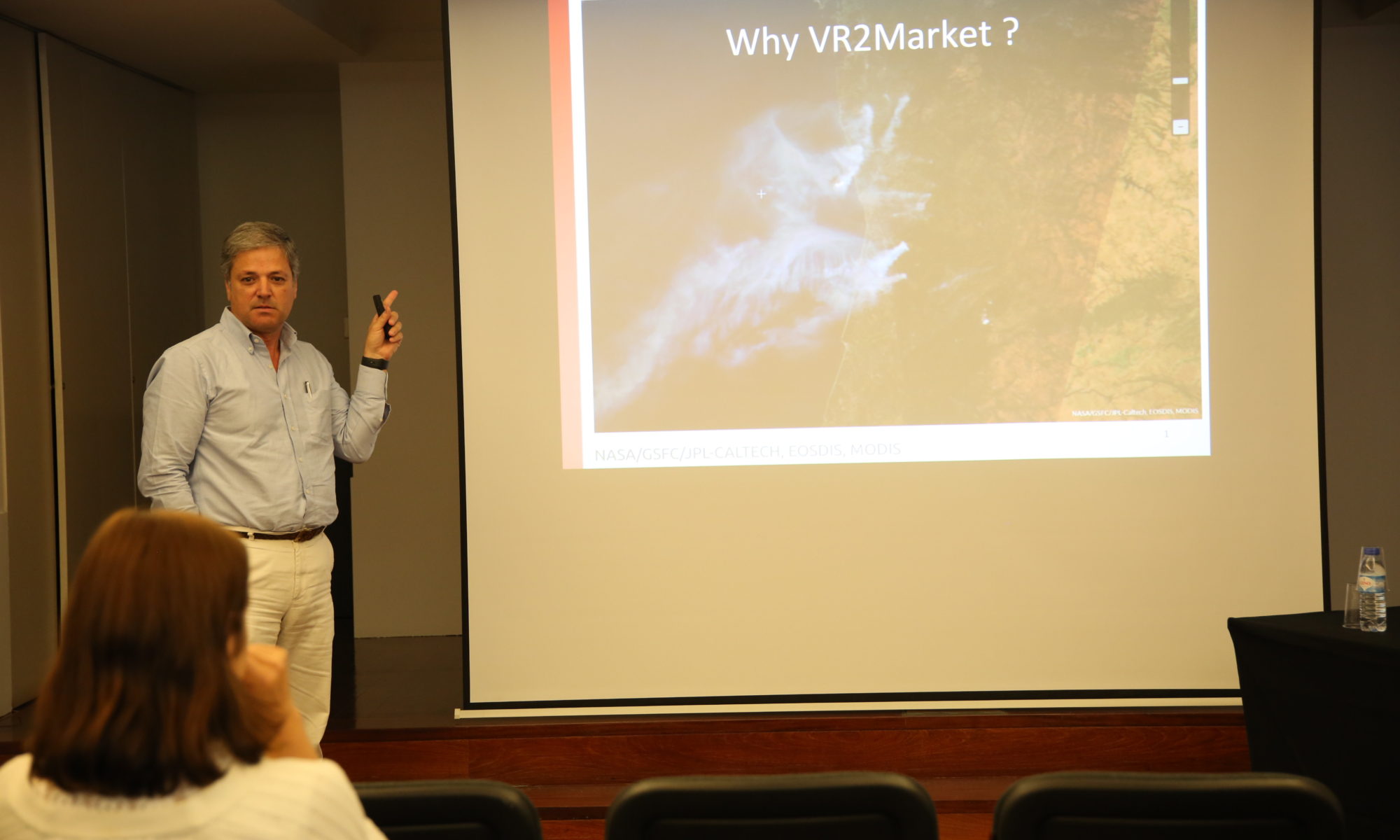
VR2 Market closing Session reveals the project results and goals for the future

The closing session of the VR2Market Project took place at INESC TEC on June 26th, 2019 with the PIs of the project João Paulo Cunha, in Portugal, and Bob Iannuci, that participated remotely from CMU. The session was opened by João Claro, INESC TEC’s Chief Executive Officer and former CMU Portugal National Director (2013-2017).

The CMU Portugal Program project VR2 Market was launched in 2013 through a Call for Entrepreneurial Research Initiatives (ERIs) financed by FCT and was developed in partnership with Institute of Systems and Computer Engineering (INESC TEC), the Institute of Telecommunications (IT), the Institute of Electronic and Telematic Engineering of Aveiro (IEETA), the Portuguese company Biodevices and the Institute of Robotics of Carnegie Mellon University (USA). During the session, each partner presented the results obtained under the research project and the event counted on a special keynote given by Bob Iannucci of the Carnegie Mellon University (CMU), who presented, from California, the results of the collaboration.


The main goal of the project was to provide secure, reliable and effective technologies for first responder professionals in critical emergency scenarios through the development of three main technologies:

  1. Wearable sensors;
  2. an IoT based platform for monitoring the exposure to dangerous levels of different agents and peaks of physiological stress of first responders’ teams 3;
  3. an analysis engine of biomedical and environmental data that is capable of detecting different hazardous states for these professionals.

Duarte Dias, one of the project´s researchers at INESC TEC’s Centre for Biomedical Engineering Research (C-BER), explained that “with these technologies, we can better protect our first responders but can also be customized to other risk professionals and even to new scenarios. The technologies have already been tested in extreme environments, with firefighters, for example. So far, professionals only used carbon monoxide sensors in this type of situation, and when these devices were available”.

These technologies will be included in the products of a new spin-off company known as WeSENSS, aiming at developing new wearable devices applied to several types of professionals and scenarios. “At the moment, we are incorporating our sensing technologies of the professionals into the UNO platform, which belongs to the EQS group which, among other services, monitors the industrial facilities in the oil field”, explains Duarte Dias.

For more information about the Project and new developments please visit: http://vitalresponder.inesctec.pt/index.php/project/

Event photos


2013 IBM Scientific Award

Deadline to submit applications: March 31, 2014
url: http://www-05.ibm.com/pt/pc/premio.html

IBM has been standing out over the years for its innovative character, and is renowned worldwide for its research and development work. In 1990, IBM Portugal created the IBM Scientific Award in order to reward works of high merit in the field of Computer Science, encouraging young Portuguese researchers to disseminate their work.

Another goal with this award is fostering the relationship between industrial, academic and scientific research communities.

Any Portuguese citizen, or any citizen residing in Portugal for at least three years, and with less than 36 years of age (completed until December 31 of the year in question), can compete for the Award worth 15 thousand Euros.

The 2013 Jury is composed of a group of worldwide renowned Portuguese scientists specialized in the main areas of knowledge associated with the Scientific Award, and a representative of the Portuguese IBM Company, S.A.:

Professor Carlos Salema (IST)
Professor Carlos Mota Soares (IST)
Professor João Rocha (U. Aveiro)
Professor Joaquim Júdice (U. Coimbra)
Professor Esgalhado Valença (U. Minho)
Professor José Fernando Ferreira Mendes (U.Aveiro)
Professor José Júlio Alferes (FCT UNL)
Professor Luís Oliveira e Silva (IST)
Professor Maria Isabel Lobato Faria Ribeiro (IST)
Professor Pedro Veiga (FCUL)
Professor Vladimiro Miranda (FEUP)
Eng. Carlos da Naia Sardo (IBM)
For more information go to http://www-05.ibm.com/pt/pc/premio.html

2011 IBM Scientific Award Distinguishes Doctorate of the CMU Portugal Program

André Martins, doctorate of the dual degree doctoral program in Language Technologies (LTI) from the Instituto Superior Técnico of the Universidade de Lisboa (IST/UL) and CMU, won the 2011 IBM Scientific Award for his paper “Turbo Parsers: Dependency Parsing by Approximate Variational Inference.” This work was co-written with his four advisors Pedro M.Q. Aguiar and Mário Figueiredo, from Instituto Superior Técnico of the Universidade de Lisboa (Portugal), and Noah A. Smith and Eric Xing from Carnegie Mellon University.