EPP Student looks into Telecom Policy for Developing Countries

EPP Student looks into Telecom Policy for Developing Countries

Moinul Zaber Moinul Zaber is a Bangladeshi Ph.D. student in the Engineering and Public Policy (EPP) dual-degree program, taught by Instituto Superior Técnico from Universidade Técnica de Lisboa (IST/UTL) and Carnegie Mellon University. His prior degrees were in Engineering, but he “always had a passion for Policy related challenges.”

Zaber joined the program in 2009. After one year and a half in the program, Zaber says that this program is very “multicultural, motivating, and unique.”

Currently, he is looking at telecommunications policies in developing countries. His main focus is to build a model which would help regulators to understand what factors aid countries to embrace new technology like 4G Wireless Network. Therefore, Zaber’s thesis title is “Spectrum Policy for Efficient Development of 4G Technology.”

This Ph.D. student in EPP is also a researcher of a new project entitled “The Role of ‘User Innovators’ in the Development of Telecom Products and Services”, funded by the Car-negie Mellon Portugal Program. This project, which is carried out by Pedro Oliveira (Faculdade de Ciências Empresariais e Económicas da Universidade Católica) and Francisco Veloso (CMU), aims to investigate the role of “users” as sources of innovative ideas for new Telecom/IT products and services.

To develop his Ph.D., Zaber works closely with his two advisors: Pedro Ferreira, from IST, and Marvin Sirbu, from Carnegie Mellon University. They usually have regular meetings in person or by skype.

In terms of studies, Zaber says “I would not say that it went smooth, but nevertheless I have always enjoyed meetings with the kindhearted and highly motivated professors and peers.” After finishing his Ph.D., he expects to work on telecom regulation.

October 2010

New Paper Reveals the Importance of Vehicles as Obstacles in Vehicular Networks

New Paper Reveals the Importance of Vehicles as Obstacles in Vehicular Networks

Rui Meireles and Mate Boban Rui Meireles and Mate Boban, dual degree Ph.D. students in Computer Science (CS) and Electrical and Computer Engineering (ECE), respectively, will present their paper “Experimental Study on the Impact of Obstructions in Vehicular Ad Hoc Networks” at the 2010 IEEE Vehicular Networking Conference.

This international conference, which will be held in December 13-15, 2010, in Jersey City, New Jersey, seeks to bring together researchers, professionals, and practitioners to present and discuss recent developments and challenges in vehicular networking technologies, and their applications.

Meireles explains that “channel models for vehicular networks typically disregard the effect of vehicles as physical obstructions for the wireless signal”. For this reason, in this paper, the authors aim to clarify the vali-dity of this simplification by quantifying the impact of obstructions through a series of wireless experiments.

In the abstract of the paper, the authors explain: “Using two cars equipped with Dedicated Short Range Communications (DSRC) hardware designed for vehicular use, we perform experimental measurements in order to collect received signal power and packet delivery ratio information in a multitude of relevant scenarios: parking lot, open space, highway, suburban and urban canyon. Upon separating the data into line of sight (LOS) and non-line of sight (NLOS) categories, our results show that obstructing vehicles cause significant impact on the channel quality. A single obstacle can cause a drop of over 20 dB in received signal strength when two cars communicate at a distance of 10 m. At longer distances, NLOS conditions affect the usable range of communication, effectively halving the distance at which communication can be achieved with 90% chance of success. The presented results motivate the inclusion of vehicles in the radio propagation models used for VANET simulation in order to increase the level of realism and meaningfulness.”

The paper was co-written by Meireles; Boban; Peter Steenkiste, faculty at CMU in Computer Science and Electrical Computer Engineering Departments; Ozan Tonguz, faculty at CMU in Electrical Computer Engineering Department; and João Barros, faculty at FEUP/IT.

October 2010

Student Orientation Promotes Entrepreneurial Experiences

Student Orientation in Portugal Promotes Entrepreneurial Experiences

On Saturday, September 18 th , 2010, the Carnegie Mellon Portugal Program held the annual Orientation Day in Portugal, at Faculdade de Ciências e Tecnologia da Universidade de Coimbra (FCTUC).

The presentations were given to the audience of approximately 25 newly enrolled students who participated in a one-day orientation program. Students already enrolled in the Carnegie Mellon Portugal program shared their valuable advice on living and studying in Portugal, and the company representatives gave the students an opportunity to understand the challenges with establishing start-up companies by emphasizing the importance of innovation.

João Gabriel Silva, head of the Faculdade de Ciências e Tecnologia da Universidade de Coimbra, made the welcome speech. He praised the progress of the Program, and emphasized the commitment of the Universidade de Coimbra to the partnership. The dual degree of Professional Master’s of Software Engineering, taught at FCTUC, has been a great success in both academics and industry, causing many Portuguese companies to become actively involved in the Program. The highlights of the Carnegie Mellon Portugal program were presented by João Barros, national director of this partnership. In his presentation, he emphasized the students’ innovative research, newly-hired and renowned faculty members, and the successful Program research projects. Barros also spoke about the importance of the Program’s strategic areas and emphasized the industry involvement (over 55 companies) in the partnership. Currently, 226 students are enrolled in the program, 60 of which have graduated. João Barros highlighted the fact that “the most important ingredient of this partnership is the students.”

Rui Meireles, Ph.D. student in Computer Science (CS), and Filippo Cagnetti, post doc in Applied Mathematics, presented their experiences and expectations within the Program and in Portugal. Meireles started his presentation by congratulating the newly enrolled students: “you made it into a great program that will change your life forever!” Meireles made a comparison between the research work and the environment in Portuguese universities and at Carnegie Mellon University concluding:“at the Carnegie Mellon University there are more opportunities to attend scientific talks given by the renowned researchers, attend demanding courses, and overall there is a bigger research ‘buzz’”. “On the other hand,” said Meireles, “Portuguese universities have a more relaxed environment which gives us more time to focus on research.”, He also gave advice on how to deal with a long-distance relationship with advisors: “always keep both of your advisors involved and in sync, they’ve already got their Ph.D.’s; therefore you must be proactive.” He finished his presentation with a message to the new students: “your Ph.D. will be dificult but ultimately rewarding.” Cagnetti emphasized the critical mass which exists in Instituto Superior Técnico, and praised the good weather in Portugal that gave him the opportunity to learn to surf.

The afternoon sessions were dedicated to entrepreneurship. Three companies and one incubator presented their role within the program. Paulo Santos, from the Coimbra’s incubator Instituto Pedro Nunes, spoke about the way that companies canbe created in Portugal and the support given by this incubator. The presentation “Research to the Market” was presented by Pedro Bizarro, researcher at FCTUC and scientific chief of Feedzai, the first startup company created within the program. Given the fact that in Portugal nine in ten startups created in two years do not subsist, the team of Feedzai went forward and established a new company which is converting research into a product that is commercialized all over the world. Feedzai is a company specialized in processing large volumes of data with low-latency producing actionable information in real-time. Marco Costa, from Critical Software, explained how to manage innovation and what is innovation for his company, emphasizing that it is very important the application of creativity. Pedro Falcão, from Novabase Capital, spoke about the importance of innovation.

September, 2010

New Master in Entertainment Technologies is unique in the European

New Master in Entertainment Technologies is unique in the European Context

Launch of the Innovative Master in the European Context The Universidade da Madeira, the Entertainment Technology Center (ETC) at Carnegie Mellon University, Madeira ITI, and Madeira Tecnopólo launched, on July 19, the dual degree Professional Master program in Entertainment Technology (MET), running under the Carnegie Mellon Portugal program, it is partly funded by the FCT. This two year program will start next month with 6 students at the Universidade da Madeira.

“This is not a Master of Science nor a Master of Arts or Fine Arts degree – rather a unique, specialized degree program in the interdisciplinary field of entertainment technology,” said Nuno Nunes, president of the Madeira Interactive Technologies Institute.

The Carnegie Mellon Portugal Professional Master of Entertainment Technology runs over a 2-year full time schedule, incorporating a three month summer break in which students are encouraged to complete internships. Starting in Madeira in September, all students will spend their first semester at Madeira ITI, the second at the ETC, in Pittsburgh, and then they will return to Madeira for the remaining two semesters.

Students in the ETC at CMU take courses ranging from computer programming to designing virtual worlds to improvisational acting, but the emphasis is on project courses. Each project course brings together interdisciplinary students teams that must produce working artifacts; in the tradition of Carnegie Mellon, the emphasis is on making real things that work.

A key aspect of the program is to ensure that students have the opportunity to work with a large, diverse set of collaborators with different skills and sensibilities. A typical project covers an entire semester and it is built around four or five students, a faculty supervisor and a client representative.

Don Marinelli, executive director of the ETC, believes in the importance of mixing computer science and arts. This innovative professional master, said Marinelli, is focused entirely on delivery to client. This, he said, is one of the big differences between methods taught at European universities and at American universities.

The session, held on July 19, 2010, in Madeira, was attended by Don Marinelli, executive director of the ETC at Carnegie Mellon University, Manuel Heitor, Portuguese Secretary of State for Science, Technology, and Higher Education, João Cunha e Silva, vice-president of the Madeira Regional Government, Castanheira da Costa, rector of the Universidade da Madeira, João Barros, national director of the Carnegie Mellon Portugal Program, and Raul Caires, president of the Madeira Tecnopolo.

July, 2010

Five Taxis Test Prototype from the DRIVE-IN Project

Five Taxi Cabs Test Prototype from the DRIVE-IN Project

Taxis Test Prototype The DRIVE-IN project, developed under the Carnegie Mellon Portugal Program, is moving forward in accomplishing its goals. Currently, the first five Portuguese taxi cabs are already using a prototype that is helping researchers to test and to collect data. In the very near future, 500 taxi cabs will be using this system.

The bet is huge but one of the most important steps was already achieved: the agreement between the research team in charge of the DRIVE-IN Project and the RadiTaxis cooperative from Porto, Portugal, was signed. Michel Ferreira, project leader, said: “with 500 vehicles we will have a network which will allow us to simulate and test efficiency of our research that is carried out indoors.” With these first five taxis, the team is already making tests and collecting data for analysis.

In the beginning of the testing phase of this research project, the communication between vehicles will be made in 3G, but the goal is to change it to the Digital Short Range Communications (DSBRC). “Once we will be able to change to DSBRC,” said Michel Ferreira, “it will be a tremendous achievement.” In the future, cars will gather information which will be provided for free to all other vehicles in a vehicular ad-hoc network (VANET).

The goal of this project is to investigate how vehicle-to-vehicle communication can improve the user experience and the overall efficiency of vehicle and road utilization. The DRIVE-IN project aims to explore two main issues: traffic efficiency and entertainment.

DRIVE-IN addresses both foundations and applications of inter-vehicle communication. Concepts, methodologies and technologies will be developed in the three main research thrusts: Geo-optimized VANET protocols, intelligent and collaborative car routing, and VANET applications and services. These research thrusts shall fertilize horizontal activities covering realistic large-scale simulation and massive real-life experiments in urban environments.

DRIVE-IN Project
Principal Investigators: Michel Ferreira, Ozan Tonguz
Teams: FCUP, FEUP, IT, Carnegie Mellon
Companies: NDrive, Geolink
Institutions: IMTT, RadiTaxis
url: http://drive-in.cmuportugal.org

Carnegie Mellon Portugal Program Student Orientation at Carnegie Mellon University


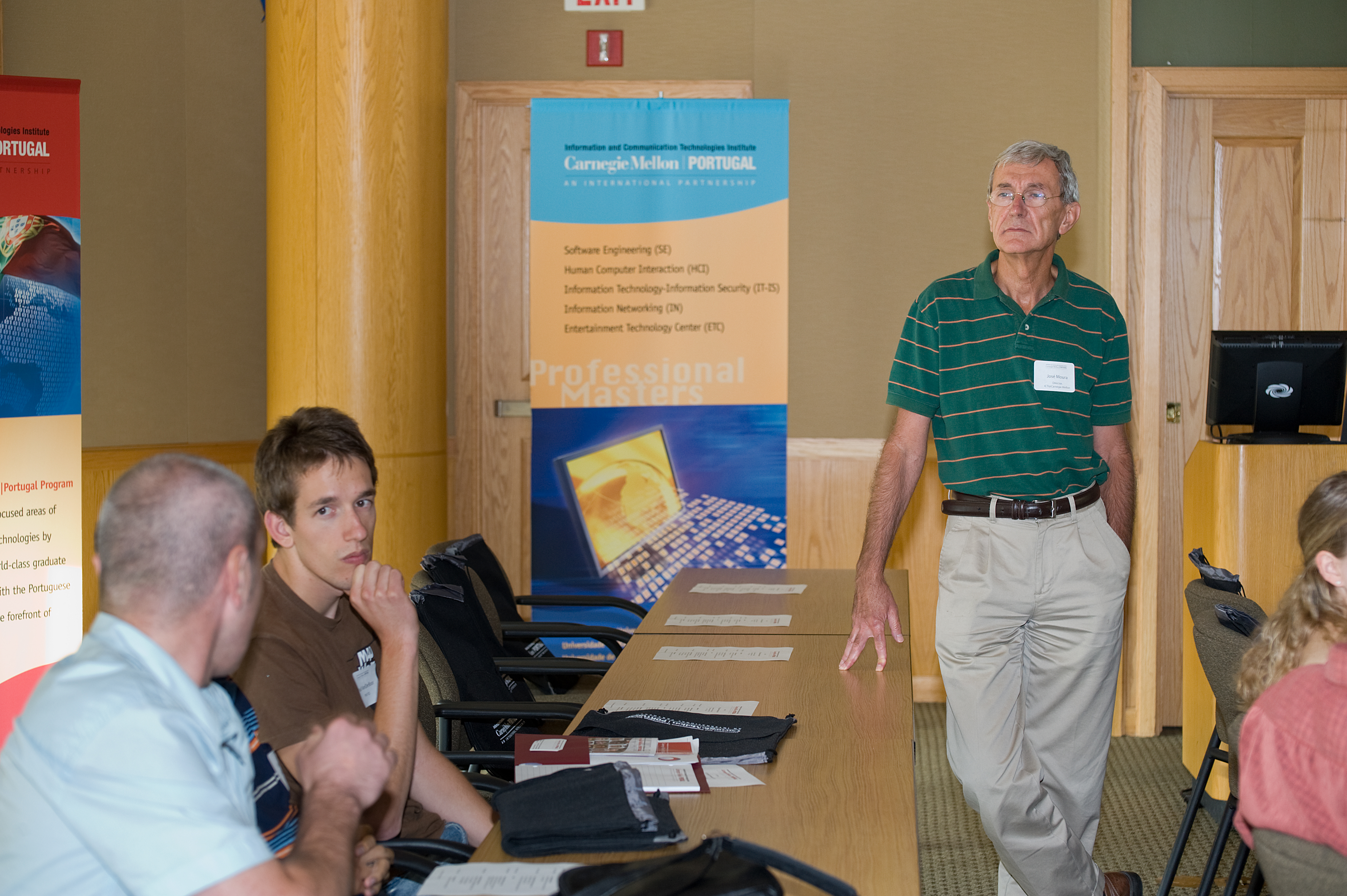
Orientation Day at CMU Though the start of the semester may now seem to have been ages ago, the CMU Portugal Program Orientation night succeeded in gathering students together for a celebration of another class and a dawning semester.On Tuesday, September 7 th , 2010, the Carnegie Mellon Portugal Program at CMU organized a night of information and celebration. The night started with a “meet and greet” in the calming environment of the Singleton Room in Roberts Hall. As students entered the room they were presented with their gift of a CMU Portugal drawstring bag filled with helpful academic and program information. Students starting their academic year at Carnegie Mellon University in fall 2010 were invited to the event, as well as the returning students in the program.

After mingling with other Program students, faculty and staff, the informative aspect of the evening began with Program Director, José M.F. Moura, addressing the attendants with a presentation about the CMU Portugal Program. He welcomed the new students and introduced them to some essential details about the Program. In his presentation, he outlined and explained the mission statement of the Program of creating new knowledge in key focused areas of information and communication technologies by means of cutting-edge research, world-class graduate education and a close connection with the Portuguese Industry, thus placing Portugal at the forefront of Science and Innovation.

Professor Moura also explained the goals of the program of internationalization, planting seeds of change, producing highly educated professionals, recruiting the best candidates in graduate students and faculty, and collaborating between Universities and Research Institutes. Additionally, he presented the students with more details on the program itself, even highlighting the organization and leadership structure of the two Program offices. He also stressed the importance of the affiliated companies’ role in the CMU Portugal Program. Additionally, he called attention to the significant growth of the Program and the consistent increase in academic enrollment since the Program’s inception. Fonseca de Moura at Carnegie Mellon Portugal Program Orientation Day at Carnegie Mellon

Following a catered dinner, Professor Peter Steenkiste, Carnegie Mellon Portugal Program Area Coordinator at Carnegie Mellon and faculty member in Computer Science and Electrical and Computer Engineering, addressed the room, explaining to the students the role of their advisors, and additionally, emphasizing the importance of proper attribution and avoiding plagiarism. He also stressed the importance of academic discipline and the value of balancing work and the personal life.

After Professor Steenkiste’s presentation, three dual degree Ph.D. students addressed their peers with some tips and advice about being a Carnegie Mellon Portugal student at Carnegie Mellon University. Presenters included: Luís Brandão (Ph.D. student in ECE), Patrick Agyapong (Ph.D. student in EPP), and Alexander Mateus (Ph.D. student in EPP). Students were given advice on techniques to balance work and fun, what to expect in the winter months on campus, best nightlife spots in Pittsburgh, and how to get around the city.

Following the three students presentations, Lori Spears, Associate Director of this partnership at Carnegie Mellon, gave the closing remarks of the event, thanking the students, faculty, and staff for attending the event. She also gave a special thank you to those who made the event happen.

There were approximately 40 people in attendance for the Orientation night. Through and through, the night was a success in presenting this year’s new students with an opportunity to meet their peers, take some pointers from “veteran” program students, connect with staff and faculty, and of course, learn a lot more about the CMU Portugal Program in an evening of celebration.

September, 2010

2010 Doctoral Consortium Promotes Interdisciplinary Environment

2010 Doctoral Consortium Promotes Interdisciplinary Environment

2010 Doctoral Consortium On June 15, 2010, more than 20 dual degree Ph.D. students in the Carnegie Mellon Portugal Program attended the Second Doctoral Consortium. The goal of this even was twofold: first, to proved students with feedback and general advice on developing their research and preparing for their future careers; and second, to provide a forum where Ph.D. students can learn about the general set of activities being developed in the context of the partnership.

João Sentieiro, president of FCT, made the welcome session speech. Sentieiro praised the importance of this initiative, impar- ting a message of support and confidence to all the Ph.D. students that embraced this innovative partnership between Portuguese universities and Carnegie Mellon University. During the day, ten dual degree Ph.D. students presented their work and discussed how it is carried out.

Sven Stork, a Ph.D. student in Software Engineering (SE), gave a presentation entitled “Æminium—Freeing Programmers from the Shackles of Sequentiality.” This project is carried out in the scope of the Carnegie Mellon Portugal Program by Paulo Marques, from FCTUC, Nestor Cataño, from UMa, and Jonathan Aldrich, from Carnegie Mellon University.
___________
“You [Ph.D. Students] will bring the positive change in the environment(s) that needs to evolve.”
– Diogo Gomes and Francisco Veloso.
_______________
Ana Venâncio, a Ph.D. student in Technological Change and Entrepreneurship (TCE), talked about her last paper entitled “Does Red Tape Hold Back Entrepreneurs? Evidence from Portugal.” In her paper, Venâncio concludes that the Portuguese “On the Spot” firm program increases the number of start-ups because it simplifies the registration procedures. “However, the number of firms created is not terribly large,” Venâncio said, “nor are these firms particularly vibrant.”, Other presentations included “P2P on Campus: Who, What and How Much,” given by Alexandre M. Mateus, a Ph.D. student in Engineering and Public Policy (EPP); and “Aliasing control with view-based typestate,” given by Filipe Militão, a Ph.D. student in Computer Science (CS).

António Câmara, CEO of YDREAMS, gave the guest speech: “The Ph.D. dissertation: an opportunity to change the World.” He talked about his memories has a Ph.D. student and about the Ph.D. students he advised when he was a professor. Câmara encouraged them to dream, and most importantly to strive for goals that can change their lives.

To close the event, Diogo Gomes and Francisco Veloso, scientific directors of the Carnegie Mellon Portugal Program and coordinators of the Doctoral Consortium, left a message for the students: “You will bring the positive change in the environment(s) that needs to evolve. We, the coordinators serve to empower you to make the change happen.”

June, 2010

Call for Research and Development Projects Results

The Fundação para a Ciência e a Tecnologia (FCT) published this week the results of the Call for Research and Development Projects, in the framework of the Carnegie Mellon Portugal Program. The evaluation panel analyzed 22 projects and selected 12 to be funded by this partnership. This evaluation panel was composed by: Prof. Sir John O’Reilly, Prof. Luigia Carlucci Aiello, Prof. Tariq Durrani and Prof. Joel Moses. These projects will be carried out during the next three years.

SELF-PVP: Self-Organizing Power Management for Photo-Voltaic Power Plants
Vítor Manuel Grade Tavares, Instituto de Engenharia de Sistemas e Computadores do Porto (INESC Porto/FE/UP).

ATTEST: AlgoriThms and Tools for reasoning about dEpendable SysTems
João Paulo Marques Silva, Instituto de Engenharia de Sistemas e Computadores, Investigação e Desenvolvimento em Lisboa (INESC ID/INESC/IST/UTL).

The Role of ‘User Innovators’ in the Development of Telecom Products and Services
Pedro Manuel Sousa Mendes Oliveira, Universidade Católica Portuguesa (UCP).

TRONE: Trustworthy and Resilient Operations in a Network Environment
Paulo Jorge Esteves Veríssimo, Fundação da Faculdade de Ciências (FFC/FC/UL).

MAIS-S: Multiagent Intelligent Surveillance System
Francisco António Chaves Saraiva de Melo, Instituto de Engenharia de Sistemas e Computadores, Investigação e Desenvolvimento em Lisboa (INESC ID/INESC/IST/UTL).

Novel Information Processing Methodologies for Intelligent Sensor Networks
João Manuel de Freitas Xavier, Instituto Superior Técnico (IST/UTL).

NeTS: Next Generation Network Operations and Management
Ricardo Santos Morla, Instituto de Engenharia de Sistemas e Computadores do Porto (INESC Porto/FE/UP).

Assuring Dependability in Architecture-based Adaptive Systems
Rogerio Sergio Neves de Lemos, Faculdade de Ciências e Tecnologia da Universidade de Coimbra (FCT/UC).

Affidavit – Automating the Proof of Quality Attributes for Large Scale Software Architectures
Mário Alberto da Costa Zenha Rela, Faculdade de Ciências e Tecnologia da Universidade de Coimbra (FCT/UC).

Innovation and the Global Economy: An Investigation of critical Challenges for Intellectual Property, Strategy and Policy in IT and beyond.
Fernando Manuel Ribeiro Branco, Universidade Católica Portuguesa (UCP).

Toward Dynamic Monitoring and Decision (DYMONDS)-Based Smart Distribution Systems
Luis António Fialho Marcelino Ferreira, Instituto Superior Técnico (IST/UTL).


Cyber-Physical Systems Technologies for Energy-Optimized Data Centers
Eduardo Manuel de Médicis Tovar, Instituto Superior de Engenharia do Porto (ISEP/IPP).

More information available at: http://alfa.fct.mctes.pt/apoios/projectos/consulta/areas.phtml.en?idElemConcurso=3180

Pages Related:
. Research Projects

XI Annual PAPS Forum Creates Networking Opportunity for Post-Graduate Students

XI Annual PAPS Forum Creates Networking Opportunity for Post-Graduate Students

PAPS XI 2010 More than 100 young Portuguese Post-Graduates attended the XI Annual Forum of the Portuguese American Post-Graduate Society (PAPS), “Science, Technology, and I.” The event took place at Carnegie Mellon University, Pittsburgh (USA), from April 10- 11, 2010, and was organized by the Portuguese American Post-Graduate Society (PAPS), with the aid of the Carnegie Mellon Portugal program, sponsored by the Fundação para a Ciência e a Tecnologia (FCT). Currently, PAPS has 618 members.

Pradeep Koshla, Dean of the College of Engineering at Carnegie Mellon University, José M. F. Moura, Director of ICTI@ Carnegie Mellon, and Anabela Maia, PAPS President, made the Welcoming Remarks. In her segment, Anabela Maia stressed the goal of the event, which was to establish a networking opportunity for Portuguese American Post- Graduates to talk about their achievements, difficulties, and goals. “The title and the agenda were made to impel the connection between Science, Technology and each of us,” said Anabela Maia.

Mariano Gago and Manuel Heitor, respectively Portuguese Minister and State Secretary for Science, Technology, and Higher Education, said that the Portuguese American Post-Graduates whose goal is to return to Portugal should create their research or entrepreneurial opportunities.
_______ “This can be impelled by the foundation of dynamic social networks, which can enable networking,” said Heitor.
_______
Gago added, “In Portugal we have an average of seven researchers for 1000 workers, whereas in Europe there are six researchers per 1000 workers.” According to Gago, the private investment in Research and Development (R&D) has raised to 0.8% of the GDP (Gross Domestic Product) in the past five years. This fact explains the growth of doctorates has manager’s or founders of Portuguese companies, so “there are opportunities when returning to Portugal,” said Gago. “We cannot plan the future,” said Heitor, “but we can try to develop opportunities.”

Manuela Veloso, Portuguese Professor in the Carnegie Mellon’s Computer Science Department, talked about the research work that she is developing with robots. Veloso addressed general myths about robots, saying that the ones that exist in the movies are totally different from the ones that are being developed at Carnegie Mellon University. She explained with examples the difficulties of creating a robot that moves, and of synchronizing movement with other robots. Veloso is the president of Robot World Cup Initiative (RoboCupTM), an international research and education initiative that fosters Artificial Intelligence (AI) and intelligent robotics research by providing a standard problem where a wide range of technologies can be integrated and examined, as well as being used for integrated project-oriented education.

The other sessions were about “Science, Technology and Art,” by Miguel Amado, curator, and Joana Ricou, artist; “Science, Technology and Society,” by Raphael Costa, historial from York University (Toronto); and “Science and Technology in Industry and Academia,” by Cláudia Ferreira, Hovione General Manager of the Technology Transfer Center in New Jersey, and Vasco Calais Pedro, from Bueda Inc. co-founder and CEO.

April 2010