Fernando Machado Wins Best Paper Award

Article about Music Piracy and Pricing Wins 2010 AMA Best Paper Award

Fernando Machado UCP “Don’t Think Twice, It’s All Right: Music Piracy and Pricing in a DRM-Free Environment” (Journal of Marketing, 74 (2), 40-54) is the title of a paper that won the best article award published in 2010 from the American Marketing Association (AMA) Innovation, Technology and Interactivity SIG. The article was written by Fernando S. Machado, an associate professor at Católica-Lisbon School of Business and Economics and co-coordinator of the dual degree doctoral program in Technological Change and Entrepreneurship, in the scope of the Carnegie Mellon Portugal Program, with Rajiv Sinha, from the Arizona State University, and Collin Sellman, doctoral candidate in Marketing.

In the article the authors recommend a model that conceptualizes and estimates the concept of hardcore piracy in an attempt to resolve this apparent paradox. On the abstract the authors explain that “based on two large empirical studies and a validation exercise with a large sample of more than 2000 college students, the model results indicate that the music industry can benefit from removing digital rights management (DRM) because such a strategy has the potential to convert some pirates into paying consumers.” In addition, “a DRM-free environment enhances both consumer and producer welfare by increasing the demand for legitimate products as well as consumers’ willingness to pay for these products.” Therefore, the authors of the article find that producers could benefit by lowering prices from currently observed levels.” The article concludes with a discussion of the practical implications of the findings for managers within the music industry.

Question (Q): According to this paper, what were the Digital Rights Management (DRM) restrictions on the demand for music downloads?
Answer (A): Unlike what common sense would suggest, our results indicate that DRM restrictions have had a negative impact on legitimate music demand. In particular, we show that a move to a DRM-free environment can convert some pirates into paying customers and be beneficial both for consumers and for the music industry.

Q: What is the real impact of the article findings?
A: The findings of this paper can potentially have a significant impact because we show that the copyright protection and pricing strategies adopted by the music industry have been sub-optimal, both for the industry itself and for the society at large. Curiously, not long before we concluded our study, the music industry changed its DRM policy in a direction that is more consistent with our results.

Q: Is it the first time that a Portuguese professor obtains this honor?
A: To the best of my knowledge it was the first time that a Portuguese professor received this particular award. However, other Portuguese scholars in the field of marketing, such as Professors Miguel Villas-Boas (U. C. Berkeley) and Lopo Rego (U. Indiana) have received important awards and a very high level of recognition for the outstanding quality of their work.

Q: What is the importance of this award to you?
A: Although research is a very rewarding activity in itself, often the researcher’s efforts appear to result in not much else than in getting the attention of a tiny audience of experts. Therefore, I regard this prestigious award as an important indicator of the impact of our research, as well as a strong motivating factor for future work.

________

Fernando S. Machado is an Associate Professor at Católica-Lisbon School of Business and Economics, and the co-coordinator of the dual degree doctoral program in Technological Change and Entrepreneurship, in the scope of the Carnegie Mellon Portugal Program. He holds a Ph.D. in Agricultural Economics from the University of Reading, UK, and two B.Sc.’s in Business Administration and in Economics from the Catholic University of Portugal. Formerly he was Associate Dean and Director of Católica-Lisbon’s Center for Applied Studies. His current research interests revolve around digital piracy, innovative pricing mechanisms and the analysis of consumer preferences for both market and non-market goods. His research has appeared in international journals such as the Journal of Marketing, Marketing Science and Environmental and Resource Economics.

January, 2012

“We are impressed especially by the way the program has secured strong engagement from industry in Portugal.”

“We are impressed especially by the way the program has secured strong engagement from industry in Portugal.”

ERC Meeting 2011

More than 100 people attended the External Review Meetings of the Carnegie Mellon Portugal Program this year. The event was held in Lisbon, at Centro Cientifico e Cultural de Macau, between January 9 and 10, 2012. Sir John O’Oreilly, Vice-Chancellor of the Cranfield University, United Kingdom, the chairman of the External Review Committee (ERC), expressed that the Committee “have been impressed with the way this partnership program has developed,” adding that “the quality of researchers and students attracted to the programme is very high.”

Every year the Carnegie Mellon Portugal Program is evaluated by the External Review Committee whose role is to analyze a report by the Directors, hold several meetings with researchers, students, alumni and entrepreneurs, and report on the progress of the partnership towards achieving its goals in terms of cutting edge research, advanced training, internationalization and collaboration among the various players, in particular Portuguese universities, Carnegie Mellon, and industry in Portugal.

The External Review Committee is formed by Sir John O’Reilly, Vice-Chancellor of Cranfield University United Kingdom, Chairman, Luigia Aiello, Università di Roma La Sapienza, Rome, Italy, and Tariq Durrani, University of Strathclyde Glasgow, Scotland, United Kingdom. During two days, the Committee saw presentations on research highlights of projects with companies and end users, spoke with more than 70 faculty, students and alumni, and had the opportunity to listen to entrepreneurs that are engaged in the Program. (agenda available here) External Review Committee 2011

The Chairman of the External Review Committee considers that “the program has broken new ground in terms of international interactions and engagement. The ‘architecture’ established for the program allowed sufficient scope for adjustment and improvement, and this has been exercised beneficially.” Sir John O’Reilly believes that “there have been gains in terms of standard and standing of research and educational programs but a very major benefit is the level of industrial engagement the partnership has stimulated and enabled.”

___________

Sir John O Reilly Interview with Sir John O’Reilly

Question (Q): How do you assess the work carried out within the Carnegie Mellon Portugal Program so far?
Answer (A): We have been impressed with the way this partnership program has developed. The quality of researchers and students attracted to the programme is very high. Research and research outputs of high quality are resulting in publications in leading research journals. We are impressed especially by the way the program has secured strong engagement from industry in Portugal. In our meetings the value that this is delivering to the companies was confirmed by the industrial participants we met with. I would say that world class research is taking place and the nature and depth of the 3-way collaboration (universities and industry in Portugal with Carnegie Melon University) can be described as world leading.

Q: What kind of impact do you consider that this program has had on the Portuguese economy and on the higher education community?
A: The program has led to the development of the ‘essential infrastructure’ for collaboration in research and education which has been of clear benefit to participating faculty members/departments in Portugal. The scale of industrial participation and the ‘real world’ character of the research projects have been of great benefit to the companies. The program has also already generated a number of spin outs with potential to develop to the benefit of the economy in Portugal.

Q: What can be expected from this program in the near future?
A: The program has produced a number of cohorts from the professional masters dual degrees which are in industry in Portugal and have been described by company representatives as both contributing directly to company projects and also acting as ‘change agents’. We are about to see the first of the Ph.D. cohorts completing. We can expect these to make a similarly distinctive contribution both to industry and academia in Portugal.

Q: Why is this partnership important?
A: It has been and is valuable/important in a number of ways: raising the standing and profile of Portuguese faculty internationally, further advancing ICT research and related education against the highest level internationally; enabling young researchers in Portugal to ‘self calibrate’ against the highest international standards and enhance their expectations of themselves. And it has led to a far greater and more productive engagement between universities and industry than was achieved previously.

Q: What is the role of the Carnegie Mellon Portugal Program External Review Committee?
A: Our role has been to review against our experience of international class research and PG education and provide suggestions and feedback to stimulate further development within the program. The leadership has responded well to this. For participant faculty and departments this has been ‘game changing’ we feel. Departments and individual faculty have raised their sights and are achieving against these raised expectations/aspirations. It is a journey started with good progress made but not yet completed.

Q: From your experience in reviewing committees, and as a consultant for the UK government and CE, what do you think about this partnership for a country like Portugal?
A: The progress made is impressive. I see this as a result of the Nature of the program, the intimacy of the engagement – and the degree of commitment that has come from Carnegie Mellon University faculty has been crucial. Precisely because Portugal is a relatively small country/economy the coupling to a leading university in a major world economy has been all the more valuable.

Q: How important is it that the Portuguese government renews the partnership?
A: An excellent start has been made and much has been achieved but to realize the benefits of the investment made to date there needs to be a second phase, in which plotting and progressing along a path towards sustainability must feature strongly.

___________

The Carnegie Mellon Portugal Program was launched at the end of 2006 as a five year partnership between 9 Portuguese universities (Aveiro, Católica Portuguesa, Coimbra, Madeira, Minho, Nova de Lisboa, Lisboa, Porto, Técnica de Lisboa) and research institutions, Portuguese companies, and Carnegie Mellon University under the support of the Fundação para a Ciência e a Tecnologia (FCT). The program targets basic research and educational activities in focused areas of Information and Communication Technologies (ICT), including fundamental technologies methodologies, applications and support sciences, as well as associated issues of managing technological change and development of related public policies. Its mission is to create new knowledge in key focused areas of information and communications technologies by means of cutting-edge research, world-class graduate education, and a close connection with Portuguese Industry, thus placing Portugal at the forefront of Science and Innovation.

At the end of five years the Carnegie Mellon Portugal Program can claim success in many of its initial ambitious goals:

· Strong educational and research relations have been established with nine Portuguese Universities and associated Research Institutions;
· Eighty-two companies participate actively in different research activities and graduate education programs (more information available here );
· Over 30 collaborative research projects producing science and technology of the highest international standards have been or are carried out, each led by a consortium of research groups of at least two different Portuguese institutions, one or more research groups at CMU, and one or more companies, providing innovative solutions for relevant research and societal challenges. In most cases, these projects leveraged research endeavors at Portuguese Institutions and at CMU leading to a multiplicative effect in terms of research activity and impact in significant areas of ICT (more information available here );
· Approximately 270 students have been recruited internationally and are enrolled in the dual degree educational programs. These students will strengthen the Portuguese labor force with highly trained experts and the faculty of Portuguese Universities and Research Institutions with pools of new talent;
· Ten dual degree Ph.D. Programs targeting areas of primary relevance to ICT in Portugal were established between 15 Portuguese university departments and 11 CMU Departments, offering technical, policy, and business breadth, while promoting and training future leaders in ICT. These dynamic programs replicate the best practices of graduate programs in top American Universities.
· Five dual degree Professional Masters Programs were launched in partnership between four CMU Departments and four Universities in Portugal, serving multiple purposes: educating and training high quality professionals in highly technological areas and reinforcing the work force in ICT related areas, while providing an essential building block for Portuguese partner universities to extend their offer of first-rate quality programs and enhance their connections to the private sector;
· Over 200 Portugal faculty and senior researchers have been intimately involved in activities of the Program with up to 31 Portugal faculty members having participated in faculty exchange stays of at least one term at CMU. They are in their own ways agents promoting change and adopting many of the best practices they experienced as part of the Carnegie Mellon Portugal Program (more information available here );
· 61 new faculty members in the ICT areas have been recruited and have been working in partner universities in Portugal (more information available here );
· The Program promoted a new generation of technology-based companies in the telecom, software, and related areas with five companies started by faculty or students as a direct result of their activities in the Program (more information available here ).

January, 2012

Master Student wins Best Poster and Demo Awards at Videojogos 2011 Conference

Master Student wins Best Poster and Demo Awards at Videojogos 2011 Conference

MET Student António Gomes António Gomes, a dual degree Professional Master student of Entertainment Technology (MET), wrote the proposals for the Demo and Poster Awards competitions at the Videojogos 2011 Conference held in Porto, Portugal, and won both prizes.

The practical components of both proposals were carried out during the course of Building Virtual Worlds in the Entertainment Technology Center at Carnegie Mellon University, Pittsburgh, along with other MET students. The game demo presented by António Gomes, titled “Whack ‘Em All – Head Mounted Display Interaction Enabled by Motion Trackers,” was developed by him, with three other MET students António Candelária, Kitesh Muchandani and Tim Forsythe. The goal was to present an immersive single player game system developed for an environment that mixes virtuality with reality using Head Mounted Display and Motion Tracking Technology. António Gomes explained in his proposal that “placing the player outside the computer screen encourages physical interaction as users can have their virtual avatar replicating all the movements and actions they make in a real world scenario which lastly will provide them with a sense of power and meaningfulness of their actions.” The demo of this game is available at http://www.youtube.com/watch?v=yxLMvK4PCGY .

The poster that won the contest for best poster award was about the “CLAUDs – Challenge Leading to the Appreciation of User Differences.” Presented by António Gomes, with António Candelária and Shibli Mansuri, this poster reveals an immersive game for exploring the factors that lead children to work together at their own choice. Through this study, the team understood how it is possible to reduce the co-operation gap through an interactive system that provides a mechanism for exploring the effect of changes in the game environment and outcomes when playing both solo and cooperatively.

According to António Gomes, “these awards reflect the top level education we get from both Universidade da Madeira and the Entertainment Technology Center at Carnegie Mellon University. I believe we won because we combined our strengths working as a team and leaving multicultural differences aside, as it’s required in such a broad program. We combined programming and design to come up with good products and the audience, who voted for us, recognized that”.

The Videojogos 2011 conference, held in the beginning of December 2011, was a multidisciplinary event that looked for contributions from several areas of knowledge including art, game narrative, computational aspects of the field as well as its study, theory and critic reflexion about practics and application in both the market and industry.

António Gomes has a bachelor in Computer Science awarded by the Instituto Superior de Engenharia de Coimbra (ISEC), and a bachelor in Communication and Multimedia Design awarded by the Escola Superior de Educação do Instituto Politécnico de Coimbra (ESEC), both in Coimbra.

December 2011

Internship: ‘A Win-Win Process to the University, to the Company, and to the Student’

Internship: “A Win-Win Process to the University, to the Company, and to the Student”

Andre Martins Originally from Lisbon, Portugal, André Torres Martins is a dual degree Ph.D. student in Language Technologies (LTI) at the Instituto Superior Técnico of the Universidade Técnica de Lisboa (IST/UTL) and at Carnegie Mellon’s School of Computer Science. Prior to joining the doctoral program, Martins worked in research and development in computer vision and image processing at Reverse Engineering, and in research and development in language technologies at Priberam Informatica. Currently, André Martins is carrying out a three months internship at the Google Research in New York.

In the U.S. it is common for the doctoral students to complete internships while taking courses. The goal is to immerse students in the industrial world. For André Martins “this kind of paid internships should be put into practice in Portugal to ease the link between academia and companies,” adding that “at the same time it would give the student the opportunity to confront with real problems that occur inside the companies.” This doctoral student feels that “this could be a win-win process to the university, to the company, and to the student.”

Being part of the natural language processing research team at Google, André Martins is helping to develop algorithms for large scale semi-supervised learning using Google’s infrastructure, the aim being to improve text analysis by using large amounts of data collected from the web. This poses new challenges that have not been much studied by the academic community, since universities do not usually have access to such massive data centers.
From Portugal to the U.S.
André Martins had already spent two years at Carnegie Mellon University, in Pittsburgh, so for him it was not complicated to get back to the U.S.. “This has been an amazing personal and professional experience, and I feel totally part of the research team.” For him “the environment inside Google is similar to the one that we feel in a top university, but with a big emphasis in engineering and applied research in large scale problems.” At the professional level, André Martins says that there are differences related to the productivity if we compare Google with some Portuguese companies. “Productivity doesn’t mean to work more hours, but it is a result from a different way of managing time, a better division of tasks, a better management of the resources, among other issues,” adding that the “American industrial culture is also very different: they give more importance to the human resources qualification and to the level of fulfillment and motivation of the worker.”

André Martins research interests overall include machine learning and natural language processing. Martins decided to come to the dual-degree program because he felt it was a good opportunity to enhance his skills in language technologies, to make research on many exciting open problems, and to interact with some of the best researchers in the field. He hopes to continue doing research on language technologies as his career develops. During his dual degree Ph.D., through the Carnegie Mellon Portugal program, he is advised by Mário Figueiredo (IST/UTL), Pedro Aguiar (IST/UTL), Noah Smith (CMU), and Eric Xing (CMU). He earned his undergraduate degree in Electrical and Computer Engineering from the Instituto Superior Técnico of the Universidade Técnica de Lisboa.

December 2011

Irene Fonseca Elected the President of the SIAM

Irene Fonseca Elected the President of the SIAM

Irene Fonseca Irene Fonseca, the Mellon College of Science Professor of Mathematics at Carnegie Mellon University and faculty member of the Carnegie Mellon Portugal program, has been elected president of the Society for Industrial and Applied Mathematics (SIAM).

“It was a privilege to be elected the president of the SIAM, most of all because of the new challenges that different areas like engineering, technology, sciences and even the general society are facing today,” said Irene Fonseca. The SIAM is the biggest world organization for Applied Mathematics and Computer Science, with more than 13,000 individual members and almost 500 institutional members.

Irene Fonseca considers that this organization must have “a very important leadership role in leading and increasing innovative interdisciplinary research beyond the mathematic traditional frontiers, and in preparing a new generation of mathematicians to be able to connect and to do networking in international partnerships.” So, Fonseca feels that SIAM is well positioned to assume this role, through its publications, conferences, and with the growth of its activity groups (SIAGs).

Fonseca expects that “SIAM will be strongly engaged with the existing cooperation’s and will be able to assist the dialogue between the mathematical sciences from the academic world with the industry and the laboratories, i.e. computer science and researchers in traditional areas considered pure mathematic.”

Irene Fonseca is the coordinator of the dual degree doctoral program in Applied Mathematics at Carnegie Mellon University, in the scope of the Carnegie Mellon Portugal Program. Fonseca is also advisor of several doctoral students and post-docs, and is the principal investigator at Carnegie Mellon of the Math Project Thin Structures, Homogenization and Multi Phase Problems, carried out in the framework of the partnerships Carnegie Mellon Portugal and the UT Austin Portugal.

Since 1998 Fonseca has served as the director of the Center for Nonlinear Analysis, at the Department of Mathematical Sciences at Carnegie Mellon University. She is the principal investigator of the network research PIRE (Partnership for International Research and Education) “Science at the Triple Point Between Mathematics, Mechanics and Materials Science“. She is a member of several “editorial boards”, and she is part of several “advisory boards” e committees, namely she is a member of the Portuguese Higher Education Agency for Evaluation and Accreditation.

December 2011

Press Releases:
Portuguese Ministry for Education and Science
Carnegie Mellon University

Carla Costa’s Paper Receives an Honorable Mention for best paper at the 2011 SMS Conference


Carla Costa and Rui Baptista Carla Costa, a dual degree doctoral student in Technological Change and Entrepreneurship at the Instituto Superior Técnico of the Universidade Técnica de Lisboa (IST/UTL) and Carnegie Mellon University, and her advisor Rui Baptista, from the IST/UTL, received an honorable mention for a paper titled “Agglomeration vs. Organizational Reproduction: The Molds Cluster in Portugal” at the 2011 SMS – Strategic Management Society Annual Conference, on November 6 to 9, 2011.According to Carla Costa, “the honorable mention puts our paper in the group of the five best papers presented at the 2011 SMS.” “The conference included over 500 papers in the competitive sessions presented over four days; it was attended by about 1,000 scholars from 44 different countries (mainly from North America and Europe). The “SMS publishes two very important A level journals in our field, we are very honored by this award.”
from left to right: Rodolphe Durand, Best Paper Award selection committee (HEC-Paris), Rui Baptista, from IST/UTL, Carla Costa, Ph.D. student at IST/UTL and CMU, and Jay Barney, president of SMS (Ohio State University).

The paper uses the Quadros de Pessoal (QP) micro-data, a Portuguese longitudinal matched employer–‐employee data set including extensive information on the mobility of workers and business owners for the period 1986–‐2008, to examine the mechanisms that have been driving regional clustering of the Portuguese plastic injection molds industry. The main goal of the paper is “to clarify what drives industry agglomeration, or what motivates companies to locate close to their competitors.” According to the data, the authors analyzed the molds industry in Portugal and concluded it is very strongly agglomerated in two regions (Marinha Grande and Oliveira de Azeméis), outside the main metropolitan centers of Lisbon and Porto. In the paper, the authors quoted Steven Klepper, from Carnegie Mellon University, “Agglomeration occurred historically since the first few firms in the industry chose to locate in that region, in a process similar to that experienced by the US automotive industry in Detroit and the semiconductor industry in Silicon Valley (Klepper 2010).”

Carla Costa explained that “we theorize that, while organizational reproduction through spinoffs dominates a cluster’s early stages of growth, agglomeration economies may possibly emerge in the cluster’s mature phase, due to the shape of the industry’s structure and firm boundaries: in a cluster populated by small, vertically disintegrated firms that are able to access external capabilities through an informal network, agglomeration economies are likely to emerge as a positive force”. The empirical approach of the authors was twofold: “first, we provide a case study of the early evolution (1946-1986) and current organization of the industry; second, we use detailed data on firms and founders for the period 1987-2009 (when entry remained pervasive) to test the predictions of each of the two theories.” The authors found that, while organizational reproduction has played a major role in the clustering of the industry, agglomeration economies recently have gained influence.

Questioned about the real impact of this paper, Carla Costa answered that “our findings have implications both for policy makers and for companies, because our conclusions confirm that policy measures designed to create clusters by promoting industry collocation (in science parks for example) may not achieve the success intended because the spinoff process is not the driver of early collocation.” However, the authors also showed that “when the industry is composed of a network of small companies that rely heavily on subcontracting collaborations, in mature stages of the cluster the companies may benefit to choose to locate in the agglomerated region.” Therefore, the authors propose that different agglomeration mechanisms play important roles at different stages of the cluster’s life cycle, depending also on the industry’s level of vertical integration.

For the authors this achievement was a “very important feedback for our paper that we hope to publish soon.”

November 2011

Title: “Agglomeration vs. Organizational Reproduction: The Molds Cluster in Portugal”
Authors: Carla Costa – PhD Candidate in Technological Change and Entrepreneurship (Social and Decision Sciences, Carnegie Mellon University and Instituto Superior Técnico of the Universidade Técnica de Lisboa (IST/UTL) and Rui Baptista – Department of Engineering and Management, Instituto Superior Técnico of the Universidade Técnica de Lisboa
Abstract: This paper examines the mechanisms that have been driving regional clustering of the Portuguese plastic injection molds industry. Two alternative theories are explored: agglomeration economies/externalities and organizational reproduction/heritage. We theorize that, while organizational reproduction through spinoffs dominates a cluster’s early stages of growth, agglomeration economies may possibly emerge in the cluster’s mature phase, due to the shape of the industry’s structure and firm boundaries: in a cluster populated by small, vertically disintegrated firms that are able to access external capabilities through an informal network, agglomeration economies are likely to emerge as a positive force. Our empirical approach is twofold: first, we provide a case study of the early evolution (1946-1986) and current organization of the industry; second, we use detailed data on firms and founders for the period 1987-2009 (when entry remained pervasive) to test the predictions of each of the two theories. We find that, while organizational reproduction has played a major role in the clustering of the industry, agglomeration economies recently have gained influence.

Carnegie Mellon’s Entertainment Technology Center donates Kids Interactive Creation Kiosk to Madeira

Carnegie Mellon’s Entertainment Technology Center donates Kids Interactive Creation Kiosk to Madeira

ETC ceremony oct 2011 Carnegie Mellon’s Entertainment Technology Center (ETC) donated two K.I.C.K.’s – Kids Interactive Creation Kiosks – to the Madeira Interactive Technologies Institute of the Universidade da Madeira. One is installed at the Hospital Dr. Nélio Mendonça, in Funchal, and the other is at the Universidade da Madeira for the Master in Entertainment Technology (MET). The official ceremony for the hospital was held on October 12, 2011, to acknowledge the donation and installation of the K.I.C.K. in the children’s emergency room of the hospital.

The K.I.C.K. was developed by a team of ETC students working with the Children’s Hospital of Pittsburgh in 2006. Known as Team ER, the team of 3 students created an original touchscreen and software suite to engage children and their parents in a creative way while they waited to be seen by a doctor. Their goal was to create an experience that would alleviate the stress and anxiety produced when visiting the emergency room. The project outcome proved so successful that upon graduation, the team created Electric Owl Studios, a start-up company and an ETC’s spin-off.

Michelle Macau, ETC Visiting Faculty at the Universidade da Madeira, during the official ceremony gave a demonstration of the various content on the K.I.C.K. and expressed ETC’s desire to share the interactive kiosk with the hospital thereby establishing a link between ETC/MET/MiTi/UMa and the community of Madeira.

Francisco Jardim Ramos, from the Madeira regional government, thanked the ETC for the donation saying that this gift will reduce the suffering and anxiety that children experience during the waiting period in the pediatrics ER room. The Regional Minister said that thanks to the interactive experiences, the young patients will be able to forget for a while about the reason that lead them to the hospital. He also emphasized the great effort that the hospital staff applies to provide solutions for the children’s health problems.

UMa’s Rector, Castanheira da Costa, also spoke saying that he was quite happy with the quality of the regional health service and with their openness to new solutions such as this one. He mentioned that this equipment is part of an international partnership that started a few years ago with top-renowned Carnegie-Mellon University, which has been quite fruitful for both the University and the Region.

Michelle Macau also played a short video sent by Electric Owl’s Phil Light, who expressed their regret for not being able to attend the ceremony. He thanked the hospital and said what an honor and privilege it was to have K.I.C.K. in their waiting room supporting the children and parents who of necessity would be visiting there.

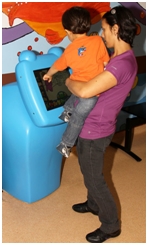
Mother & Child play
with K.I.C.K. at the hospital
while waiting to be seen by a doctor.
etc ceremony oct 2011 2

Other guests included Pedro Campos, Vice-President of M-ITI’s Board, Monchu Chen, director of MET at MiTi, and Dulce Pacheco, project manager at MiTi, several doctors and nurses of the Pediatric Services, and various members of the local press.

The other K.I.C.K. will stay at MiTi where MET students (Alexander Goldman, Duarte Teixeira, Mara Dionísio, Po-an Shen, Venkata Kushal, Wein Chang) will use it as a development platform to create unique animation, games, puzzles, and other interactive content.

Article Written by Michelle Macau
Photos by António Pedro Dias Gomes
November 2011

“Knowledge Applied in Strategic Areas Can Help Companies to Go Further”

“Knowledge Applied in Strategic Areas Can Help Companies to Go Further”

Susana Sargento Susana Sargento is involved in the Carnegie Mellon Portugal Program, funded by the Fundação para a Ciência e a Tecnologia (FCT), in several different ways. She is a Professor in the Universidade de Aveiro and a guest faculty of the Department of Electrical and Computer Engineering at Carnegie Mellon University (since August 2008), a faculty exchange member (spent one semester at Carnegie Mellon), a co-principal Investigator of the DRIVE-IN Project, and advisor of four dual degree Ph.D. students in the program.

As a researcher and assistant professor, the most important message that she passes to her students is: “If we like what we do and if we work hard, we can do anything we want and make a good contribution in the world, not only in the academic field, but also in the environment and industry. Our country is in crisis and needs brilliant minds to help to recover. Only with knowledge applied in strategic areas we can help our companies and organizations to go further.”

Susana Sargento joined the Department of Computer Science of the Universidade do Porto in September 2002, and she has been a faculty in the Universidade de Aveiro and at the Instituto de Telecomunicações since February 2004. In an interview to the Carnegie Mellon Portugal website, Susana Sargento speaks about her research achievements and challenges.

Question [Q]: You returned from Carnegie Mellon University on April, 2011, after spending short periods there. Can you comment on your experience as a faculty exchange member?
Answer [A]: It was a great experience, both from teaching and research point of views. The fact that I have been directly working with two outstanding colleagues, Ozan Tonguz and Peter Steenkiste, with a completely different way of approaching research was a great opportunity. The direct involvement in classes and with the students, and the closer contact with Portuguese colleagues and Portuguese students in this Program was also very important.

Q: You were exposed to new practices and approaches at CMU. What kind of experiences?
A: Coordinating and teaching a course is very different when comparing CMU and Portugal. In Portugal, a Professor is responsible for the course and for the classes he teaches, both theoretical and practical classes. In CMU, the involvement of Teaching Assistants in the overall coordination of homework’s, projects, quizzes and exams is very valuable. From one side, the number of students per Teaching Assistant is much reduced, enabling a good interaction between both. From the other side, the Professor is concentrated on only one course, and has significantly more time to work on research.

Q: You are involved in several research projects, and one of them is related with the Carnegie Mellon Portugal program, namely the Drive-In project. What is your role in this project?
A: I am Co-PI of the project, responsible for the work performed in Instituto de Telecomunicações – Pole of Aveiro. In Aveiro we are mainly dealing with communication aspects in vehicular-to-vehicular networks. In the research point of view, we are working on the enhancement of the vehicular-to-vehicular communication, either by evolving and optimizing the communication protocols, or by investigating how infrastructure network elements can enhance the communication in the vehicular-to-vehicular networks. In the experimental and testing point of view, we have implemented and prototyped the new standard for vehicular networks, the IEEE 802.11p, in wireless cards, that is able to perform communication between vehicles, both with emergency and entertainment services. We have also worked on extensive tests to evaluate the functionalities and limits of vehicular networks.

Q: Your team is developing a specific prototype for this project, which in the future can be deployed by industries. Could you explain the main advantages of the project?
A: We have implemented and developed a prototype of the wireless boards for vehicular communications, with its new standard IEEE 802.11p. This standard is able to cope with the hostile environments of vehicular networks, the large velocities and the envisioned transmission ranges. As an example, two vehicles driving in the same direction at around 50 Km/h are able to exchange a real-time video between themselves with several Mb/sec, with good quality, in a range of hundreds of meters. However, if a warning message of an accident arrives, this standard allows that the information of this message is reliably received while the video is running. To implement this standard, we had to face several challenges, since real testing and evaluation in such dynamic environments are challenging. However, we have overcome the challenges and we have a prototype working: we have been presenting our demos in the main conferences in the area, such as ACM MOBICOM in September 2011, and IEEE Vehicular Networking Conference in November 2011.

Q: What is the importance of this prototype?
A: The importance of this prototype is enormous, because this is an area that is just starting now and the number of available cards with IEEE 802.11p is very low [to the best of our knowledge only two companies are selling IEEE 802.11p compatible cards, NEC and Cohda Wireless] and they are very expensive, in the order of several thousands of Euros. These prices would be unbearable to deploy a large scale testbed. Our prototype will enable us to deploy a testbed of 500 taxis in the city of Porto in the next months, which at this stage, would be the largest one in the world. The set of large scale experiments and results that we will be able to deploy will be of enormous value not only to the scientific community, but also to the vehicular companies, to the environment and traffic coordination, to the health and safety, and also to application providers.
Drive In Prototype

The major IT companies are already aware of the commercial impact that vehicular applications can provide, and they are trying to get a momentum into this area. This prototype, although originally developed through open source software, will be made available to companies, in the telecommunications and vehicular fields, and we are now addressing the knowledge transfer aspects. [videos about this prototype available at http://www.av.it.pt/ssargento/media.htm]

Q: You are co-advisor of four Ph.D. students in the scope of the Carnegie Mellon Portugal Program, two students started in the last academic year (2010/2011) and the other two started this year (2011/2012). How do you manage your time with them, and also with the other Carnegie Mellon advisors?
A: A Ph.D. student requires a strong support from the advisors and a deep coordination between advisors is very important. Although last year I have been in Carnegie Mellon for a long time due to sabbatical in Portugal, this year my availability will decrease. However, the Internet provides us great facilities, and we stay in very close touch at all times. With students [currently I have two students at CMU and 2 students in Portugal], we keep in touch every weeks through skype meetings. Some of these meetings are also between the 3 of us, student and both CMU and Portugal advisors.

Q: As a researcher and assistant professor, what is the most important message that you pass to your students?
A: The message is: If we like what we do and if we work hard, we can do anything we want and make a good contribution in the world, not only in the academic field, but also in the environment and industry. Our country is in crisis and needs brilliant minds to help to recover. Only with knowledge applied in strategic areas we can help our companies and organizations to go further.

October, 2011

Doctoral Student Wants to Give a Strong Contribution to the Machine Translation Community

Doctoral Student Wants to Give a Strong Contribution to the Machine Translation Community

Wang Ling 2011 Wang Ling is a dual degree Ph.D. student in Language Technologies, at the Instituto Superior Técnico of the Universidade Técnica de Lisboa (IST/ULT) and Carnegie Mellon University (CMU), who has been carrying out research on Machine Translation. He is under the supervision of Isabel Trancoso, from the IST/UTL and researcher at the L2F Spoken Systems Lab / INESC ID, and Alan Black, from Carnegie Mellon University. Wang Ling goal is to “give a strong contribution to the Machine Translation community.”

During his first academic year, 2010/2011, this doctoral student developed an open-source Machine Translation toolkit named Geppetto, and had six papers accepted in several top conferences in the Machine Translation area. The toolkit Geppeto is used “to generate translation models for Phrase-based Machine Translation systems,” explained Wang Ling. This tool is available at http://code.google.com/p/geppetto/. With this project, Wang Ling presented one system description paper and a paper (http://www.inesc-id.pt/pt/indicadores/Ficheiros/6696.pdf) about this toolkit, at the International Workshop on Spoken Language Translation (IWSLT) 2010, in the Machine Translation track. The paper was written by several authors: Wang Ling, Tiago Luís and João Graça, Ph.D. students at the IST/UTL, and Luísa Coheur and Isabel Trancoso, researchers at the L2F Spoken Systems Lab, INESC ID.

As part of his Ph.D. course project, Wang Ling was involved in the conception of an educational game aimed at teaching a second language to foreign students which employed Machine Translation. “An automated agent is employed as an opponent in order to improve the user’s motivation and maintain the user focused,” said Wang Ling adding that “the agent’s actions are based on statistical machine translation outputs.” The system demo and description paper, written by Wang Ling, Isabel Trancoso, and Rui Prada, from IST/UTL, were submitted and accepted in the ISCA (International Speech Communication Association) Special Interest Group (SIG) on Speech and Language Technology in Education (SLaTE) 2011[http://www.inesc-id.pt/pt/indicadores/Ficheiros/7361.pdf]. The test was conducted among 20 Portuguese learners of Mandarim in the Missão Macau, facilities in Lisbon, and in Centro Cientifico e Cultural de Macau, where weekly Mandarin Classes were given. This system had a web-based implementation and is easily accessible by language learners.

Finally, he had a partial contribution in a work involving Brazilian Portuguese to European Portuguese translation, which leads to a paper in the 15th Annual Conference of the European Association for Machine Translation (EAMT) 2011. In this paper the authors – Luís Marujo, dual degree doctoral student in Language Technologies, Nuno Grazina, from the Spoken Language Laboratory / INESC-ID Lisboa, Tiago Luís, from the Spoken Language Laboratory / INESC-ID Lisboa, Wang Ling, Luisa Coheur, and Isabel Trancoso – describe a method to “efficiently leverage Brazilian Portuguese resources as European Portuguese resources.” Based on this study, the authors of the paper derived a rule based system to translate Brazilian Portuguese resources. Some resources were enriched with multiword units retrieved semi-automatically from phrase tables created using statistical machine translation tools. Their experiments suggest that applying their translation step improves the translation quality between English and Portuguese, relatively to the same process without this adaptation step. [http://www.inesc-id.pt/pt/indicadores/Ficheiros/7268.pdf]

Therefore, he finds “working in research very entrancing, especially when the results of your research are the fruit of your own ideas.”

Wang Ling’s work in Portugal has been focused mainly on Machine Translation, namely in improving the translation quality of the translation system. Although, the PT-STAR project, were he is a researcher, is focused on Speech-to-Speech translation, where Machine Translation is only one component within the pipeline, improvements in this component generally lead to an improvement in the overall Speech-to-Speech translation quality. In the future, Wang Ling said that he might be interested in working with Speech Recognition, since he thinks that the field is both relevant to the project and interesting, but for the time being, “I think that there is still a lot to be done in Machine Translation.”

Wang Ling is an open mind student that wants to learn as much as possible from all the very influential people in the field of language processing and machine learning. He expects “to make a strong contribution to the Machine Translation community”, a goal that he says that it is “not limited to expanding the current knowledge base in the Machine Translation Field, but also provides tools that can aid the current and the following generations of researchers to expand this field.”

October 2011