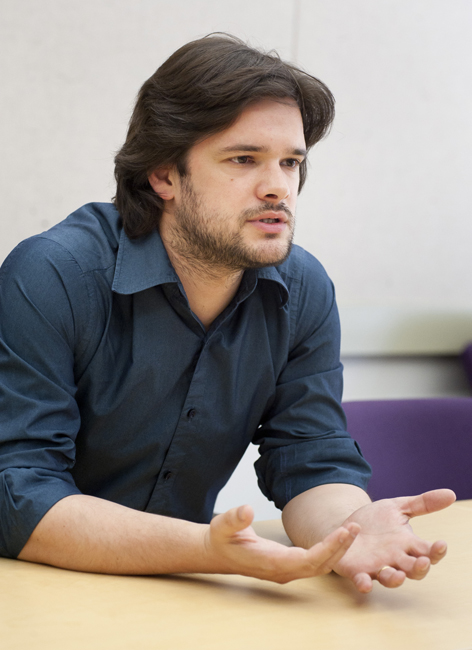
Manuel Beja from Novabase said We are helping to Change the Academia in Portugal

“We are helping to Change the Academia in Portugal”

Manuel Beja Novabase Novabase is one of the industry partners of the Carnegie Mellon Portugal Program and it is “100 per cent engaged with the partnership since its beginning,” said Manuel Beja, head of corporate development for Novabase. In the last five years, Beja feels that the results of this partnership are deeper than the ones they were expecting in the beginning, and he really feels that “Novabase is modestly helping to bring change to the Academia in Portugal.”

“Education is one of the biggest concerns of Novabase,” said Manuel Beja explaining that this was one of the main reasons that led Novabase to become an industry partner of the Carnegie Mellon Portugal Program. Manuel Beja highlighted the Universidade de Coimbra and the Universidade da Madeira as good examples of Portuguese institutions of higher education, which modernized themselves and are currently attracting top talented professors and students from all over the world.

The Universidade de Coimbra, for example, launched a dual degree professional master in software engineering (MSE) within the partnership; an initiative very well accepted by the business community, including Novabase. The same happened with the Universidade da Madeira that launched two professional masters, one in Human Computer Interaction and another in Entertainment Technology. These two innovative areas merge design, entertainment, technology, and business. Novabase already had 14 employees trained and this year 2011/2012 will support the training of five in software engineering and three employees, for the first time, in the area of Human Computer Interaction, taught by the Universidade da Madeira and Carnegie Mellon University. “We make life simpler and happier for people and businesses. This is the vision of Novabase,” said Manuel Beja, clearing that “design thinking is a key tool to bring the vision to life and so the goal is to give to these employees the opportunity to learn from the best.”

Through the partnership, Novabase gave the opportunity to a MSE student to become a dual degree doctoral student. Paulo Casanova started his Ph.D. last year, with an FCT scholarship and he is currently at CMU. For Manuel Beja this is an excellent opportunity for the company and employee, but he feels that the partnership should invest more in the professional masters, because “a doctoral program is a very long run for the companies.” Therefore, he sees professional masters as very powerful instruments to the company in terms of training employees with the best of the best, as well as in hiring the best graduates from the universities.

Besides training, Novabase is involved in several research, capstone and studio projects. Innovative projects which are creating value to the company are carried out with faculty and students rom Portuguese universities, and from Carnegie Mellon University. Aeminium – Freeing Programmers from the Shackles of Sequentiality and Affidavit – Automating the Proof of Quality Attributes for Large Scale Software Architectures are good examples of research projects funded by the Carnegie Mellon Portugal Program, through the Fundação para a Ciência e a Tecnologia (FCT). These two projects are carried out by Novabase, Universidade de Coimbra, Universidade da Madeira, and Carnegie Mellon University. The Aeminium is a project approved for three years of funding in the CMU|Portugal call of 2008, which seeks to create a platform that builds in concurrency by default: instead of sequencing code, programmers express dependency information, which are used by a compile time checker to verify correctness conditions, and by the libraries and runtime system to enable concurrent execution. On the other hand, the Affidavit project, approved in the call 2009, aims to make the current state of knowledge about software architecture design accessible to mainstream system developers by building a framework that will allow architects to investigate the properties of their architectures through architectural simulation and to ensure their correct implementation through architectural transformation.
Enlarging the Link with Academia

This partnership, in Beja’s opinion, is also important because it allowed enlarging the R&D network of Novabase. “Through this partnership, we were able to meet several Portuguese and non-Portuguese players in academia, and to build a network that will work beyond the partnership”, said Beja. Nowadays it is usual for Novabase to invite professors to give seminars and lectures to their employees.

Novabase is a Portuguese company leader in the ICT solutions area in Portugal. Novabase has specialized products and services for the Telecoms & Media, Financial Services, Government & Healthcare, Energy & Utilities, Aerospace & Transportation and Manufacturing & Services sectors. Its current business lines are Business Solutions, Infrastructures & Managed Services, Digital TV and Venture Capital. Currently, there are two alumni of the CMU|Portugal Program supporting international activities of NOVABASE: António Alvim in Angola and Miguel Oliveira in Kenya.

October, 2011

‘This Program Provides the Opportunity to Do Cutting-Edge Research’ – Can Ye

Can Ye: “This Program Provides the Opportunity to Do Cutting-Edge Research”

Can Ye Can Ye started his dual degree doctoral program in Electrical and Computer Engineering (ECE) in the fall of 2008 at the Universidade do Porto and Carnegie Mellon University. He selected the Carnegie Mellon Portugal Program because of the excellent opportunities of research collaboration, and because of the exciting experience that he is gaining in Europe, which he thinks may be of great help to his future career.

Passionate by biomedical signal processing, pattern recognition and machine learning, Can Ye is currently working on the Vital Responder Project. The Vital Responder Project aims at realizing real-time health monitoring of first responders (e.g., fire fighters) wearing Vital Jacket, a smart textile capable of collecting various vital signals via embedded miniature biosensors, including electrocardiogram (ECG) signal, respiration and blood pressure. He is the primary research investigator in the signal processing group of the project in the Carnegie Mellon Portugal program, funded by the Fundação para a Ciência e a Tecnologia. This project involves several Portuguese universities (Universidade de Aveiro, Universidade do Porto), research institutes (IEETA, IT), companies (Biodevices, Petratex, McLaren Electronics), and Carnegie Mellon University.

Can Ye doctoral thesis aims to “develop advanced signal processing and machine learning systems to enable the intelligent interpretation – processing, modeling and mining – of vital signals such as ECG signals, blood pressure and respiration, collected via wearable miniature sensors.” He thinks that such system can provide a comprehensive estimation of the user’s real-time health status, so as to detect health abnormalities and alarming trends autonomously, and consequently, warn the user and inform health care givers for appropriate action. He explained that this system “combined with superior bio-sensing and bio-communication technologies can realize ubiquitous real-time health monitoring for various populations, such as elderly and chronic disease patients.”

Since the beginning of his Ph.D., Can Ye accomplished “three IEEE conference publications, one journal, and there are two conference submissions underway,” with his advisors Miguel Coimbra, from the Faculdade de Ciências da Universidade do Porto (FCUP) and Instituto de Telecomunicações (IT), and Vijayakumar Bhagavatula, from Carnegie Mellon. The first publication titled “Arrhythmia Detection and Classification using Morphological and Dynamic Features of ECG Signals” (Proc. IEEE EMBC, Buenos Aires, Argentina, Sep 2010), “resulted in the best performance (99.59%) so far in the literature for detecting and classifying arrhythmias via ECG signals on the baseline MIT-BIH Arrhythmias Database,” said Can Ye. The MIT-BIH Arrhythmias Database is regarded as the benchmark database in the topic of cardiac arrhythmias detection and classification.

Recently Can Ye, J. Pallauf (CMU), B.V.K. Vijaya Kumar (CMU), and M. Coimbra (FCUP), presented the paper “Customizing Training Dataset for Improved Heartbeat Recognition Performance in Long-Term ECG Signal Analysis”, at the IEEE Engineering in Medicine and Biology Society (EMBC) on August 30 – September 3, 2011, in Boston, MA (USA) . In this paper the authors presented “an investigation of the potential benefits of customizing the analysis of long-term ECG signals, collected from individuals using wearable sensors, by incorporating small amount of data from these individuals in the training set of our classifiers.” One of the conclusions is that “given that the scenario of long-term, real-time and ubiquitous health monitoring in unsupervised environments is concerned, our study hints that the long-term ECG signal analysis requires frequent adaptation of the pre-determined global settings to tackle both the individual and context differences.” For this reason, the authors said that “in future work, it will be desirable to develop a self-adaptable classifier to cope with these variations.”

Can Ye feels that “this novel program provides not only the excellent opportunity to do cutting-edge research in two excellent research institutions in the area, but also the chance to experience and savor different cultures in the US and in Europe.” He believes “this unique cross-continent experience will prove beneficial to my future professional career.”

September 2011

Rodrigo Ventura: “The Academic Community would benefit from a More Widespread Participation in this Faculty Exchange Program”

“The Academic Community would benefit from a More Widespread Participation in this Faculty Exchange Program”

Rodrigo Ventura 2011 Rodrigo Ventura is an assistant professor at the Instituto Superior Técnico of Universidade Técnica de Lisboa (IST/UTL) and a researcher at the Institute for Systems and Robotics – Lisboa (ISR-Lisboa), who participated in the Faculty Exchange program at Carnegie Mellon University. He was hosted by Manuela Veloso, a Portuguese full professor in the Computer Science Department at Carnegie Mellon University (CMU) from January to May 2011.

Education and research were the main interests that lead Rodrigo Ventura to embrace this chance given by the Carnegie Mellon Portugal program. Ventura is one of the 30 researchers from Portuguese universities that have had the opportunity to spend one semester at Carnegie Mellon. While participating in the Faculty Exchange program, faculty are engaged with teaching courses and conducting research. This researcher believes that “even though the high level quality of most research carried out in Portugal, the academic community would benefit from a more widespread participation in this faculty exchange program.”

Rodrigo Ventura is an enthusiastic researcher in Robots, and while at CMU, he worked closely with Manuela Veloso with the CoBot project. The project consists of working with a robot developed by the Manuela’s Veloso research group and the goal of the project is to contribute to a multi-robot, multi-human symbiotic relationship, in which robots and humans coordinate and cooperate as a function of their limitations and strength. Ventura’s participation on this project focused “on the challenges of effectively deploying mobile service robots to real users.” Office and home environments are not robot-friendly; consequently many trivial tasks cannot be (reliably) performed by mobile robots. During his time at CMU, Rodrigo Ventura helped to develop architecture for users to schedule tasks to the robot, and even interacting with it during the task execution. On the other hand, the team guarantees “the execution of these tasks in order to both detect faults or other unexpected events, end to cope with them,” said Ventura. Currently, the CoBot robot is able to transport objects from A to B, and it is possible to do real-time monitoring of robot location and status, amd to perform telepresence.

For the past six years, Rodrigo Ventura lectures the course Artificial Intelligence and Decision Systems at the IST/UTL. So while at CMU he attended the Graduate Artificial Intelligence which allowed him to “apprehend many interesting aspects about the teaching of the course contents.” After this experience at CMU, Rodrigo Ventura submitted a proposal to the IST/UTL administration to create a Ph.D. course which could “cover a similar range of topics, but with more emphasis on robotics.” Rodrigo Ventura is proud to say that his proposal was accepted and he “will teach it during the 2012/2013 academic year.”

Rodrigo Ventura feels that the program was “extremely fruitful” in twofold: from a personal level it was positively enriching “in terms of improving my teaching and student supervision practices, as well as research-wise,” and from an institutional point of view, “it allowed to initiate a collaborative line of research, which is currently ongoing beyond the end of the exchange,” he said.

September 2011

Carnegie Mellon Portugal Program Fall 2011 Orientation Kicked off with a Day of Fun at Kennywood Park


CMU Portugal Orientation Day at CMU 2011 The Carnegie Mellon Portugal Orientation Day at CMU was launched by introductions from students and staff members. An overview and expectations of the ICTI program was given by Lori Spears, Associate Director of ICTI@CMU. Following the overview, Leid Zejnilovic, a third year Ph.D. student in the Technological Change and Entrepreneurship program gave reflections on the Carnegie Mellon Portugal program, campus living and social resources. This event was held on August 22, 2011.

Both new and returning students were exposed to the traditional Pittsburgh summer amusement park, Kennywood, which is known for its festive atmosphere. Students enjoyed the balance of the day experiencing the thrills of the park and sharing unforgettable moments. The orientation trip gave students the opportunity to network with their peers in a sociable environment and the day ended with a group photo under the famous Kennywood arch.

September 2011

Doctoral Student Presents Paper at the IEEE International Conference on Image Processing 2011

Doctoral Student Presents Paper at the IEEE International Conference on Image Processing 2011

Ricardo Silveira Cabral The paper “Fast Incremental Method for Matrix Completion: an Application to Trajectory Correction” was selected to be presented at the IEEE International Conference on Image Processing 2011. The paper was written by Ricardo Cabral, a Carnegie Mellon Portugal dual degree doctoral student in Electrical and Computer Engineering (ECE), with his two advisors João Paulo Costeira, from the Instituto Superior Técnico da Universidade Técnica de Lisboa (IST/UTL), and Fernando De la Torre, from Carnegie Mellon, with Alexandre Bernardino, from the IST/UTL. The Conference will be held on September 11-14, 2011, in Brussels.

In this paper the authors address the problem of incrementally recovering a matrix of tracked image points, based on partial observations of their trajectories. Besides partial observability, the authors “assume the existence of gross, but sparse, noise on the known entries,” explaining that “this problem has obvious applications in real-time tracking and structure from motion, where observations are plagued by self-occlusion and outliers.” Recently, research work in the optimization community has spun optimal methods for matrix completion when this matrix is known to be low rank by minimizing the nuclear norm, the sum of its singular values. Despite exhibiting several optimality properties, no available algorithms perform this minimization incrementally.

“Build upon the Nuclear Norm Robust PCA (Principal Component Analysis) method and SPectrally Optimal Completion to propose a fast and incremental algorithm which is able to cope with outliers,” the authors present “experiments showing the competitive speed of our method while maintaining performance comparable to the state-of-the-art.”

The International Conference on Image Processing, organized since 1994, is the first forum for the presentation of technological advances and research results in the fields of theoretical, experimental, applied image and video processing. This event will gather leading engineers and scientists in image processing from around the world.

Paper available at http://humansensing.cs.cmu.edu/projects/fimmc/fimmc.pdf

September 2011

Ph.D. Student Develops a Math Model to Describe the Free Trials in IPTV Network

Ph.D. Student Develops a Math Model to Describe the Free Trials in IPTV Network

Chen Wang 2011 Chen Wang is a dual degree Ph.D. student in Electrical and Computer Engineering (ECE), in the scope of the Carnegie Mellon Portugal Program, who spent her first academic year in the Faculdade de Engenharia da Universidade do Porto (FEUP), in Portugal. A year that she considered “fantastic, and where I learned and improved my research skills.” Recently, Chen Wang travelled to Carnegie Mellon University to do her second year there.

Throughout her doctoral program, Chen Wang has two advisors: Ricardo Morla, professor at FEUP and researcher at INESC Porto, and Hyong Kim, professor and researcher at CMU. This fact is not a problem for her, because they are always available by skype, videoconference or for a meeting at the office. Chen Wang is very pleased to have two advisors from two different countries, two different cultures, which give origin to two different ways to act. Actually she already has a way to differentiate both realities: “the research atmosphere is more strict and theoretic in Portugal, and more creative and practical in the US.”

During her first year in Portugal, Chen Wang was mainly focused on research in a special Enterprise network, Internet Protocol Television (IPTV) network. She used the Gaussian Mixture Models (GMMs) to model the network events and to try to detect anomalies by the mixture model. “I also described the free trials in IPTV network based on subscription equilibrium,” and “based on that, I have also done some economical analysis on the revenue and costs which are caused by free trials.” Chen Wang explained that “the first part of the work is about anomaly detections which is part of the fault localization, and the second part is more focused on economic analysis in network management and control.” After her first year, Chen Wang already submitted a paper about the second part of her research work to a top conference in her field (IEEE Infocom), and she is now working on a second paper about anomaly detection. “A journal paper is also in plan which will analyze the influence of network parameters on free trial economic effects,” Chen Wang added.

Chen Wang is a passionate for research and feels that her main goal is similar to the one that several Ph.D. students have: “to find a creative and practical idea is hard, and to prove it strictly and theoretically is even harder. But I think, since my two professors from two different continents have both of these features, they will help me a lot on my difficulties.”

“For me, the biggest challenge of this Ph.D. is from life and not from research,” says Chen Wang explaining that as a dual degree Ph.D. student she needs to spend time in Portugal and in the US, at Carnegie Mellon. These changes of location are not easy because of bureaucratic and logistic issues.

Above all, Chen Wang considers the program “wonderful” because “it let me see different educational environments in different geographical areas.”

Chen Wang was born on June 1985, in China. She holds a MSc. in Signal and Information Processing and a BSc. in Information and Communication Engineering, both by the Xi’ an Jiaotong University in China.

September 2011

Rui Prior said ‘Graduate Courses at Carnegie Mellon are More Research Oriented’

Rui Prior Said: “Graduate Courses at Carnegie Mellon are More Research Oriented”

Rui Prior Rui Prior is an assistant professor at the Faculdade de Ciências da Universidade do Porto (FCUP) and researcher from the Instituto de Telecomunicações (IT) who spent four months (April to July, 2011) at Carnegie Mellon University, in the scope of the Faculty Exchange Carnegie Mellon Portugal Program.

Hosted by Hyong Kim, professor in the Electrical and Computer Engineering department at Carnegie Mellon, Rui Prior was involved in several activities, from education to research. In the beginning, he was planning to do the qualification for teaching the Carnegie Mellon/Electrical and Computer Engineering (ECE) courses, but because of his late arrival on March 15, he was not able to go through with the plan. Meanwhile he was involved in the graduate course 18-757 Network Management and Control at CMU. An experience very enriching because this course was research oriented. “The discussion of recent research papers [given in advance to the students, and which they were supposed to have read] was frequent in the classes, and some included lectures by more senior Ph.D. students on their own research work,” said Rui Prior. The course projects were used to explore research ideas, and by the end of the semester students presented their work and delivered reports of publishable quality, some of which evolved into actual research papers. “This engagement of students in research, contrasts to the more spoon-feeding attitude still frequently found in Portuguese universities,” said Rui Prior.

During his time at Carnegie Mellon, Rui Prior started a collaborative work with Hyong Kim and Ricardo Morla, from the Faculdade de Engenharia da Universidade do Porto (FEUP), on the use of machine-learning techniques in network management, a field that is entirely new for him. “More specifically, our work concerns the automatic detection of abnormal BGP events (caused by Internet worms, blackouts, etc.) from the UPDATE messages exchanged with the peers,” said Rui Prior adding that “the work is still ongoing, and will give rise to a joint publication.”

Rui Prior participated on the weekly research group meetings, where he had the opportunity to give two talks, one on a recently published paper “Systematic Network Coding for Packet Loss Concealment in Broadcast Distribution,” and the other one on the use of network coding with Transmission Control Protocol (TCP).

“Overall, my experience was very positive, and I believe it will allow me to improve my work both in terms of research and education,” said Rui Prior.

August 2011

Novabase Creates Software Engineering Group with Carnegie Mellon Portugal Alumni

Novabase Creates Software Engineering Group with Carnegie Mellon Portugal Alumni

NOVABASE SEG Group
From left to right: Pedro Saraiva, Filipe Martins, João Pina, Marco Jorge, Miguel Graça Oliveira, Carlos Simões, Pedro Abreu, Marina Santana, Pedro Mota
The first Novabase students that were enrolled in the Professional Master program in Software Engineering in the scope of the Carnegie Mellon Portugal program graduated one and a half year ago. Upon their return to the company, the question among the Novabase managers was: should these employees return to their former business area or should Novabase create a dedicated group exclusively focused on the software engineering field?

Manuel Beja, head of Corporate Development at Novabase, explained that the implemented solution was quite challenging for the group: the Carnegie Mellon Portugal graduates should dedicate 80 per cent of their time to their former business area, and 20 per cent to the Software Engineering Group (SEG). This strategy would be effective threefold: it would generate knowledge transfer among their colleagues, it would potentiate career advancement, and it would create value to the customers. The results are already appearing.

The SEG group was created in January 2010 with the mission of contributing to the adoption of best practices in the Software Engineering area, based on the knowledge acquired through the MSE program taught by the Universidade de Coimbra and Carnegie Melon University, in the scope of the Carnegie Mellon Portugal program. Initially the SEG group had 8 members, but this number has grown to 12 members that come from different business areas. Manuel Beja is the Software Engineering Group mentor and believes that it will be possible to integrate “more than 20 members until the end of the fifth year of this partnership.”

Alumnus of the MSE program, João Pina is one of the members of the SEG. “Rewarding and intense,” were the words uttered by João Pina about the MSE program experience, where he had the opportunity to develop his skills and knowledge with a group of international experts. Before entering the MSE program, João Pina, through Novabase’s outsourcing company was working as a developer for the Caixa Geral de Depósitos. After completing the MSE program, this Carnegie Mellon Portugal Program alumnus was invited to join SEG, and to work as a software architect and analyst. João Pina said “the 20 percent of our time that we get to work at SEG is extremely fulfilling as we have a chance to use what we learned at the MSE while helping people from all areas improving the way they work”.

The role of SEG is centered in analyzing the problem, suggesting new techniques, monitoring results, and validating what was done. The group activity is organized in three areas: Requirements Design (what should be done?), Software Architectures (how should it be done?), and SmartWorld (“soft” skills for team management). In each area, the members of SEG develop and detect opportunities to better apply these “components” in the different projects developed by Novabase.

During 2010, the Software Engineering Group was involved in 45 projects with around 450 Novabase employees from all areas, and gave more than 1500 training hours for a total of 150 people. “The evolution of SEG is the result of the good integration that this group has had with the customers, inside and outside, which lead the group to reorganize and diversify its offer” said Manuel Beja.

August 2011

“Faculty Exchange Objectives were Accomplished and Even Exceeded”


Bruno Cabral Faculty Exchange 2011 Bruno Cabral, assistant professor at the Informatics Engineering Department of the Universidade de Coimbra (UC), recently finished his faculty exchange at Carnegie Mellon University (CMU), through the Carnegie Mellon Portugal Program. He spent four months and a half in the United States.The main goals of Bruno Cabral were to acquire the core competences necessary to integrate the faculty body of the CMU/UC Professional Master Program in Software Engineering (MSE), and to follow and contribute to the research work carried out at CMU in the AEMINIUM project.

The AEMINIUM project, developed by the Universidade de Coimbra, Universidade da Madeira and Carnegie Mellon University, with Novabase, aims to be a strong contribution to shaping how concurrent software development will be performed in the future and to strengthening Europe and America’s capabilities in this important area. Bruno Cabral, as researcher of this project, took part of the weekly research meetings at CMU. Alcides Fonseca a master student at UC, which is also involved in the AEMINIUM project, spent three months at CMU working closely with Bruno Cabral and Jonathan Aldrich. Alcides Fonseca, that is not involved in the CMU Portugal program directly, was at CMU as a visiting scholar.

During his time at Carnegie Mellon University, Bruno Cabral was totally engaged in all the activities related with the Professional Master in Software Engineering, from the admission process to the teaching part. He was a Teaching Assistant (TA) on several MSE courses, such as Analysis of Software Artifacts and Seminar in Software Process. As TA he gave five lectures, prepared materials for the students, and participated in the course faculty meetings. He was also a mentor of studio projects teams and individual students.

New Institute for Software Engineering (ISE)

Besides being involved in the MSE program, Cabral is the coordinator of the new center of excellence in Software Engineering consulting and training in Portugal, the Institute of Software Engineering (ISE). “We hope that the ISE will provide top quality services and training in Software Engineering to its clients and partners,” said Bruno Cabral adding that “this institute will help raising the quality and efficiency of SE practices in Europe, giving it a worldwide competitive edge.” Therefore, the research team involved in the foundation of this institute believes that it will contribute to the consolidation of the Universidade de Coimbra as a center of excellence in SE, by supporting research and training programs at the University.

While in CMU, Bruno Cabral had the opportunity to learn more about the Software Engineering Institute from this university, an institute well known all over the world, in areas such as organization and management, and to establish some synergies that will work beyond this visit.

Bruno Cabral said “this exchange period was extremely challenging and rewarding at both professional and personal levels,” adding that he believes “that all the proposed objectives were accomplished and even exceeded.”