Francisco Veloso said: “We Want to Educate Agents of Change”

Francisco Veloso said: “We Want to Educate Agents of Change”

Francisco Veloso img Francisco Veloso is the new Dean of the Catolica-Lisbon School of Business & Economics. Veloso is one of the scientific directors of the Carnegie Mellon Portugal Program, funded by the Portuguese Foundation for Science and Technology (FCT), and a member of the National Advisory Council for Innovation and Entrepreneurship.

Veloso was recently interviewed by a Portuguese journalist from the economic newspaper Diário Económico (pdf) about his strategy for the Catolica-Lisbon School of Business & Economics, his overview of the Portuguese academia and also about Portugal’s economy. Bellow we give you an idea about the key messages left by Francisco Veloso in this interview.

His goals for Catolica-Lisbon are to consolidate the institution internationalization and to produce more entrepreneurial students. Catolica-Lisbon is a triple-crown accredited institution (EQUIS, AMBA and AACSB), which is also part of the top 35 Business Schools according to the Financial Times rankings. It has “faculty from 10 different nationalities, and 30 per cent of the master students are foreigners,” reveals Francisco Veloso.

An expert in innovation and entrepreneurship, Francisco Veloso feels that it is important to support the creation of new companies, and it is crucial to mobilize the students to add value to the companies through the launching of new initiatives within them. Therefore, “at Catolica-Lisbon this is carried out by giving more opportunities to the students to put in practice entrepreneurship ideas during their studies,” explains Francisco Veloso adding “we already had the 24 Hours of Entrepreneurship, and this year we are promoting a Summer of Start Ups.” Veloso emphasizes that entrepreneurship is a very important area for Catolica-Lisbon, with six professors from four different countries teaching and doing research in this area.

Veloso supports the idea that the Portuguese universities should be more competitive, and find ways to encourage the researchers to mobilize more private and public competitive funds for their institution beyond the State support. Catolica-Lisbon School, for example, is a private institution that does not receive any direct support from the State.

Questioned about endogamy in Portuguese academia, Francisco Veloso answered that this is a problem because it limits the intellectual diversity of the institutions. He feels that the government should limit to 10 per cent the possibility of universities to hire their own doctorates, say for a period of 10 to 15 years. Afterwards, “when the system is mature enough this limit could even disappear,” he says.

Worried about the economic crisis that the country is facing, Veloso tries to contribute in finding ways to strengthen the country. He has been a member of the National Advisory Council for Innovation and Entrepreneurship where, together with others, he has been working on proposals for new initiatives and policies to foster innovation and entrepreneurship in Portugal.

Veloso considers himself an optimistic person, that’s why he left the US and came to Portugal to embrace the opportunity to become the Dean of the Catolica-Lisbon School. “We have a wonderful country, with fantastic people,” he says. Therefore, “it is crucial to put the country finances in order, because the country has a promising future with the opportunity to launch technology startups”. He leaves one idea to foster the development of technology-based companies: “to provide a grace period for payment of taxes.”

July 2012

IBM Scientific Award 2011 Distinguishes Doctorate of the CMU Portugal

IBM Scientific Award 2011 Distinguishes Doctorate of the CMU Portugal

André Martins 2012 André Martins, doctorate of the dual degree doctoral program in Language Technologies (LTI) by the Instituto Superior Técnico of the Universidade Técnica de Lisboa (IST/UTL) and CMU, won the IBM Scientific Award 2011 for his paper “Turbo Parsers: Dependency Parsing by Approximate Variational Inference.” This work was written by André Martins, with his four advisors Pedro M.Q. Aguiar and Mário Figueiredo, from Instituto Superior Técnico of the Universidade Técnica de Lisboa (Portugal), Noah A. Smith and Eric Xing from Carnegie Mellon University.

In this paper, the authors address the problem of parsing natural language text, using methods of statistical inference. André Martins explains that “this is a difficult problem, since the natural languages ​​are highly ambiguous and enable a wide variety of constructions.” The authors believe that the statistical methods are well suited to this problem because they are able to capture some of these linguistic phenomena automatically from corpora, but in their opinion this statistical methods are generally based on simplified models. Therefore, André Martins work “aims to fill this gap by building richer statistical models, without sacrificing the efficiency of parsing algorithms.”

Why is this work important? Well, the parsing of text is very relevant for applications such as text search, machine translation and information extraction. Many of these tools are used in a day-to-day basis, for example when looking for information on the Internet through a search engine. André Martins explains that “the automatic interpretation of a text also allows to organize and to retrieve information efficiently, with a response speed that surpasses humans.” In his opinion, “there is a huge technological potential in this area,” and the “advent of social networks introduces new problems for which these technologies may be relevant, such as media monitoring and analysis of opinion pieces.”

Through the Carnegie Mellon Portugal program, André Martins have had the opportunity to spend two years at Carnegie Mellon. “During this period I interacted with other students and faculty in the statistical learning and natural language processing natural fields, and I have learned a lot with them,” Martins says. About this experience, Martins misses the network spirit at CMU.

André Martins completed his Ph.D. in this academic year, 2011/2012, and is now part of the research team in Machine Learning of the company Priberam, which is a spin-off of the Instituto Superior Técnico of the Universidade Técnica de Lisboa, in Portugal.

June 2012

Today it is Fundamental to Experience Mobility and to Work in Network

“Today it is Fundamental to Experience Mobility and to Work in Network”

José Machado da Silva These words were uttered by José Machado da Silva, associate professor of the Faculdade de Engenharia of the Universidade do Porto (FEUP) and senior researcher at INESC TEC. Machado da Silva was at Carnegie Mellon University from February 12 to May 12, 2012, as a faculty exchange member, in the scope of the Carnegie Mellon Portugal Program.

During this visit, Machado da Silva had the opportunity to carry out teaching and research activities, in both cases “addressing the domain of design and testing of analog and mixed-signal microelectronic circuits,” he said. Machado da Silva was hosted by Shawn Blanton, professor at the Center for Silicon Systems Implementation, department of Electrical and Computer Engineering at Carnegie Mellon University (CMU).

With reference to teaching, Machado da Silva considers that “it was a rewarding experience seeing the effort dedicated on preparing the lessons being recognized by the students, who manifested interest in the subjects and promoted further discussion in the class.” This associate professor identified “new contents, namely on the domain of submicron MOS transistors modeling, to be included in the course Analog Microelectronics of the Integrated Masters on Electrical and Computer Engineering at FEUP, as well as the introduction of CMU students to issues related to RF testing, a subject that was not initially foreseen in the course syllabus.”

The first involvement of Machado da Silva with the Carnegie Mellon Portugal Program occurred with the submission of a project prepared jointly with Carnegie Mellon colleagues to the CMU Portugal Call for Research Projects 2008. Currently, with this trip to Carnegie Mellon, Machado da Silva was able “to prepare future collaboration on research projects and students’ supervision.”

Importance of this Experience
Machado da Silva explained “during my career I had also the opportunity of visiting and working with colleagues in different European universities.” Therefore, he said “these experiences are always beneficial to know other realities and practices, as well as to help us to know better our own capabilities.” Today, particularly in the academic domain, it is fundamental to experience mobility and to work in network.

The main reasons that took Machado da Silva to become a faculty exchange member were “the accreditation of a course taught at FEUP to be included in CMU/FEUP joint programs, as well as, to promote joint research.”

June 2012

National Director successfully completes the Agregação

National Director Successfully Completes the “Agregação”
João Barros, associate professor of Electrical and Computer Engineering at the Faculdade de Engenharia of the Universidade do Porto and national director of the Carnegie Mellon Portugal Program, was unanimously approved in his Habilitation (“Provas Públicas de Agregacao”) that were held on June 18 and 19, 2012 at the Faculdade de Engenharia of the Universidade do Porto (FEUP).

These included public discussion of João Barros’ curriculum vitae, a course proposal on Foundations of Communications, which Barros submitted half a year ago, and a presentation on “Physical Layer Security: From Information Theory to Security Engineering”. The two days provided many opportunities for lively discussion among members of the Committee and the candidate.

The picture below was taken after the deliberations of the Committee.

Agregação João Barros

(from left to right)
Artur Pimenta Alves, Full Professor of the Faculdade de Engenharia of the Universidade do Porto;
José Alfredo Ribeiro da Silva Matos, Full Professor of the Faculdade de Engenharia of the Universidade do Porto;
José Carlos dos Santos Carvalho Príncipe, BellSouth Chair and Distinguished Professor of University of Florida, USA;
João Barros, associate professor with “agregação” of the Faculdade de Engenharia of the Universidade do Porto;
Sebastião Feyo de Azevedo, dean of the Faculdade de Engenharia of the Universidade do Porto (chair);
Isabel Maria Martins Trancoso, Full Professor of the Instituto Superior Técnico of the Universidade Técnica de Lisboa;
Mário Alexandre Teles de Figueiredo, Full Professor of the Instituto Superior Técnico of the Universidade Técnica de Lisboa;
Paulo Jorge dos Santos Gonçalves Ferreira, Full Professor of the Universidade de Aveiro;
Pedro Henrique Henriques Guedes de Oliveira, head of the Electrical and Computer Engineering department and Full Professor of the Faculdade de Engenharia do Porto.

June, 2012

Sérgio Pequito Receives ECE Outstanding Teaching Assistant Award

Sérgio Pequito Receives ECE Outstanding Teaching Assistant Award at CMU

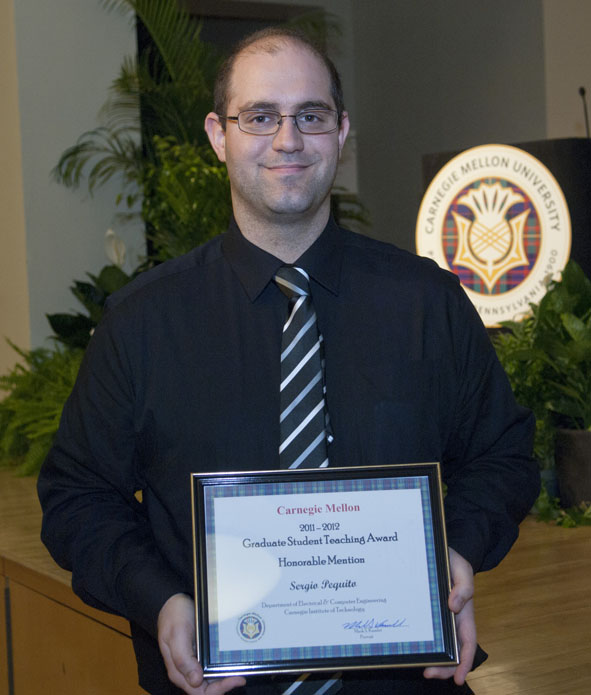
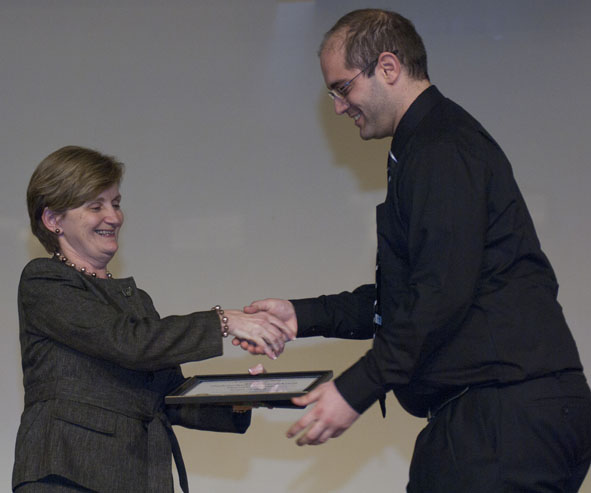
Sérgio Pequito's Award Sérgio Pequito is a Portuguese student that is carrying out his dual degree Ph.D. in Electrical and Computer Engineering (ECE) at Instituto Superior Técnico of the Universidade Técnica de Lisboa and Carnegie Mellon University, in the scope of the Carnegie Mellon Portugal program. On May 20, 2012, Pequito received the Carnegie Mellon University’s ECE Outstanding Teaching Assistant Award. On April 5, 2012, he received an Honorable Mention (2nd place) of the 2012 CMU Graduate Student Teaching Award competition, funded by the Eberly center, graduate student association and the Provost.
The Carnegie Mellon University’s Graduate Student Teaching Award is given annually to recognize a graduate student who has demonstrated exemplary teaching. The goal is to foster a culture of teaching excellence among graduate Teaching Assistants (TAs) and instructors. Pequito’s nomination was the result of several letters written by undergraduates and graduates grateful for his explanations, detailed lecture notes, and his respectful and caring attitude toward students.

We spoke with Sérgio Pequito about these two achievements, the challenges of being a TA, and about his expectations for the future.

Sérgio Pequito's Graduate Teaching Award Sérgio Pequito ECE Outstanding Teaching Award

Carnegie Mellon Portugal Program: In April you received an honorable mention (2nd place) of the CMU Graduate Student Teaching Award and on May 20 you achieved the ECE Outstanding Teaching Assistant Award. How do you feel with these two distinctions?
Sérgio Pequito (SP): It is a honor to be distinguished with such awards, the least I can say is that it was an extraordinary experience to which several people contributed to: it was a mix of open minded responsible professors that allowed me to introduce some novelty in the course and the awesome students/colleagues I had the pleasure to work with throughout the semester.

CMU Portugal: Most of the students which wrote a letter about you as a teacher assistant (TA), said that you were able to explain several boring issues in a very interesting way. What is your secret?
SP: I can say there are several secrets. First, teaching methodologies at CMU are different from those in European universities I have been enrolled in the past. At CMU usually one begins with applications and motivations after the common ground is explored and the theory presented. On the other hand, such approach might not be suitable for more abstract/theoretical courses; the trick was to mix both European and American methodologies to fulfill the diversity of students present in the classroom, by trial and error. In addition, I was producing some lecture notes for the students to get the material covered in the class in a organized fashion. I also added further details and examples to compensate for lack of background or limited time to explain a difficult topic. Finally, it is my belief that the TA cannot be understood as “the grader”, but rather as the colleague that is there to help, in order to achieve that throughout the semester I brought some cakes and chocolates in weeks that students seemed to be overwhelmed with coursework. Occasionally I also tried to bring to the class some humor and making jokes about real life examples where the theory given in class was mislead. I also challenged them with hard problems to get them to experience the difficulties by themselves. It was the best of times, it was the worst of times… but we all learn with each other, and this is most likely the most important point, there was no entity that carries all the knowledge and deliveries it afterwards, we are all willing to learn!

CMU Portugal: Is it difficult to be a TA and to carry out a Ph.D. at the same time?
SP: Definitely. Nevertheless, TAing is part of the Ph.D., although it should be understood as a ‘learning to teach’ experience. It is most of the times understood as another requirement to be fulfilled. Besides the TA work we need to do research and sometimes coursework. On top of this, there is always something happening that changes our schedule: seminars, meetings and visiting professors, among others. Although as TAs we are supposed to spend at most 12 hour/week, the truth is that by personal experience and by discussing with other colleagues we spend much more time, depending on how much big the class is and the responsibilities we have, it turns out that it might even become a full time job.

CMU Portugal: Could you please explain what is the role of a TA at CMU? Is it different from being a TA in Portugal?
SP: It varies from course to course but in general consists in creating weekly homeworks and its written solutions, grading them, helping to prepare the midterms and finals and its solutions (as well as grading), preparing lab assignments and helping in the labs, give recitations (the equivalent to practical class or wrap up course content), give 2h office hours every week and finally cover some lectures while the responsible professor is not on campus. In Portugal (my experience is resumed to IST – Math department), the concept of TA (aka “Monitor”) is different. TAs help grading the midterms and finals and do several classes (2/3 for 2h) per week where they solve exercises. In the ECE department at IST the concept of TA is recent, it is my personal belief that it tries to borrow ideas from the TAing at CMU, I think it is one of the impacts of the CMU-Portugal program. Let’s hope that professors and institutional rules allow the TAs to be innovative and to reinvent the meaning of teaching by reenforcing the link between students and the course.

CMU Portugal: You are now carrying out your Ph.D.. What do you intend to do in the near future?
SP: That is a difficult question to answer. First, I have personal goals concerning the Ph.d. itself, I would like to tackle relevant problems that are likely to make impact in my field of research. After that both teaching and working in a company are viable options, I like to think that I can postpone the decision for at least one more year. Then I will apply for both companies and universities and hope to hear from them. At that time, depending on the offers I receive I will make a decision.

More information available at http://www.cmu.edu/graduate/professional-development/innovation-with-impact/index.html

June 2012

André Martins Gets a Ph.D. and is Hired by Priberam

André Martins Gets a Ph.D. and is Hired by Priberam

Andre Martins On May 11, 2012, André Torres Martins became the first dual degree student to finish a Ph.D. in Language Technology (LT), at Instituto Superior Técnico of the Universidade Técnica de Lisboa (IST/UTL) and Carnegie Mellon University (CMU). he became the fourth student to accomplish this goal in the scope of the Carnegie Mellon Portugal Program. Alexandre Mateus (Engineering and Public Policy) was the first one, then Rita Ferreira (Applied Mathematic) followed, and at the end of 2011 Ana Venâncio (Technological Change and Entrepreneurship) finished her Ph.D. All of them finished their Ph.D.’s in different programs.

In a little interview, André Torres Martins speaks about his future and also about the impact of his thesis titled “Advances in Structured Prediction for Natural Language Processing,” (http://www.cs.cmu.edu/~afm/Home_files/thesis.pdf ) carried out with his four advisors: Mário Figueiredo (IST/UTL), Noah Smith (CMU), Pedro Aguiar (IST/UTL), and Eric Xing (CMU).

CMU Portugal: You finished in May your dual degree PhD. In looking back, what were your main challenges?
André Martins (AM): The whole experience was very challenging. My early Ph.D. years were spent at CMU, where besides doing all the coursework, I learned about all the challenging problems in natural language processing and machine learning. Given that I had so much to learn, it was challenging to make the most of those two years, but overall it went very well. It wouldn’t be so without the help of all my friends and family during our stay in Pittsburgh. Research-wise, I had to deal with four advisors – which multiply by four the number of challenging problems! – but I was very fortunate to have the support of all of them. Perhaps the most difficult challenge was to put all the material together to write a coherent thesis.

CMU Portugal: What kind of impact does your thesis has to the area of Language Technology?
AM: My thesis paves the way for developing more accurate statistical models of language, which will have an impact in search quality, translation systems, and text analytics. While most previous work resorts to oversimplified models for the sake of computational tractability, I propose a new framework based on linear relaxations that incorporates rich linguistic knowledge without sacrificing efficiency. By using machine learning techniques, I show how the proposed framework yields efficient and state-of-the-art syntactic parsers for several languages.

CMU Portugal: What do you intend to do next?
AM: I will join the Machine Learning research team at Priberam, a spin-off company from Instituto Superior Técnico of the Universidade Técnica de Lisboa. Priberam has been developing language technology for more than two decades. With the advent of social media and the availability of large amounts of textual data, there are many opportunities to apply some of the machine learning techniques I learned during my Ph.D. to develop new products. There are lots of interesting research to be done.

May 2012

Articles about André Martins:
Internship: “A Win-Win Process to the University, to the Company, and to the Student”
Portuguese Ph.D. Student Launches Priberam Machine Learning Lunch Seminars

Francisco Veloso Featured in Portuguese Newspaper

“Portugal needs companies with high growth potential”, Expresso Economia, 03-03-2012

Highlight: Francisco Veloso endorses a new model of innovation

Francisco Veloso “Portugal must improve the conditions for the emergence of more “gazelles” (firms with high growth potential and qualified job creation). These are critical for economic recovery of the country,” argues Francisco Veloso, a professor in Innovation and Entrepreneurship at the Catholic University and also a professor in the Department of Engineering and Public Policy at Carnegie Mellon University. He bases this belief on a recent study of Kauffman Foundation, an American association linked to entrepreneurship, which shows that 6.5 of every 10 jobs created in the U.S. were a result of a new company (with less than 5 years) and a strong growth.

But what is the X factor that makes a company a gazelle? “The important thing is to do something else, something different around,” says Francisco Veloso. “In Portugal the bets are usually on “mouse-companies” (some are born, others die) that almost don’t innovate,” he says. Even so, as report from the Ministry of Economy shows that between 1992 and 2007 were born in Portugal 360 “gazelle-companies” per year, employing an average of 90 people. This potential is not properly explored: “If all companies grow 20% a year, during three years, that would mean three creations of 25,000 jobs. But if we doubled the number of “gazellecompanies”, would be 50,000 jobs in three years,” emphasizes Francisco Veloso.

The problem, he warns, is that in recent years the birth of Portuguese “gazelle-companies” “has been declining.” A weak entrepreneurial dynamic that this teacher of Catholic University says can be improved by “changing the logic to support innovation,” namely through the existence of more seed capital. “We must create conditions so that many companies can go into the market and try their luck. Some will succeed and others will stay in the way.” He adds: “Years ago we gave major relevance to the business plan as a tool that required the team to think in the several dimensions of the business, but now it is also crucial experimentation, and you can take advantage of the a global and networked world.” He gives an example: “Today you can make a game, put it on a website and see how many people discharge it, or to use a crowdfunding platform to see if it has interest to the crowd. After a month or two, it is possible to know how many people believe in the idea.”

More centers of excellence

In order to emerge more innovative and competitive Portuguese companies in the international market, Francisco Veloso considers that it is essential that some of the
Portuguese universities become scientific centers of excellence and inducing business innovation. “If you compare our universities with the top of Sweden (a country with a population similar to the Portuguese) we find that there are between 3 and 5 % of doctorates, whereas in the Scandinavian country there are more than 10% of faculty with this degree. We are far from this idea of concentration of knowledge,” notes Francisco Veloso. He further arguesthat “Portugal must focus its efforts on excellence and in who is able to compete and to stand up internationally. We have to end with the Portuguese complex that no one can stand out from each other.” The teacher of Catholic University welcomes the fact that the mentality of the Portuguese faculty is changing. “It is no longer a problem or misinterpreted that faculty are also entrepreneurs and earn money. There is now in universities a certain emphasis on the creation of spin-offs that will have a demonstration effect.”

Incubate or accelerate?

Being in a space of incubation can be useful in the beginning because it lowers the cost of trial, but does not make much difference,” says Veloso, arguing that it is more advantageous for start-ups to start from an accelerator. “It allows the entrepreneur to accelerate the learning process and put you in contact with potential investors or customers.” Francisco Veloso believes that the emergence of successful entrepreneurs who create fund to support entrepreneurship (i.e. Pthena of António Murta), is positive, but says more cases are needed to bridge the gap in seed capital in Portugal. Arguing that entrepreneurship is not innate, the teacher believes that business opportunities are born from ideas that are often rejected within large organizations. “Many people only become entrepreneurs when those ideas are unable to proceed otherwise.” And gives the classic example: “The founders of Intel worked for Fairchild and only left because the board decided that this company would work only in the memories and did not believe in the potential of the semiconductors. It is something that happens often.”

So what is higher education in entrepreneurship for? The Catholic University professor admits that “does not replace the creativity of people, but that helps them to design a better structure of the project and to better use their talents.”

Profile
Francisco Veloso interrupted a comfortable position as an university professor at Carnegie Mellon and returned to Portugal in 2009 to lead ZON Innovation and Entrepreneurship at Catholic Lisbon School of Business. He embodies a happy example of a Portuguese skilled in the Diaspora who decides to return to his country to face a challenge: to create an international reference in Lisbon in the areas of entrepreneurship and innovation. After graduating in Physic Engineering at Instituto Superior Técnico (1992), and a Master at ISEG, he became an “immigrant” in the USA when received a grant from Foundation of Science and Technology (JNICT at the time). He took the opportunity, got his doctorate at MIT and followed an academic career at Carnegie Mellon University.

March, 2012

Ed Schlesinger Interviewed by Portuguese Magazine Exame Informatica

The End of Moore’s Law – Interview with Ed Schlesinger – Exame Informática, March 1, 2012

Ed Schlesinger Will Intel still exist in five years? And in 10 years? Who will lead the production of self repairing chips?

Ed Schlesinger, director of the Center for Memory Intensive Self-Configuring lntegrated Circuits (MISCIC), which is managed by the Defense Advanced Research Projects Agency (DARPA), predicts a bright future for devices that self-configure and repair their own flaws.


How are created self-configurable integrated circuits?
At our center we have with phase change materials. These are materials used in rewritable CDs which can move from an amorphous state to a crystalline state. All this is already known. By creating circuits with these materials we can turn on and off electrical connections on equipment. The goal is to create circuits that change their function – and that do it in the hardware itself and not through software. Maybe in the future my computer, mobile phone or any other device can change, not because there is a new software but because there were changes in the hardware.

How are these materials called?
The phase change materials can be chalcogens… and we also work with germanium. There are colleagues who work with strontium oxide, which has different mechanisms in relation to how they resist to changes.

How far can we go in miniaturization?
As much as some would think that technology has reached a remarkable level of sophistication. I think we’re just on the surface of what we can do with it… we begin to manipulate materials at the atomic scale and can do several interesting things.

Let me guess. We put three atoms together and we have a processor/CPU?
It may not be three atoms… a single copper atom for example has properties of copper, but it doesn’t behave in the same way as copper as a metal. If I have a multitude of atoms for example, 10 to the 23 rd , which is what is usually a cubic centimeter of copper – in that case it has all the properties of copper. Now imagine you have a cube of copper to which I take out two atoms to place other kind of atoms. This new material can no longer be considered copper metal because it is below the limit at which atoms change its properties. It will have a different behavior from that which is common in copper atoms but it cannot be considered copper metal because we withdrew atoms. If I can control the concentration of atoms and, possibly, their positions, I can create materials that have properties that were never thought of before. And this is only an example.

Only with a new industry is possible to move in this direction.
Yes, it must appear a new industry. But improving the quality of life and economic development requires innovations. I was a child when the movie 2001: Space Odyssey of Stanley Kubrick came out. In that movie, the shuttle that takes the astronaut to the space station is from PANAM and today that company does not exist. One of the characters makes a video call to Earth with a CFtT TV that has the symbol of Bell that was also dismantled. People in 1968 never thought that in 2001 these companies would not exist anymore. And also never imagined it would be possible to have a phone for video calls… and never thought about the emergence of companies like Google, Intel, Microsoft…

Intel will continue to exist in 2020?
Maybe yes, maybe not.

What is still left to discover in order to atomic computing to proceed?
There are several technologies that are being explored – from the physical manipulation of the sensitive probes or self-producing tools. It is about going from electromechanical systems to technologies that allow for exerting forces or pressure, using light, magnetic forces or heat.

Moore’s Law will never fail?
Gordon Moore’s Law tells the dimensions of the transistors and also of the economic scale. In addition to predicting even smaller transistors, the law predicts that the manufacturing cost is reduced. Moore does not just say that next year someone will be able to put twice as many transistors on a CI, also says that the transistors of the next year will cost less than this year. Therefore, consumers will want to buy the latest transistors because they are cheaper and do more things. Except that Moore’s Law will also end… and we are already seeing signs of that end.

What signs?
It is becoming difficult to maintain valid Moore’s Law. To keep it means increasing the cost of manufacture. And the Moore’s Law will eventually come to an end. If not in the next five years, it will be in the next 10 or 15 years. Then, maybe we will have something that we can call Moore’s Law, but that took different directions.

The manipulation of atoms can help to join the electronic human organs?
Yes, probably there will be created new interfaces between humans and electronics. There is an area that goes be the name of Brain-Computer Interface which makes us predict that in the future can be created a unique interface between electronics and the human body.
Maybe, I’ll be able to buy memory and somehow connect it to myself… and if I want more computing capacity I will also be able to buy something that also connects to me through an interface. We can imagine devices so small that enter into cells to fight diseases or help create systems that fight disease cell by cell.

A configurable device can also be an equipment without failures?
It will be possible to create circuits configured by humans and also channels that are self-configured. In the first case we have a circuit in which the manufacturer chooses a particular setting. And until you go back to the factory this device remains with the configuration. But even more interesting are the circuits that take self-configured settings in response to events or information that comes from outside. We can imagine a circuit that measures different signs and that adapts to receive the one who is stronger – all without human intervention.

It is a revolution in hardware but it also implies a revolution in software!
Without a doubt! It is also about what we can do more efficiently with the software or with the hardware… We tend to forget what already exists. An example: the smart cars. It’s not a question of when they will appear – it is an evolution that technology will provide us. Today most cars leaving the factories turn lights on when senses it’s dark. To most people are not smart cars, because it is just the inclusion of light sensors. But the cars also have water sensors to active windshield brushes and anti-skid systems and so on… The cars are already smart. And since there are cars that can park themselves, we must get used to the idea that one day cars will drive themselves.

A car with autonomous driving won’t be something much more viable than the computer that repairs itself?
I believe that the computer that repairs itself will start with some systems, where some simple but important things can be done to fix some details. And the user won’t even notice because it is a very complex system. Probably we already have things like that and do not care. For instance, a cabinet that turns off when we use too much electricity. We can imagine similar things happening in a microscale, allowing to protect the system and avoiding the user having to press a button that stops the operation in order to reestablish contact. Again, I say that is an evolution, we begin by introducing one or two things in a technology until one day we ask ourselves: how could we live without circuits that self-repair themselves?

Profile
Besides leading the research center at DARPA, Ed Schlesinger directs the Department of Electrical and Computer Engineering at Carnegie Mellon University. His area of research is applied physics with special emphasis on the area of sensors and configurable chips.

March, 2012

Entrepreneurship In Residence

Entrepreneurship In Residence
In July 2011, Carnegie Mellon Portugal and UTEN Portugal programs established a pilot Entrepreneurship in Residence program (EIR). The EIR consists of five Portuguese companies including Dognaedis, TreatU, FeedZai, ObservIT, and faces.in. The purpose of the EIR is to help Portuguese companies enter the U.S. market. The EIR consist of a seven month period of one-on-one workshops, training and consultation sessions with various mentors from Carnegie Mellon University.

Over the seven month period, the EIR is broken down into three Phases. Phases I and II prepares the companies to develop pitches to potential investors and customers, provides information on topics such as knowing your market and competition, university relationships, differentiation and segmentation, and partnerships for development and distribution. Phase III consists of the Portuguese companies traveling to Pittsburgh, PA to participate in a “Business Week” which allow them the opportunity to make their pitch to potential clients, customers and investors. Additionally, the Portuguese businesses will be paired with specific U.S. companies of interest to discuss potential business options as it relates to sales, customers and investment.

Phase III will take place Feb. 8-10, 2012 in Pittsburgh (more information available here).

EIR Team members
Tara Branstad Tara Branstad
Associate Director
Center for Technology Transfer and Enterprise Creation (CTTEC)
Carnegie Mellon University
Barbara Carryer Barbara Carryer
Adjunct Professor,
Entrepreneurship, Embedded Entrepreneur, Project Olympus
Innovation Advisor, Institute for Social Innovation
Carnegie Mellon University

Thoughts on Portugal and Entrepreneurship: Trying to find their Way out of the mess Through new Venture Creation (New Venturist Blog, October 18th, 2011)

Raymond F. Vennare Raymond F. Vennare
Former President, CEO and Co-Founder
ThermalTherapeutic Systems

More Thoughts on Portugal (New Venturist Blog, November 4 th , 2011)

Dave Mawhinney CMU Dave Mawhinney
Assistant Teaching Professor of Entrepreneurship
Associate Director, Donald H. Jones Center for Entrepreneurship
Carnegie Mellon University
Managing Director, Open Field Entrepreneurs Fund at Carnegie Mellon
Director, i6 Agile Innovation System, a collaboration between InnovationWorks and Carnegie Mellon
Chairman, NewCare Solutions LLC
Former Founder, Chairman, and CEO, mSpoke Inc.
EIR Participants
DOGNAEDIS Dognaedis, start-up from the Universidade de Coimbra
DOGNÆDIS is a startup focused on information security created by a team of researchers from CERT-IPN and the Dependable Systems Group at the University of Coimbra. CodeV is our first product, acting as an automated security expert that can be integrated into the software development process, identifying potential vulnerabilities in the source code. Beyond its high coverage and low false positive rates, it supports both the developer and the (security) quality assurance team. The tool also provides an assessment of the company’s security maturity to management.

Mário Zenha-Rela and Dognædis – Computer Science Prof Turns to Entrepreneurship (New Venturist Blog, October 25 th , 2011)

feedzai FeedZai , start-up from the Universidade de Coimbra
At FeedZai we aim to enhance the real time processing of information of organizations, large and small. FeedZai Pulse provides a turn-key solution for your actionable information needs. A “Real-Time Business Appliance” that once connected to data sources immediately starts producing Business Critical information.
observit ObservIt , start-up from the Instituto Superior Técnico of the Universidade Técnica de Lisboa
Observit was born in 2001 with a simple dream: to create a market-leading company in computer vision technology, an emerging area whose potential was immediately evident. From the start, our aim has been to create the best video surveillance and image processing solutions possible for a market that demands nothing less than the highest standards. We are driven by new challenges and we value speed, flexibility and efficiency throughout the consulting, installation and maintenance process for our solutions, emphasising long-term relationships with our clients.
TreatU
The ultimate goal of Treat U is to improve patient’s health and reduce costs with health care. Treat U has developed a novel and versatile platform for targeted drug delivery (PEGASEMP), allowing an increased concentration of a therapeutic agent to be effective only where it is necessary, hence increasing safety. Treat U’s main customer is the Pharmaceutical Industry, which has not been able to efficiently address tumor-specific treatments. Our customers require new technologies and products to keep their revenues at growing rates, which implies a shift in their business model towards more personalized therapies with higher specificity.

Vera Moura, bombing cancer tumors with Treat U (New Venturist Blog, November 1 st , 2011)

/uploadedImages/abouticti/partners/faces.in_logo.png faces.in, startup from Instituto Superior Técnico of the Universidade Técnica de Lisboa
faces.in is a fast and fun way to discover friends nearby. Launched successfully with Vodafone as Vodafone Radar, faces.in is positioned globally to allow mobile operators get into the game of geo-location and social networking as a value-added revenue driver. faces.in offers a highly entertaining experience on Android and iPhone smartphones and is available via SMS text, a unique and crucial capability for developing markets, reaching an unmet audience of millions of users.