Innovation and Entrepreneurship as Key Economic Drivers

Innovation and Entrepreneurship as Key Economic Drivers
On 30 and 31 October, the Pittsburgh Regional representatives were in Portugal to show how innovation and entrepreneurship can go hand in hand to become key economic drivers not only for the Pittsburgh Region, but for the United States in general.
Their intention was also to show how growth in innovation and entrepreneurship go hand in hand as a key economic driver not just for the Pittsburgh Region but the United States. Additionally, the focus was on how growth in innovation and entrepreneurship serves as an international business attraction magnet for the region as innovative technology companies seek global growth by soft landing in the Pittsburgh region.

In collaboration with Católica-Lisbon and UTEN Portugal, the Carnegie Mellon Portugal program organized two events designed to inform and educate students, faculties, technology transfer officers and corporations on entrepreneurship, open innovation and regional growth. The keynote speakers were Suzi Pegg, Vice President, International, Pittsburgh Regional Alliance (PRA), and DeWitt Peart, Executive Vice President, Economic Development, Allegheny Conference on Community Development; President, Pittsburgh Regional Alliance, an affiliate of the Allegheny Conference. The two events welcomed more than 90 participants.

The Strategic Session, entitled “ Entrepreneurial and Regional Growth: Connect with Pittsburgh ”, was organized by the UTEN Portugal in collaboration with the Carnegie Mellon Portugal program and held at Universidade Nova de Lisboa, on 30 October 2012. The guest speakers stressed that Entrepreneurship for the sake of entrepreneurship is no longer the answer to achieve regional growth and that the future of regional growth that is tied to entrepreneurship comes from the efforts to connect regional participants and to further integrate larger and more established businesses all the way into the research activities of universities.

The Pittsburgh region was presented as being the home to many materials companies who are leaders in their field, while the University of Pittsburgh and Pennsylvania State University develop world leading research in materials science. Therefore, if the researchers are interacting with the appropriate business leaders, there will be more awareness on the research and market problems can be considered.

Targeting policy makers, public authorities, university management, technology transfer officers (TTOs), start-up companies and researchers, as well as the general public, the session was an opportunity to share new visions on how Entrepreneurship can be used to achieve economic and regional growth.

The second event, entitled “ Entrepreneurship and Open Innovation: Connect with Pittsburgh for a Regional Growth ,” was organized by the Católica Lisbon School of Business and Economics, in collaboration with the Carnegie Mellon Portugal Program, and held at the Católica-Lisbon on 31 October 2012. During the event, the invited speakers had the opportunity to explain and promote regional strengths and potential customers as the backbone for entrepreneurship, and how it is possible to make a market without the capital required simply by creating an environment of open innovation and connecting with regional stakeholders.

During this event, Suzzi Pegg and DeWitt Peart explained that “over $1billion in research driven by academics and scientists leads to innovations that need to be aligned with markets,” adding that “the cost of developing those innovations for markets is higher if the markets are not involved in the innovation process.”

November, 2012

Chairman of the CMU Portugal ERC Leads Knowledge and Innovation in the UK


Sir John O'Reilly Professor Sir John O’Reilly, chairman of the External Review Committee of the Carnegie Mellon Portugal program, was recently appointed as the new director general of Knowledge and Innovation at the Department for Business, Innovation and Skills (BIS) in the United Kingdom. He will take up his new post in early February, 2013.

According to the Department for Business, Innovation and Skills website, Sir John O’Reilly will take responsibility for higher education as well as science and innovation, overseeing Business, Innovation and Skills knowledge and innovation group. He will also have oversight of the research councils, the Higher Education Funding Council for England, the Student Loans Company and the Technology Strategy Board, as well as three BIS executive agencies: the UK Space Agency, the IPO and the National Measurement Office.

In a statement to the Department for Business, Innovation and Skills website, Sir John said that “There is no more important task in the UK today than creating a strong, growing economy based on science, innovation and research. I am looking forward to working on this with colleagues in the group, in the Department more widely and beyond.”

Sir John O’Reilly has been the chairman of the External Review Committee of the Carnegie Mellon Portugal program since 2008. Annually, Sir John O’Reilly, Joel Moses (Massachusetts Institute of Technology); Tariq Durrani (University of Strathclyde); David Audretsch (Indiana University); and Luigia Aiello (Università di Roma La Sapienza) review the yearly activities implemented by the Carnegie Mellon Portugal program. This committee has an advisory role oriented towards the independent evaluation of the CMU Portugal activities.

Sir John O’Reilly has been Vice Chancellor at Cranfield University since December 2006; and before that, he spent five years as Chief Executive for the Engineering and Physical Sciences Research Council.

Source: Department for Business, Innovation and Skills ( http://www.news.bis.gov.uk/Press-Releases/Cranfield-University-head-to-lead-business-department-s-Knowledge-and-Innovation-group-68245.aspx )

The External Review Committee of the Carnegie Mellon Portugal program activity:
“We are impressed especially by the way the program has secured strong engagement from industry in Portugal.” (January, 2012)
Carnegie Mellon Portugal Program ERC 2010 Report more
Carnegie Mellon Portugal Program ERC 2009 Report more

Graduates from the Carnegie Mellon Portugal Program find themselves better prepared for the technical professions

Graduates from the Carnegie Mellon|Portugal Program find themselves better prepared for the technical professions
Graduates of the Carnegie Mellon|Portugal Program are finding themselves better equipped for positions in the professional world due to the rigorous education, collaboration, and research experience. “The program helped me to have contact with different realities and to test my capacity to its maximum,” says Inês Freitas Oliveira, alumna of the Aveiro MS in Information Networking (MSIN). “Value has been created to my employer as new skills, strengths, and networking opportunities have been generated.”

Ana Rita Rodrigues, alumna of the Masters in Software Engineering Program, says that she was drawn to the program by its technical and professional focus and international environment. She says that she found the Software Development Studio, a project the students complete in lieu of a thesis, was one of its most differentiating aspects. “The focus on processes and best practices went beyond my expectations,” says Rodrigues. “This and the opportunity to experiment and apply the knowledge acquired in the courses in the Studio were the most positive aspects of the program.”

Across the board, alumni agree that the program provides an enhanced education experience that combines the best elements of Carnegie Mellon and the partner institution. Fabio Ferreira, alumna of Aveiro MS in Information Networking (MSIN), says that the program has greatly improved his method and discipline. “It has provided me with an updated view of the current technologies with the level of excellence only obtained from one of the most important universities in the world,” he says.

A significant benefit that students find in the program is that their culminating projects are often directly applicable to the needs of their employers upon graduating. Ricardo Oliveira, an alumnus of the Lisbon MS in Information Technology – Information Security (MSIT-IS), completed research in operational optimization of security managed services in large corporate networks. Oliveira now works for Portugal Telecom, a corporate sponsor of the program, and says that his research experience has given him a leg up in the company.

“I am now more involved with the company’s information security strategy and also called upon to provide expert input on several critical projects, cooperating in the development of solutions for several security issues,” he says. “My thesis project that was specifically aimed at current needs, and is currently in the process of being deployed.” Ricardo Caetano, alumnus of Aveiro MS in Information Networking (MSIN), has also found that his experiences in the program have benefitted his career with Portugal Telecom. “With my Carnegie Mellon degree I have been placed in a more ‘core’ section of Portugal Telecom,” he says. “I’m currently at the planning and network deployment area of Portugal Telecom. I’m managing the deployment of IP networks related with the core and transport networks.”

Caetano says that he expects to combine the technical knowledge he has gained from the program with his increasing responsibilities within Portugal Telecom. Emanuel Mendonça Fernandes, alumnus of Coimbra MS in Human Computer Interaction (MHCI), also currently works for Portugal Telecom. Like Caetano, he credits his position in the company to his experiences in the program. “I joined because it was kind of an adventure,” he says, “and it seemed to like a great opportunity that I should not waste.”

Academia Up With Industry Improves Intelligent Surveillance Systems

Academia Up With Industry Improves Intelligent Surveillance Systems
Contribute to improve surveillance systems is the goal of a research project carried out by Francisco Melo, assistant professor at Instituto Superior Técnico of the Universidade Técnica de Lisboa and senior researcher at INESC-ID, and Manuela Veloso, researcher at Carnegie Mellon University, with the Portuguese company ObservIT.

The MAIS+S – Multiagent System for Intelligent Surveillance project aims to use current research in multi-agent planning and apply it to a specific real-world scenario – the creation of intelligent surveillance systems.

Francisco Melo considers that the work with ObservIT is being very proactive, “not only our research has the potential of greatly improving the performance of their surveillance networks in several aspects, but also the discussions that often take place in our frequent meetings have led to many interesting ideas that can be explored in their systems or in future collaborations.” Carried out in the scope of the Carnegie Mellon Portugal Program, funded by the Portuguese Foundation for Science and Technology, this research project is now getting to its third year.

Francisco S. Melo We spoke with Francisco Melo about the real-world testbed that it is being shaped at ISR, the achievements of the project until know, and about the connection with ObservIT.

Carnegie Mellon Portugal Program (CMU Portugal): Why is the MAIS+S project important?
Francisco Melo (FM): The overall goal of the MAIS+S project is to use current research in multi-agent planning and apply it to a specific real-world scenario – the creation of intelligent surveillance systems. There are two important motivations behind this goal:
– From a research perspective, the multi-agent planning approach adopted in the project (known as decision-theoretic planning) has been the focus of much recent research. Decision-theoretic planning in multi-agent settings is a very hard problem, and much of the recent work has focused on particular instances of this general problem that exhibit some structure that can be used to simplify the problem. Surveillance networks have natural structure that can be effectively exploited. Moreover, decision-theoretic planning research has placed a great emphasis on theoretical results, but has seldom been applied to real-world problems. MAIS+S provides a real-world testbed for the theoretical research conducted within the project, enabling a strong empirical assessment of the validity of common assumptions in this area of research.
– From a technology-transfer perspective, MAIS+S work has been developed in close collaboration with the surveillance company ObservIT. Our collaboration has been very fruitful, and our research will contribute to improve surveillance systems in several aspects.

CMU Portugal: Could you give some examples on how the results of this research project can be applied?
FM: I can give three examples. The first example is the robustness to failures in the network. Given the decentralized nature of the algorithms developed within MAIS+S, the agents in the network – robots, security personnel, control central – are able to coordinately respond to detected events, even if a failure takes place in parts of the network. The second example is the possibility to extend surveillance capabilities. The use of robotic agents integrated in the network allows the network to survey spaces not covered by the fixed cameras. For example, if a person of interest is detected, robots can be dispatched to ensure that such person is never out of the field-of-view of the network. The third example is related to smart event handling. The information displayed to the personnel in the control central is controlled by intelligent algorithms that are able to prioritize the different events detected by the network, allowing for more efficient management of events by the human controllers. Also, the robots in the field, are able to prioritize the different events detected and autonomously respond to the most urgent events.

CMU Portugal: More than one year after its start, what were the main achievements of the research team?
FM: The first year of the project was focused on research. The project produced a number of significant results, both in terms of decentralized planning and in terms of vision. Namely,
– The state-of-the-art optimal Dec-POMDP solver was developed in the context of the project. A Dec-POMDP is a complex model of a multi-agent system used in decision-theoretic planning, and investigated extensively in MAIS+S research.
– We developed a new algorithm that, for special classes of Dec-POMDPs (such as those considered in the project), is able to solve problems orders of magnitude larger than other existing methods.
– We developed distributed learning algorithms that enable an agent in a network of agents to adapt to the actions of other agents.
– We developed a new vision algorithm that allows a camera network to track a person across multiple cameras.
During this second year, although maintaining the strong research profile, we have been working close to ObservIT to define test scenarios where the research could be applied. We have acquired and deployed the necessary hardware, and the first initial scenario should be in place within the next month. The last year will be focused on deploying the remaining (more complex) scenarios.

CMU Portugal: How do you comment on the work carried out with Observit?
FM: The work with ObservIT has been fundamental to ground the research within MAIS+S. It is common for researchers to rely on assumptions that, although enabling powerful theoretical results, are often challenging to deploy in real world scenarios. Our frequent meetings with ObservIT, where we always present the most recent results in terms of research, and discuss the impact on surveillance networks, has helped our research to remain grounded on real world systems, contributing to make our results more solid. Also, from ObservIT’s perspective, I believe that MAIS+S has contributed to set ObservIT apart from their competition in terms of surveillance systems. Not only our research has the potential of greatly improving the performance of their surveillance networks in several aspects, but also the discussions that often take place in our frequent meetings have led to many interesting ideas that can be explored in their systems or in future collaborations.

November, 2012

From Portuguese to English and Vice-Versa: An Innovative Speech Translation System

From Portuguese to English and Vice-Versa: An Innovative Speech Translation System
After three years of hard research work and funding, the project PT-STAR: Speech Translation Advanced Research to and from Portuguese reached its end. The achievements are remarkable: the prototype of live Speech-to-Speech Machine Translation System from Portuguese to English and vice-versa is ready and the recently work done within this project allowed the research team to integrate the Universal Speech Translation Advanced Research (U-STAR) Consortium.

Each year, more than a billion Euros is spent translating documents and interpreting speeches by the European institutions. Therefore, the main goal of the PT-STAR project, carried out in the scope of the Carnegie Mellon Portugal Program, was to improve speech translation systems for Portuguese by strengthening the integration of the three components of the Speech-to-Speech Machine Translation (S2SMT), namely Automatic Speech Recognition (ASR), Machine Translation (MT) and Text-to-Speech Synthesis (TTS).

“When we address speech-to-speech translation we need to work with very complex models of speech-to-text conversion (recognizers), of text in a language-to-text in another language (translators), and text-to-speech (synthesizers),” explained Luísa Coheur adding that “this is a fascinating work in a scientific level.”

During the PT-STAR project, the researchers completed several tasks. The first one was the translation of spontaneous speech. At the end of this task, the researchers were able to do the integration between the two modules: Automatic Speech Recognition (ASR) and Machine Translation (MT). The second task was to make the voice conversion, which allowed the synthesized speech to retain the characteristics of the original voice, making it very useful for a wide range of S2SMT applications. It followed the third task, which addressed major problems in statistical machine translation: the study of different methods to automatically build aligned parallel corpora from non-aligned ones, the updating of the translation model, and the use of fully supervised, semi-supervised and completely unsupervised approaches for adapting the system, using actual user results. The fourth task targeted the implementing of a proof of concept prototype. All the tasks were completed successfully and the prototype is working properly.

Demonstration of Real-time S2SMT System

In the course of this project it was possible to make “improvements in full stops and commas insertions, capitalization and detection of interrogatives; to take advantage of in-domain texts to build domain adapted language models for ASR/MT; to take advantage of imperfect transcriptions (in which annotations do not include laughter, applause, filled pauses, repetitions, or other disfluencies, and sometimes contain errors); to build acoustic models for ASR; to build Statistical Parametric Synthetic voices for Portuguese; to develop a language independent statistical Intonation model; to cross lingual voice morphing to match source speaker. To develop techniques for optimal synchronization using MT N-best list; to carry out a framework for building real-time translation systems; among other achievements.”

The research team of the project believes that “in social terms the project is very important because it makes us move towards the elimination of language barriers,” said Luísa whose team is already working “on a system that will enable speech-to-speech translation from Portuguese to Chinese and vice-versa.”

Moreover the project finished, Luísa Coheur alleged that “there is a lot to do and the work between the INESC-ID and the LTI at CMU will continue. We would love to bet on a PT-STAR 2.” There are “several doctoral students focusing their work on the conversion of the pitch from one language to another, on the extraction of pairs of phrases from parallel text, the processing of disfluencies in spontaneous speech, the combination of systems for simultaneous translation into various languages, among others,” explained Luísa Coheur.

Integration at the Universal Speech Translation Advanced Research (U-STAR) Consortium
Luísa Coheur is very pleased to be part of the Universal Speech Translation Advanced Research (U-STAR – http://www.ustar-consortium.com/) consortium. “Our recently work within this project made it possible,” Coheur said. The Consortium is an international research collaboration entity formed to develop a network-based speech-to-speech translation (S2ST). It aims of breaking language barriers around the world and to implement vocal communication between different languages.

INESC ID Luísa Coheur Team
The L2F Group from the INESC-ID.

The PT-STAR project, funded by the Portuguese Foundation for Science and Tecnology (FCT), started on May 2009, and finished on July 2012. It involved a consortium of researchers from several entities: INESC-ID – Instituto de Engenharia de Sistemas e Computadores Investigação e Desenvolvimento em Lisboa; Universidade da Beira Interior (UBI), Fundação da Universidade de Lisboa (FUL/UL), Carnegie Mellon University. Like all the CMU Portugal research projects, the PT-STAR has two principal investigators: Luísa Coheur from INESC-ID in Lisbon, Portugal and Alan Black from Carnegie Mellon University.

August, 2012

What do you think of this article? Share your thoughts and concerns about articles, suggest topics, or contribute with articles and pictures. Please send your feedback to: news@cmuportugal.org .

Manuela Veloso said These Robots Are Not Science Fiction

“These Robots Are Not Science Fiction”

Manuela Veloso May 2011 Manuela Veloso, a well-known Portuguese researcher at Carnegie Mellon University (CMU), was recently interviewed by WIRED Magazine (http://www.wired.com/gadgetlab/2012/08/worlds-most-wired-roboticist/) about her team’s challenges and wishes to build up the first robots that will “intermingle with the living, breathing masses.”

After pursuing research on automated planning algorithms for her Ph.D. thesis in Computer Science at CMU, Manuela Veloso became interested in actual intelligent robots, capable of the complete autonomy cycle: detect the state of the world, generate a plan to achieve goals, and actually execute planned actions – just like humans do.

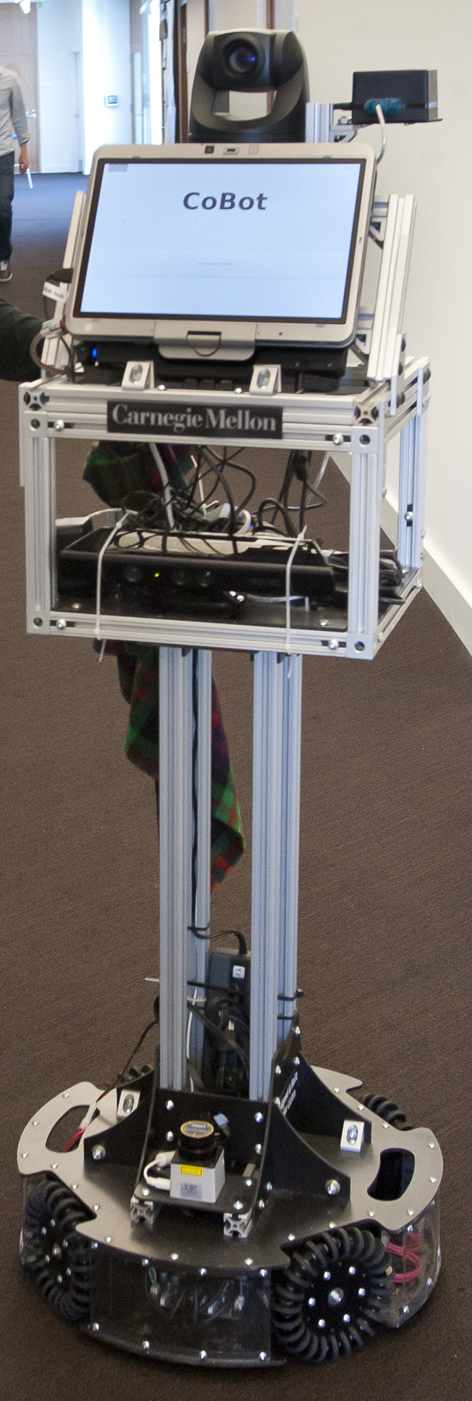
COBOT 2011 In the mid-1990s, Manuela Veloso started to build robots that could play soccer (http://www.cs.cmu.edu/~coral/), in multiple different leagues, including teams of small-wheeled fast robots and four-legged and biped robots. The researcher explained to the WIRED reporter that: “Even up until 2002, they could hardly stand and kick the ball. All of our research was on having the biped humanoid machines lift up one foot and kick the ball – and 90 per cent of the time they’d fall down.” Currently, “complete games are run between these humanoid robots. They run on the field, they move fast, they kick, they stand up by themselves. It’s all another story.” Veloso’s robot soccer teams participate and have won several annual championships organized by RoboCup, an international scientific initiative that seeks to advance the state of the art of intelligent robots. “The people behind this initiative want their bipeds to beat human soccer teams by 2050,” wrote the reporter.

Interestingly, Veloso mentions that her research experience with teams of soccer robots led her to think about service robots also in a team with the humans in their environments, indeed in a symbiotic relationship.

Symbiotic Autonomy
In parallel, Manuela Veloso’s research team is setting up CoBots (collaborative robots), which are mobile robots that are able to perform different tasks. It is normal to find one CoBot at the Gates Hillman Center at CMU, where Manuela Veloso is located. In fact, visitors to Manuela Veloso are regularly escorted to her office by one CoBot robot.

The driving principle behind Veloso’s CoBots is that “Robots can do very little.” Therefore, Manuela Veloso explained to the WIRED reporter that she “decided that in order to really have these robots be a part of our environment, they need a symbiotic relationship with humans, and they need to proactively ask for help when they need help.” One example is when the CoBot asks for humans help to press an elevator button.

The WIRED reporter explains that “in symbiotic autonomy, robots move through the world by themselves, but if they encounter uncertainties about their location, or if what they’re doing surpasses the threshold of their capabilities, they stop and ask humans for help.”

“This has been a little bit of a revolution for us,” said Veloso to the WIRED reporter adding: “to look at these robots as needing help, capable of asking for help, and doing the rest by themselves.” The CoBots are part of an NSF-funded research project. (http://www.cs.cmu.edu/~coral/projects/cobot/ )

Questioned about the future, Manuela Veloso told the reporter that her team in the next few years “will be working on giving the CoBots the ability to actively learn semantic labels for locations in an environment; perform natural language-based interaction with humans; autonomous execution monitoring; and learning by example from human demonstration a and human correction.”

Manuela Veloso within the CMU Portugal Program
In the scope of the Carnegie Mellon Portugal Program, Manuela Veloso has several roles: she is the Principal Investigator on a research project, serves as an advisor within the Program, and receives faculty exchange members at CMU. As a Principal Investigator at Carnegie Mellon of the MAIS+S project, she works in conjunction with the Instituto Superior Técnico of the Universidade Técnica de Lisboa (IST/UTL) with the research institutes: INESC ID and ISR, Carnegie Mellon University, and the Portuguese company Observit. The project addresses the problem of planning in decentralized multi-agent systems in the context of intelligent surveillance networks. Susana Brandão is the dual degree doctoral student in Electrical and Computer Engineering whom is advised by Veloso and João Paulo Costeira, a professor from the IST/UTL. Recently Manuela Veloso received at CMU Rodrigo Ventura an Assistant Professor at the IST/UTL.

August, 2012

What do you think of this article? Share your thoughts and concerns about articles, suggest topics, or contribute with articles and pictures. Please send your feedback to: news@cmuportugal.org .

Internships in the Summer Holidays: Why Not?

Internships in the Summer Holidays: Why Not?
Several dual degree doctoral students involved in the Carnegie Mellon Portugal Program, funded by the Portuguese Foundation for Science and Technology (FCT), are engaged in internships in companies like Google, Apple, Cisco Systems, Industrial Light and Magic, Bosh, among others. The opportunity arises from the two job fairs organized by Carnegie Mellon University in September, and continues during the academic year.

In Portugal it is not usual to do internships during a Ph.D., but in the U.S. it is very common. Job Fairs are organized by the university and the goal is to match the needs of companies with the research and studies of the students. In fact, this initiative is well accepted by the dual degree students. Typically, the summer internship is a full time position for the duration of the summer (three months), and the outcomes are beneficial for the growth of the students.

Ricardo Silveira Cabral
Ricardo Cabral
José Jerónimo Moreira Rodrigues
Jerónimo Rodrigues
At least four dual degree students in Electrical and Computer Engineering (ECE), namely Ricardo Cabral (IST/UTL and CMU), Jerónimo Rodrigues (IST/UTL and CMU), Saurabh Shintre (FEUP and CMU) and Mate Boban (FEUP and CMU), are engaged in internships during the summer.

Ricardo Cabral is now a software engineering intern at Google, but last year he was a R&D intern at the Industrial Light and Magic (ILM), a division of Lucasfilm, Ltd. This division is responsible for creating technology solutions to support digital artists to create the next generation of special effects. At ILM, Ricardo Cabral had the opportunity to develop his research interests in Computer Vision, and to “compare the research done in the industry with academia, especially in this part of the entertainment industry.”

Saurabh Shintre
Saurabh Shintre
Mate Boban
Mate Boban

Other example is José Jerónimo Rodrigues, who is now an intern at Google Inc, but last summer he was a research intern at the Qualcomm Innovative Center. At Google he is working on a project related to computer vision and machine learning. Also Saurabh Shintre is an intern at Cisco Systems in the areas of security and anonymity in wireless networks. Last summer, Mate Boban was an exploratory design intern at Apple Inc. During his internship he was able to design and implement experimentally validated indoor Wi-Fi optimization model, and to perform experiments with different products to validate and improve the model.

André Martins, doctorate in Language Technologies, spent last summer as an intern at Google Research. Martins worked at the “research group in natural language processing, and was able to developed algorithms for semi-supervised learning for syntactic processing of text on a large scale.” The idea was to “use the Google platform to improve the analysis of text using large amounts of information in the non-labeled web,” Martins said. This dual degree doctorate advocates that this possibility helps to match the research carried out in the academia with the companies needs. Therefore, he believes that this practice should be implemented in Portugal. Andre Martins
Brandon Mauch Brandon Mauch, doctoral student in Engineering and Public Policy at IST/UTL and CMU, spent last summer at Bosh. He worked “on energy management in commercial and residential buildings.” This company manufactures a wide range of appliances for homes and businesses. According to Mauch, Bosh research aims to “manage the energy used to reduce costs for their customers.” As a result, Mauch “worked with other interns to develop an algorithm to minimize energy costs in a building with various energy price scenarios and incentives,” adding that “I also researched demand side management potential for customers since Bosch is interested in making ‘smart’ appliances that can operate in demand side management programs easily.” Mauch has chosen Bosh because “I wanted to gain a better understanding of how an industry does research.”

August 2012

What do you think of this article? Share your thoughts and concerns about articles, suggest topics, or contribute with articles and pictures. Please send your feedback to: news@cmuportugal.org .

António Casimiro Says: To Ensure a Trustworthy Network Operation will be Crucial for Telecom Operators

António Casimiro Says: “To Ensure a Trustworthy Network Operation will be Crucial for Telecom Operators”

António Casimiro FCUL The Carnegie Mellon Portugal Program, through the Portuguese Fundação para a Ciência e a Tecnologia (FCT), funds 25 research projects in the Information and Communication Technologies areas. One of the projects approved for funding is TRONE – Trustworthy and Resilient Operations in a Network Environment, which goal is to enhance network quality of service and protection, operational efficiency and agility. During the first year of this project the research team published one paper in a journal and four papers in International Conferences and Workshops.

António Casimiro, principal investigator of the project at the Faculdade de Ciências of the Universidade de Lisboa (FCUL), in Portugal, explains that “the initial work in the project was directed towards the analysis of the possible use cases and the selection of one that would be appropriate to anchor the expected project results and, at the same time, relevant for Portugal Telecom,” the project industrial partner. Therefore “in the deliverable we analyze the main threats to the cloud infrastructure components and identify the possible controls that may be in place to prevent or minimize potential threats.” The research team did also a risk analysis for the considered use case, classifying the threats as more or less severe according to the probability of vulnerability exploitation. “The scenario provides a base for forthcoming work,” says Casimiro adding that “in particular it will serve to guide the definition of concrete proof-of-concept prototypes to show the benefits and impact of TRONE solutions.

CMU Portugal: The main goal of the TRONE project is to enhance network Quality of Service and Protection, operational efficiency and agility. This was a decision supported on the technology push, and on the consumer pull, why?
António Casimiro [AC]: The Internet, as we have known it for the last two decades, is changing. Today, everybody talks about the Cloud, a new Internet that is even more pervasive, more present, which delivers all sorts of services and keeps track of our data. The Cloud leverages on Next Generation Networks, on the ability of providing multiple services with on-demand provisioning, and all that in a seamless and technology-independent manner. The Telecom industry is strongly involved in this technology push, eager to provide more and better services, while users create the consumer pull, being eager for new, more efficient, reliable, secure and cheaper services. The confluence of these two trends leads to increased challenges on the way operators manage and operate their infrastructures today, in order to master the increasing complexity and likelihood of failures, which may also be malicious. In particular, Quality of Service and Protection, operational efficiency and agility appear as key factors for the success of these next generation networks and the competitiveness of a telecom operator. TRONE is therefore focused on addressing these challenges and providing solutions that will lead to an improved, trustworthy network operation.

CMU Portugal: In what way do you feel that this kind of research can help companies in the telecommunications area, like Portugal Telecom?
AC: As I mentioned above, the ability to ensure a trustworthy network operation will be crucial for telecom operators, providing them a competitive advantage in particular when considering services provided to large enterprises or governments. It is expected that TRONE will contribute with scientific and technical advances that will help improving the monitoring platforms used by operators to monitor their data centers. More specifically, increased trustworthiness is foreseen with the application of TRONE mechanisms for on-line fault diagnosis and detection that will be associated to recovery and dynamic adaptation strategies, and by employing architectural components and protocols that are able to survive attacks and overloads. Portugal Telecom is involved in the project and as such will benefit from a direct knowledge and access to these solutions and the possibility of applying them on their own infra-structure.

CMU Portugal: Why did the research team selected the PT cloud computing environment as the use case scenario?
AC: The initial work in the project was directed towards the analysis of the possible use cases and the selection of one that would be appropriate to anchor the expected project results and, at the same time, relevant for Portugal Telecom. The main contribution of the deliverable is the presentation of the selected use case scenario. The use case scenario that we will consider in TRONE is developed over the PT cloud computing environment. In the deliverable we analyze the main threats to the cloud infrastructure components and identify the possible controls that may be in place to prevent or minimize potential threats. We also did a risk analysis for the considered use case, classifying the threats as more or less severe according to the probability of vulnerability exploitation. The scenario provides a base for forthcoming work. In particular, it will serve to guide the definition of concrete proof-of-concept prototypes to show the benefits and impact of TRONE solutions.

CMU Portugal: This is a three year project. What kind of impact do you expect that this research project could have on Portugal Telecom, and also in the academic community?
AC: I expect two kinds of impact on Portugal Telecom: a short term impact and a medium to long term one. The short term impact will be reflected on the application of some of the TRONE solutions for improving the existing tools or parts of PT’s monitoring infrastructure. The fact that PT relies on proprietary solutions will be an obstacle for the integration of TRONE solutions, but we look at TRONE solutions as usable in a complementary way. In general terms, I would say that the main impact will be that the overall resilience of PT’s infrastructure will increase. A medium to long term impact is also expected through the adoption of architectural principles and solutions defined in TRONE. This adoption takes time, but the direct involvement of PT in the project ensures that they are aware about the benefits of TRONE solutions for trustworthiness and, thus, this should have a future impact on their decisions. From an academic perspective, the project provides an excellent opportunity to develop a number of ideas, implementing them and evaluating their impact. This is the goal of research. More objectively, we have students involved in the project that will become, we hope, skilled researchers, by learning while working in the project development. Additionally, but not so directly, we expect TRONE results (e.g. protocols, diagnosis methods, services) to be reflected in materials used in graduate courses in the areas of security, dependability and communication systems, thus benefiting a large number of students.

The TRONE project is carried out by researchers from the Faculdade de Ciências of the Universidade de Lisboa (FCUL), Faculdade de Ciências e Tecnologia of the Universidade de Coimbra (FCTUC), Carnegie Mellon University (CMU), with the partner company Portugal Telecom |PT Security Lab. The principal investigators are António Casimiro, from FCUL, and Prya Narishman, from CMU. This project started in 2010 and will end in 2013.

July, 2012

What do you think of this article? Share your thoughts and concerns about articles, suggest topics, or contribute with articles and pictures. Please send your feedback to: news@cmuportugal.org .

Employees as User Innovators

Employees as User Innovators
After analyzing 759 innovation proposals submitted by employees of a large international Information and Communication Technology (ICT) firm to a corporate idea management system over a two years period, three researchers concluded that “employees innovate in various ways, including modifying internal processes, creating new products and services, or significantly changing the way the firm delivers an existing service.” (Extract of the paper “Employees as User Innovators: An Empirical Investigation of an Idea Management System,” June 2012)

The paper titled “Employees as User Innovators: An Empirical Investigation of an Idea Management System,” was written by the dual degree doctoral student in Technological Change and Entrepreneurship Leid Zejnilovic at Carnegie Mellon University; Católica-Lisbon School of Business and Economics; Instituto Superior Técnica of the Universidade Técnica de Lisboa, with his two advisors Pedro Oliveira, Católica-Lisbon School of Business and Economics, and Francisco M. Veloso, Carnegie Mellon University. This paper was written in the scope of the Carnegie Mellon Portugal Program, funded by the Portuguese Foundation for Science and Technology (FCT).

Leid Zejnilovic We spoke with Leid Zejnilovic, the first co-author of the paper, about the importance of these findings.

CMU Portugal: What is the real impact of this paper?
Leid Zejnilovic (LZ): When we started this research it was a surprise for me to learn that despite the evidence of a growing popularity of the idea management systems, their performance is at best not consistent, and it is not uncommon for their implementation to end with a failure. And there is quite a history of their use, more than a century of different experiences. We were intrigued to learn if there is a way to exploit successful practices in the open innovation world to improve the performance of the tool (Idea Management System – IMS) that is consistently believed in by so many firms and for so long. In our research, we find a remarkable success of proposals that configure employee-user innovations: 90% of the proposals were implemented by the broader organization; they were 3.5 times more likely to be adopted when compared to other IMS proposals. The extent of change these innovations introduce to existing processes, products or services was also much higher. Our result indicates potentials for important improvement in the performance of the IMSs. But, to fully exploit these findings it may be important to think about the opportunities employees are given to exercise their user-innovator drive inside a firm. From interviews with people in the firm that shared its data with us, but also in other firms, we concluded that there is not much attention being paid to the potential role that internal or external users can play in the innovation process. In addition, most organizations do not have their systems, products and services structured in a way that employees can easily tinker and change them. The findings from our paper could motivate decision makers to change such a practice, and organize for more productive user-innovation with employees, but also users outside the firms. There is a significant academic research on innovation and suggestion systems, and their successors, idea management systems. We contributed with a novel approach to analysis of performance of these systems, taking into account the user-innovation perspective.
“Our study contributes to practice and academic work in managing innovation in several ways.” – Paper authors.
CMU Portugal: According to this paper, what kind of strategies can be used to stimulate employees to behave as user innovators?
LZ: There is not a single strategy that fits every firm. But there are general recommendations that may help developing a successful strategy. People are curios by nature and engage into experimenting and tinkering with whatever they work, and the results often come as a positive surprise. A good way for firms to begin is by being open to embrace opportunities that come from their employees being user-innovators. That process starts by assessing relevance of current user-innovation contributions to the firms’ ideation process. This should be accompanied with identification of successful experiences that can be amplified, and obstacles that can be addressed. The outcome would eventually reinforce efficient innovation practices, and serve as an impetus for faster mobilization of the inner innovative force. Another approach, not necessarily separate from what is mentioned above, is to learn from the rich experiences in the world of open innovation. Flexible work platforms, venues for collaboration and solutions sharing beyond a working place or geographic location, are only a few of successful approaches that firms can employ to stimulate user-innovators to self-mobilize and contribute.

CMU Portugal: What kind of data did you analyzed to achieve these conclusions?
LZ: The core of our data is a set of 759 innovation proposals submitted by employees of a large international information and communication technology firm to a corporate idea management system over a two years period. We gathered detailed information about the innovation proposals’ types, their expected use, field of application, and the extent of change they introduce, whether they represent a user-innovation by the employees, and their success in the idea management system. A group of independent coders, assigned by the firm, coded the innovation proposals, to rule out any bias from our side – the researchers. Our primary interest was to explore whether a systematic difference in performance exists between innovation proposal that describe user-innovations by employees, and the rest of the innovation proposals. We also investigated alternative answers, that the difference is driven by factors other than user-innovation. We gathered data about the environment where the proposals originated (departments and business lines), and also the idea’s authors – their demographics, academic and industrial education, tenure in the firm, and experiences within the firm with respect to work in different departments, and included them in our analysis. In addition, we validated our data and findings through a number of interviews with the firm’s innovators, and innovation managers.

CMU Portugal: Could you give an example of an employee that becomes a user innovator?
LZ: An example illustrates the idea. A telecom engineer in charge of mobile network “health” started coding his own analytical approach to analyze records of equipment performance logs as a set of procedures in a program. Over time, he developed a software tool, so that he could reduce the time needed to complete his analyses. Later, he described his program in a proposal submitted to the internal IMS. The result is a software, adopted division wide, which makes the role of an engineer in the “health” check process almost obsolete, cutting the service time from a few weeks to a few hours. These effects eventually led the corporation to completely change the way the “health” check service is provided to the customers – telecom operators. In this example, the innovation was first developed and used by an employee, who was motivated by his own benefits from using it. After the innovator materialized the idea, he thought it would be good to report it to the firm’s IMS. The innovation advanced from a solution used by an individual to a globally applied corporate solution. This example was far from unique. Our study of proposals submitted by the firm’s employees to the IMS left no place for doubts. Out of 759 observed proposals submitted over 2 years, 46 proposals contained a description of an idea that has been already materialized and used by the authors to some extent.
“The employees empowered by technology, with a rich use experience, and motivated by the potential benefits of using the innovation were able to convert their ideas into reality. They are the user innovators who modify processes, products, and services, to better meet their needs. Given their environment, we refer to them as employee-user innovators.” – said Leid Zejnilovic.
CMU Portugal: What will be your next steps?
LZ: My general research interests are in exploring the ways technology may help firms and individuals innovate better, and how such innovative output can be used to improve social welfare. The Insituto Superior Técnico and Católica Lisbon School of Business are great places to develop such a research, with prominent academic staff, world-class researchers, and very active international collaboration. With my advisers, Pedro Oliveira and Francisco Veloso, the next step is investigating a role that technology, and in particular innovation tools, may play for improving innovation in the health-care sector. These tools include idea management systems, and collaborative innovation platforms.

What can managers do? At least three steps are suggested by Leid Zejnilovic and the co-authors:

• Assess relevance of current user innovation contributions to the firm ideation process;
• Identify successful experiences that can be amplified, and obstacles that can be addressed;
• Devise a strategy to stimulate employees to behave as user innovators, and also share their solutions, including changing work platforms towards greater flexibility.

July, 2012

What do you think of this article? Share your thoughts and concerns about articles, suggest topics, or contribute with articles and pictures. Please send your feedback to: news@cmuportugal.org .