Partnership Builds Critical Mass in ICT

Partnership Builds Critical Mass in ICT

Portuguese Minister and State Secretary at CMU April 2010 On a recent visit to Carnegie Mellon, the Portuguese Minister and the State Secretary for Science, Technology, and Higher Education witnessed how the Carnegie Mellon Portugal program is pushing an ambitious agenda in Information and Communication Technologies (ICT).

Mariano Gago and Manuel Heitor, respectively Portuguese Minister and State Secretary for Science, Technology, and Higher Education, visited Carnegie Mellon University in April, 2010. The purpose of the visit was to participate in the XI Annual PAPS Forum, and also to meet with the students, researchers, and program coordinators who are involved in the Carnegie Mellon Portugal Program. The goal was to hear about their current achievements and future plans for the partnership.

The following key questions were asked: (i) Is the Carnegie Mellon Portugal program building critical mass in Information and Communication Technology (ICT), and (ii) is the engagement between researchers and students authentic, strong and sustainable? The answer given by all the participants in the meetings with the Minister and the State Secretary was an enthusiastic “Yes”. In different ways and levels, students and researchers are working side-by-side to develop their work, and to contribute to the economic development of Portugal. Minister with Students at CMU

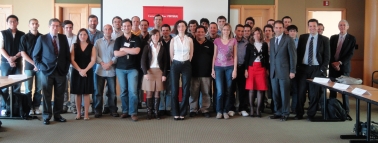
During their visit, the Minister and the State Secretary had the opportunity to talk with the 24 dual degree Ph.D. and Professional Master students that are currently at Carnegie Mellon University. The students talked about their experience, research fields, advisor’s role, and goals for the future. They agreed that this is a very demanding, challenging and hard program that prepares them for the academic or industrial world. In February 2010, the program graduated 60 students that are now agents of change in their companies. “I am delighted to know that each one of you is motivated and engaged with researchers and professors from [not only] the Portuguese universities, but also from Carnegie Mellon University,” Gago said, addressing the students.

Heitor also took time to meet with five faculty members from Portuguese universities enrolled in the Faculty Exchange program in the scope of the Carnegie Mellon Portugal program, sponsored by Fundação para a Ciência e a Tecnologia (FCT). These faculty members are spending the spring term 2010 at Carnegie Mellon University, where they are teaching courses, carrying out research projects, and some of them are writing joint papers. All of them agreed that this is an experience very enriching at all levels – both personal and professional. These young faculty members are looking for various practices that can be implemented at their home universities when the exchange is completed. For example, one “easy” change might be to encourage the presence of white boards in public spaces, like corridors or halls. This is a simple step that can enhance student discussions.

Heitor met with groups working in Computer Science (CS), Language Technologies (LTI), Engineering and Public Policy (EPP), and Technological Change and Entrepreneurship (TCE). “Now the goal is to give sustainability, to evolve and to optimize the partnership,” said Heitor.

May 2010

InRes 2014 Startup: Portugal Ventures Announces Investment on Followprice

InRes 2014 Startup: Followprice Portugal Ventures Announces Investment on Followprice

followprice Followprice, which has been linked with the CMU Portugal Program by benefitting from the inRes 2014, will receive an investment from Portugal Ventures, a Portuguese venture capital and private equity firm.

Portugal Ventures recently announced the name of the three new tech-based startups that will receive investment: Followprice, Invine and Moodoptic. The projects chosen for investment will benefit from the advice of specialists, preferably international experts, with a vast experience and an extensive network of relevant contacts. These projects may also be given the opportunity to be incubated and accelerated at the centers for the Portuguese entrepreneurship ecosystem in San Francisco (Silicon Valley), “Portugal Ventures in the Bay,” Boston, “Portugal Ventures in Boston” and Austin.

Gonçalo Mendes and Vasco Moreira, co-founders of Followprice, state “we have been travelling down a road, full of energy, drive and a lot of ambition, over the last 12 months”. As João Leitão, co-founder of Followprice, said “the objective is to transform the Followprice button in a must-have thing in every online shop in the world.”To accomplish this goal, “we need to have the right tools that will allow us to grow, by improving our product and to make it unique and attractive not only for online stores, but to all the users,” says Vasco Moreira. 2014 inRes Immersion in the US at Tech 50 Awards

As João Leitão, co-founder of Followprice, said “the objective is to transform the Followprice button in a must-have thing in every online shop in the world.” To accomplish this goal, “we need to have the right tools that will allow us to grow, by improving our product and to make it unique and attractive not only for online stores, but to all the users,” says Vasco Moreira.

“The process that led to the investment was obviously full of challenges and the opportunity to participate in the acceleration program inRes 2014, promoted by the CMU Portugal Program, was a valuable contribution for the definition and clarification of the objectives and for the necessary approach to accomplish this striking objective,“ explains Vasco Moreira. Vasco Moreira and Gonçalo Mendes benefited from the inRes 2014 edition, which combined a period of training in Portugal followed by seven weeks of immersion in Pittsburgh, anchored at Carnegie Mellon University, in the United States. “We had the pleasure to participate in numerous workshops with experts in the field of startups development and, even more important, we had mentoring from recognized professionals with a vast experience in the area,” says Vasco Moreira. “We went on this inRes 2014 journey with six more young Portuguese entrepreneurs that had the ambition to leave a footprint in Portugal and all over the world!”

The Call For Entrepreneurship is the entry point to the Ignition Programme, an initiative spearheaded by Portugal Ventures, which is an integral part of the +e+i Programme (more entrepreneurship, more innovation). The main goal of this program is to boost the Portuguese technology-based entrepreneurship ecosystem, thus contributing to the development of a more modern and competitive economy, opened to the world, based on knowledge, innovation and highly qualified human capital, with a strong entrepreneurial spirit.

February 2015

João Gabriel Silva Reelected Rector of the Universidade de Coimbra

João Gabriel Silva Reelected Rector of the Universidade de Coimbra

João Gabriel Silva Rector UC The General Council of the Universidade de Coimbra reelected João Gabriel Silva as the new rector for the term 2015-2019.

According to a press release from Universidade de Coimbra, João Gabriel Silva wants to “transform Universidade de Coimbra in a Global University, by investing in research, in internationalization, and in the attraction of foreign students.”

João Gabriel Silva has been linked with the CMU Portugal Program since its inception. More recently, the rector of the Universidade de Coimbra was a member of the Board of Directors of the Program. João Gabriel Silva was one of the leaders of the dual degree Professional Master in Software Engineering (MSE), taught by the Universidade de Coimbra and Carnegie Mellon University (CMU).

February 2015

Miguel Araújo wins Best Student Paper Runner-Up Award at an International Conference

Dual Degree Ph.D. Student in Computer Science Miguel Araújo Wins Best Student Paper Runner-Up Award at an International Conference

Miguel Araújo CMU Portugal 2012 Miguel Araújo, dual degree Ph.D. student in Computer Science, at Faculdade de Ciências of the Universidade do Porto (FCUP) and Carnegie Mellon University (CMU), received the Best Student Paper Runner-Up Award at the Pacific Asia Knowledge Discovery and Data Mining 2014 (PAKDD) for the paper he co-authored titled “Com2: Fast Automatic Discovery of Temporal (’Comet’) Communities.”

“Winning an award is the best way to keep you motivated. The committee’s recognition validates the work you are doing and it is a good way to see it promoted in the community,” says Miguel Araújo who co-authored this paper with his advisor at CMU Christos Faloutsos, and with Spiros Papadimitriou (Rutgers University), Stephan Guennemann (CMU), Prithwish Basu (BBN Technologies), Ananthram Swami (Army Research Laboratory), Evangelos E. Papalexakis (CMU), and Danai Koutra (CMU).

Miguel Araújo, who is currently enrolled in his third year, was able to publish three papers so far. “I am very happy as I feel that the quality of my work has been constantly improving, and I feel that each submission is better than the last,” says Miguel Araújo explaining that “it is very difficult to keep the pace for a very long time as new ideas and insights need time to mature.”

Miguel Araújo is co-advised by Christos Faloutsos, faculty member at CMU, and by Pedro Ribeiro, from FCUP, at the MAP-I program (Doctoral Program common to three Portuguese Universities – Aveiro, Minho and Porto).

CMU Portugal: What are the main findings of your paper titled “Com2: Fast Automatic Discovery of Temporal (’Comet’) Communities”?
Miguel Araújo (MA): We developed a very efficient tool to automatically identify communities in time-evolving networks. Our method finds groups of users that are very well connected, either persistently or at some points in time. We analyzed phone call and computer networks and, for example, our method makes it easy to distinguish personal and work-related communications.

CMU Portugal: Is the topic of your paper related to your dual degree Ph.D. work?

MA: My Ph.D. work is focused on detecting patterns and anomalies in structured graph data, and communities are a very good example of the type of patterns we can find. Understanding these patterns is an essential part for recommendation tasks in social networks, but there are also many applications in biology; for instance, the study of protein-protein interaction networks is important to gain insights in biochemical processes and can lead to the development of new drugs. On the other hand, anomalies can simply be described as an event that breaks the pattern. There are clear applications in intrusion detection, credit card fraud, spammers, etc.

CMU Portugal: Since the beginning of your studies as a dual degree Ph.D. student you were able to publish three papers in leading conferences and journals, and one of them awarded. How do you comment on these three years?

MA: I am very happy as I feel that the quality of my work has been constantly improving and I feel that each submission is better than the last. However, it is very difficult to keep the pace for a very long time as new ideas and insights need time to mature. After each paper is submitted, we often work in several directions simultaneously and only then decide which one is worth exploring. The constant juggle between breadth and depth is very interesting.

CMU Portugal: How do you comment on your experience as a dual degree Ph.D. student in CS that is on his third year?
MA: We get to experience the best from both worlds – we get twice the feedback and it’s a lot easier to get the ball rolling! Then there are significant differences in research methodology, and the need to be in two sides of the ocean at the same time is challenging. Overall, the exposition to different environments is key and helps us be better researchers.

__________

Title : ” Com2: Fast Automatic Discovery ofTemporal (’Comet’) Communities

Authors: Miguel Araújo (Universidade do Porto and CMU), Spiros Papadimitriou (Rutgers University), Stephan Guennemann (CMU), Christos Faloutsos (CMU), Prithwish Basu (BBN Technologies), Ananthram Swami (Army Research Laboratory), Evangelos E. Papalexakis (CMU), Danai Koutra (CMU).

Abstract:
Given a large who-calls-whom network, changing over time, how can we find patterns and anomalies? We propose Com2, which operates on a network of 4 million mobile users, with 51 million edges (phonecalls), over 14 days. Com2 is able to spot temporal communities (comet communities), in a scalable and parameter-free way.
The idea behind our method is to use a novel and fast, incremental tensor analysis approach, coupled with minimum description language to discover both transient and periodic/repeating communities without the need for user-defined parameters. We report our findings, which include large ’star’-like patterns, near-bipartite-cores, as well as tiny groups (5 users), calling each other hundreds of times within a few days.

___________

PAKDD is a leading international conference in the areas of data mining and knowledge discovery. It provides an international forum for researchers and industry practitioners to share their latest developments, new ideas, original research results and practical development experiences from all knowledge discovery in databases (KDD) related areas.

March 2015

Carnegie Mellon Portugal Program Projects Have Achieved Impressive Results


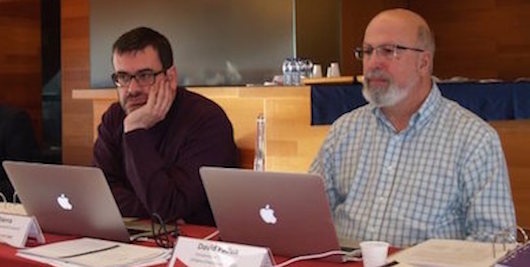
2015 Project Review at CCCM 2015 Project Review at CCCM GBarthe 2015 Project Review at CCCM 02
[l-r] Professors Björn Asheim, Miguel Lagunas, and H.S. Jamadagni Professor Gilles Barthe (chair) [l-r] Professors Carles Sierra and David Padua

The Carnegie Mellon Portugal Program held its 4 th Annual Project Review Meeting on January 20-21, 2015, at Centro Científico e Cultural de Macau, in Lisbon. The research teams of the 15 R&D projects from the 2009 call and the research teams from the 6 Entrepreneurial Research Initiatives(ERIs), carried out in the scope of the program, and funded by the Fundação para a Ciência e a Tecnologia (FCT), presented their challenges and achievements.
Report January 20-21, 2015.

“The projects from the 2009 calls of the CMU Portugal Program have achieved impressive results, in terms of successful Ph.D. defenses, publications, technology transfer, community building, and strengthening of Portuguese leadership for research and technology in key ICT areas.

The ERI projects hold the promise to leverage the successes of the completed projects and to expand the scope of the program with an increased emphasis on achieving significant entrepreneurial impact.

The evaluation of the ERI projects showed a clear indication that the projects are proceeding well. We strongly recommend that the projects keep on track with their proposed industrial collaborations.

Overall, the CMU Portugal Program has been very successful in developing internationally competitive research and technology transfer at the highest level. It remains important and challenging to leverage on the successes of the Program, and in particular to ensure that brilliant graduates, young researchers, and faculty that developed or consolidated their outstanding capacities within the Program could remain in Portugal, either in academia or in industry.”

Review Committee:
Professor Gilles Barthe, Madrid Institute for Advanced Studies (IMDEA) – chair
Professor Björn Asheim, University of Lund
Professor Carles Sierra, Artificial Intelligence Research Institute, Spanish National Research Council
Professor David Padua, University of Illinois at Urbana-Champaign (UIUC)
Professor H.S. Jamadagni, Indian Institute of Science (IIS)
Professor Miguel Lagunas, The Centre Tecnològic de Telecomunicacions de Catalunya

Madeira Interactive Technologies Institute Declared Public Service Institution

The multidisciplinary Institute is recognized for its contribution to the region Madeira Interactive Technologies Institute Declared Public Service Institution

The Portuguese Government declared the Madeira Interactive Technologies Institute (M-ITI) a public service institution that “provides and develops activities of public interest through research and development in the field of human-computer interaction in Madeira” and “organizes and carries out its activities, without profit, for the benefit of the entire region” as of February 12 th 2015.

The resolution, published in the Official Journal of the Madeira Autonomous Region, further justifies the decision by arguing that the M-ITI creates and supports “advanced training initiatives for human resources and provides services in the same sphere, cooperating with higher education and research institutions in the human-computer interaction area”.

According to Prof. Nuno Nunes, president of M-ITI and scientific director of the Carnegie Mellon Portugal Program, the Institute had an impact “of 10 million euros in project portfolio in the recent years, which means employment, services and taxes for the region”, he declared in an interview to the Diário de Notícias Madeira in February. The official statistics show that the Institute “represents 15% of the R&D expenses of the region.” Prof. Nunes goes on to illustrate that this number means that “if it wasn’t for the M-ITI, Madeira would be 15 years behind in terms of science and technology intensity, back to 2001 numbers.”

The M-ITI is an Institute of Innovation as defined by the statutes of the University of Madeira, established as a non-profit private associate, whose founding members are the University of Madeira, Madeira Tecnopolo S.A. and Carnegie Mellon University. It is the result of the institutionalization of the international partnership Carnegie Mellon Portugal Program, with the support of the regional government, dedicated to research and education in the area of computer science and human-computer interaction.

Over the course of the five years of its existence, the M-ITI has enjoyed the support of the Regional Government of Madeira, the CMU Portugal Program, of several companies, and of the North-American University, Carnegie Mellon University (CMU). It is an association of research and development public, non-profit, which is part of the associated LARSyS laboratory, which develops interdisciplinary research in Robotics and Engineering Systems, bringing together four R&D units, involving the University of Lisbon (through IST-Instituto Superior Técnico) and the University of Madeira.

In 2013, the Madeira Interactive Technologies Institute experienced two major accomplishments: inaugurated its new facilities and received a European Research Area Chairs ( ERA Chairs) grant of €2.35 million for the following four years, under the pilot program of the European Commission’s (EC) Horizon 2020 Framework Program. It was awarded to the Portuguese project LEAPFROG HCI-DI , presented by the Madeira-ITI. This was the only grant awarded to Portugal.

February 2015

1st Edition of Innovation in Aeronautics Roundtables Joins Academia and Companies

CMU Portugal Program ERI: Innovation Dynamics in Aeronautics and Embraer in Évora
1 st Edition of Innovation in Aeronautics Roundtables Joins Academia and Companies

201501 ERI Innovation in Évora 01 “Uncertainty, Globalization and Skills” was the title of the first edition of Innovation in Aeronautics Roundtables organized in the scope of the Entrepreneurial Research Initiative (ERI) Innovation Dynamics in Aeronautics and Embraer in Évora: Towards a Distributed Platform for Entrepreneurial Initiatives, New Employment and Skills Development, carried out within the CMU Portugal Program. The session took place on January 16, 2015, at INESC TEC, in Porto.

This was the first of a series of debates designed to foster the exchange of ideas between different players on critical issues regarding the development of aeronautics. Discussing research results and directions using complementary viewpoints from industrial partners, the idea is to pave the way for the development of a comprehensive perspective on the opportunities and challenges facing the aeronautics industry.

The contribution of small technology-based companies to the aeronautics industry and the use of 3D metal printing, which are critical for the development of aeronautics, were some of the issues discussed at the session. Other topics included the industry’s uncertainty and the development of skills in and for the sector.

According to Joana Mendonça, researcher at IN+/IST-UL and the principal investigator of the ERI Innovation Dynamics in Aeronautics and Embraer in Évora in Portugal, “some technological areas aren’t sufficiently explored in Portugal; however, small technology-based companies can play a fundamental role in this sector,” and the ultimate goal here “is to create an opportunity for industry and university players to share experiences.” 201501 ERI Innovation in Évora 02

The ERI, which is led by Granger Morgan at CMU, looks at the increasing complexity and uncertainty of technological advances and related value chains and business configurations in aeronautics. Motivated by the installation of two new Embraer plants in Évora, Portugal, the project’s goal is to secure the role of these plants as centers of excellence in aeronautics. Evora’s plants are a singular case as they are fully Embraer and also first tier suppliers of Embraer Brazil. This requires their activities to be fully integrated with the needs of Embraer, while keeping a competitive edge.

The session at INESC TEC welcomed various experts and representatives of all partners involved in the project, with John Whalley (Aerospace Wales Forum) as keynote speaker. (agenda available here) The idea with this session was, according to Joana Mendonça, “to empower Portugal to play a significant role in aeronautics” in three different components: value chain (addressing the role of technology-based companies), technology with implementation potential, as is the case of additive manufacturing, addressed in this session by Jaime Bonnin Roca, dual degree Ph.D. student in Engineering and Public Policy at IST-UL and CMU, and improving competences in this particular industry. “And even though there is much to be done, companies are now willing to cooperate with higher education institutions,” Joana Mendonça stresses.

The ERI Innovation Dynamics in Aeronautics and Embraer in Évora: Towards a Distributed Platform for Entrepreneurial Initiatives, New Employment and Skills Development involves several institutions IN+/IST-UL, INESC TEC, IDMEC, Embraer, CEIIA and CMU as partners, and it is funded by Fundação para a Ciência e a Tecnologia (FCT).

February 2015

Understanding the Key Drivers to Achieve Excellence

Faculty Exchange Program
Understanding the Key Drivers to Achieve Excellence

/uploadedImages/people/faculty_exchange/pedro amorim(1).jpg An opportunity to exchange ideas, become acquainted with other people’s research, learn the best practices of a top research group and strengthen cooperation – these are some of the views that Pedro Amorim, assistant professor at Faculdade de Engenharia of the Universidade do Porto (FEUP) and researcher at INESC TEC, has on the period he spent at Carnegie Mellon University (CMU).

Pedro Amorim stayed at CMU for a period of four months in 2014 (January and February, June and July), as part of the Faculty Exchange Program offered by the CMU Portugal Program. more specifically at the Chemical Engineering department, where he worked with professor Ignacio E. Grossmann’s research group. “It was wonderful to get familiarized with the best practices of a top research group and to understand the key drivers to achieve that level of success,” Pedro Amorim says.

Research-wise, this was also a very fruitful visit “because we were able to work on a paper that addresses an integrated framework for making decisions regarding supplier selection in supply chains in the processed food industry,” he explains. As part of this paper, the researchers assessed the relevance of including tactical production and distribution planning in this procurement decision. “We were especially concerned with the option of branding a product as ‘local’ or ‘mainstream’. For that, we proposed a new two-stage stochastic mixed-integer programming model for selecting suppliers in the processed food industry that maximizes profit and minimizes the risk of poor customer service,” he explains.

Additionally, during the first part of the visit, Pedro Amorim was able to audit two courses, more specifically ‘Integer Programming’ and ‘Advanced Process Systems Engineering’ at Tepper School of Business and at the Chemical Engineering department, respectively. “This allowed me to understand the main pedagogical methodologies and to learn the best teaching practices used at Carnegie Mellon,” Pedro Amorim says.

In the second part of his visit, the professor gave two seminars about ‘Risk Management in Production Planning of Perishable Food Goods.’ The first seminar was for members of the Process Systems Engineering Research Group. The second seminar was part of a series of seminars called ‘Enterprise-wide Optimization Seminars,’ and participants included researchers from companies, such as British Petrol, ExxonMobil, Total, P&G and Unilever.

“Now that I’m back in Porto, my goal is to incorporate some of the best practices that I found interesting over there, such as having a weekly one-hour meeting with all Ph.D. students to discuss ongoing work,” Pedro Amorim reveals. “I also hope that this research collaboration encourages my Ph.D. students to go to CMU for a period of time,” he adds. To foster this collaboration, professor Ignacio E. Grossmann is coming to Porto for a short visit by the beginning of the New Year.

February 2015

________________

The Faculty Exchange Program is offered by the Carnegie Mellon Portugal Program and it allows academics from Portuguese universities to spend at least one term working in research and education at Carnegie Mellon, experiencing the culture of a top university in the United States. Carnegie Mellon professors are also given the opportunity to spend time in Portugal to engage in teaching and research activities with local higher education institutions and research labs.

Success Stories from Faculty Exchange Members >>

Faculty Exchange Program: Getting a Holistic View of a Top University

Faculty Exchange Program
Getting a Holistic View of a Top University

/uploadedImages/people/faculty_exchange/manuel marques ISR.jpg A symbiotic environment, in which robots are aware of their perceptual, physical, and reasoning limitations and proactively ask for help from humans, was what Manuel Marques – assistant researcher at the Institute for Systems and Robotics of the Instituto Superior Técnico of the Universidade de Lisboa (ISR-IST/UL) – found when he arrived to Carnegie Mellon University (CMU), to take part in the Faculty Exchange Program offered by the CMU Portugal Program.

Between September and December 2014, the Portuguese researcher was at CMU’s Computer Science department, hosted by professor Manuela Veloso research group, called CORAL , which focuses on the development and study of autonomous agents that “ C ollaborate, O bserve, R eason, A ct, and L earn”. At CORAL, Manuel Marques had the opportunity to participate in the group’s weekly meetings, which were attended by all members, including undergraduate, master, and Ph.D. students, as well as a postdoctoral fellows. “For me, this was an interesting way of getting to know what these people are doing, and an opportunity for me to present some of my work as well,” Manuel Marques stated.

When Robots Say “Hello Human”

The stay at CMU was “mostly research-based, and it was a fundamental learning experience for me as a robotics researcher. We were able to address a different research project, and we developed a method to detect when a person approaches an autonomous mobilerobot platform equipped with a depth camera, such as a Kinect.” The detection algorithm and implementation were successfully tested on the CoBot robots, developed by the members of CORAL.

Working together with the CORAL research group was a “very gratifying experience,”. During the stay “we developed a method to detect the approaching of a person to an autonomous mobile robot platform equipped with a depth camera, such as a Kinect.” The detection algorithm and implementation was successfully tested on the CoBot robots. “The method, tested in different human approaches, enables the robot to initiate an interaction with an approaching human in the natural way, such as saying ‘Hello Human’,” explains Manuel Marques. “That is very rewarding,” the researcher admits.

While at CMU, Manuel Marques was also invited by José Moura, professor at CMU’s Electrical and Computer Engineering department and director of the CMU Portugal Program at CMU , to participate in the weekly meeting of his research group. There, Manuel Marques also presented some of his most recent research and interacted with graduate students. In both groups, “I realized that these periodic meetings and discussions are fundamental for the members to share ideas,” he says.

No Ordinary Feat

Attending classes of the graduate course on Planning, Execution and Learning, and various seminars hosted by the various departments of the School of Computer Science, in particular those on Machine Learning, Computer Science, of the Robotics Institute (RI) and Vision and Autonomous System Center (VASC), was also a “wonderful learning experience because I was able to improve my knowledge on how these areas apply to the robotics field,” the researcher explains.

“All this allowed me to get a holistic view of a top university and I’m really proud of participating in the Program,” he said.

Manuel Marques completed his undergraduate degree, master’s degree and Ph.D. at Instituto Superior Técnico of the Universidade de Lisboa in Electrical and Computer Engineering, in 2005, 2007 and 2011, respectively.

February 2015

________________

The Faculty Exchange Program is offered by the Carnegie Mellon Portugal Program and it allows academics from Portuguese universities to spend at least one term working in research and education at Carnegie Mellon, experiencing the culture of a top university in the United States. Carnegie Mellon professors are also given the opportunity to spend time in Portugal to engage in teaching and research activities with local higher education institutions and research labs.

Success Stories from Faculty Exchange Members >>