inRes Teams Start Structured Immersion in Pittsburgh

inRes 2015 inRes Teams Start Structured Immersion in Pittsburgh

inRes 2015 Teams in Pittsburgh

The inRes 2015 teams – AdaptTech, Playsketch, Sceelix and Scraim – started on September 21 st , an intensive training and networking agenda in Pittsburgh and at Carnegie Mellon University (CMU), in the United States.

In the United States, the teams will be exposed to a highly competitive international environment, which will allow them to reinforce their leadership and project management skills in a technological framework. João Claro, national director of the CMU Portugal Program, stresses the potential of the teams participating in this edition, and explains how they can benefit from the experience in the American market: “ All of the teams are talented in management and technological innovation. They are at a time in their lifecycle in which the realization of their potential depends entirely on their ability to refine and validate their product concepts and business models, by successively contacting with potential users, partners, investors, and several other specialists in their fields of expertise .”

Pioneering in its focus and in the way the schedule is structured, with a preparation period in Portugal followed by seven weeks in the United States, the inRes was designed and is led by a joint team of experts in Portugal and at CMU. “ During the inRes, we follow the teams closely so that they make the most of all opportunities available to them. In Portugal, we organized four workshops, with group sessions and individual tasks for the teams, where we consolidate fundamental concepts, work intensively on product concepts and business models, and design strategies for their immersion period, ” says João Claro.

In addition to adopting international reference methods to support the new businesses, the program also features innovative aspects, including the development of specific management skills for emerging technology-based businesses. “ This type of business is managed very differently than mature businesses, or businesses without a technological innovation base, and is commonly not addressed in the syllabus of most business and engineering schools. Moreover, entrepreneurial training and support programs usually focus on articulating business opportunities rather than the actually managing new businesses. This is a clear gap and it is one of the priorities of inRes .”

The four 2015 inRes teams have a workspace at Project Olympus , a CMU business accelerator. Furthermore, they will be participating in several relevant entrepreneurship and innovation initiatives, such as LaunchCMU, promoted by CMU’s Center for Innovation and Entrepreneurship (CIE). Here, the inRes teams will not only showcase their projects at a trade fair, but also pitch their business. João Claro emphasizes that in the 2014 edition of inRes “besides the scheduled appearances, the teams also had the opportunity to participate in unscheduled events with prominent people. For instance, last year Addvolt won a pitch competition that unexpectedly came about.”


“The inRes teams have privileged access to an ‘augmented reality’ in their business context, which is crucial for them to find their place and grow in the market. This facilitated and supported presence in the field gives them the proper knowledge and skills to better manage their startups today and in the future” – João Claro


João Claro also highlights the “good results” of the previous edition, which involved the teams Addvolt, DISPLR, Followprice and Xhockware: “The 2014 edition of inRes was very positive for the teams, which, in turn, reflected the level of maturity and credibility of the startups, and improved their capacity to attract investment, or to establish partnerships with businesses and experts contacted during the immersion.”

This year, the inRes is also supported by Caixa Capital, which will provide a 50,000€ prize to one of the projects participating in the 2015 edition. The winner may also access an additional 100,000€ investment, in the scope of the “Caixa Empreender Award.”

inRes is an initiative of the CMU Portugal Program, funded by the Fundação para a Ciência e a Tecnologia (FCT) and supported by the Conselho de Reitores das Universidades Portuguesas (CRUP), in partnership with CMU, the Pittsburgh Regional Alliance (PRA), Caixa Capital, UTEN Portugal and INESC TEC.
inRes Success Stories >>
inRes in the Media >>

CMU: From Pittsburgh to the Silicon Valley Campus

Ana Barros, Research Associate at INESC TEC, participating in two ERIs CMU: From Pittsburgh to the Silicon Valley Campus

Ana Barros is a research associate at INESC TEC that recently returned from almost a year as a courtesy visiting research professor at the CMU campus in Silicon Valley. “A very rewarding and intensive year,” she says, which has helped her to further develop and strengthen the research work within the two Entrepreneurial Research Initiatives (ERIs) she is involved with, as well as to boost the CMU Portugal Program network on the Silicon Valley campus. AnaBarros_SiliconValley
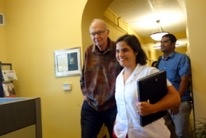
Ana Barros with Don Knuth, who participated on the Distinguished Lecture Series.

Supply chain management, innovation networks, and technology implementation management are the main research areas, Ana Barros pursues. Since 2012, this research associate has been participating in the different activities promoted by the CMU Portugal Program, namely: she spent two months at CMU in 2012, as part of the Faculty Exchange Program and she leads several tasks in two Entrepreneurial Research Initiatives (ERI), i.e. “VR2MARKET: Towards a Mobile Wearable Health Surveillance Product for First Response and other Hazardous Professions;” and the “Innovation Dynamics in Aeronautics and Embraer in Évora: Towards a Distributed Platform for Entrepreneurial Initiatives, New Employment and Skills Development” (E4Value).

CMU Portugal: How did the opportunity to go to Silicon Valley campus come about?

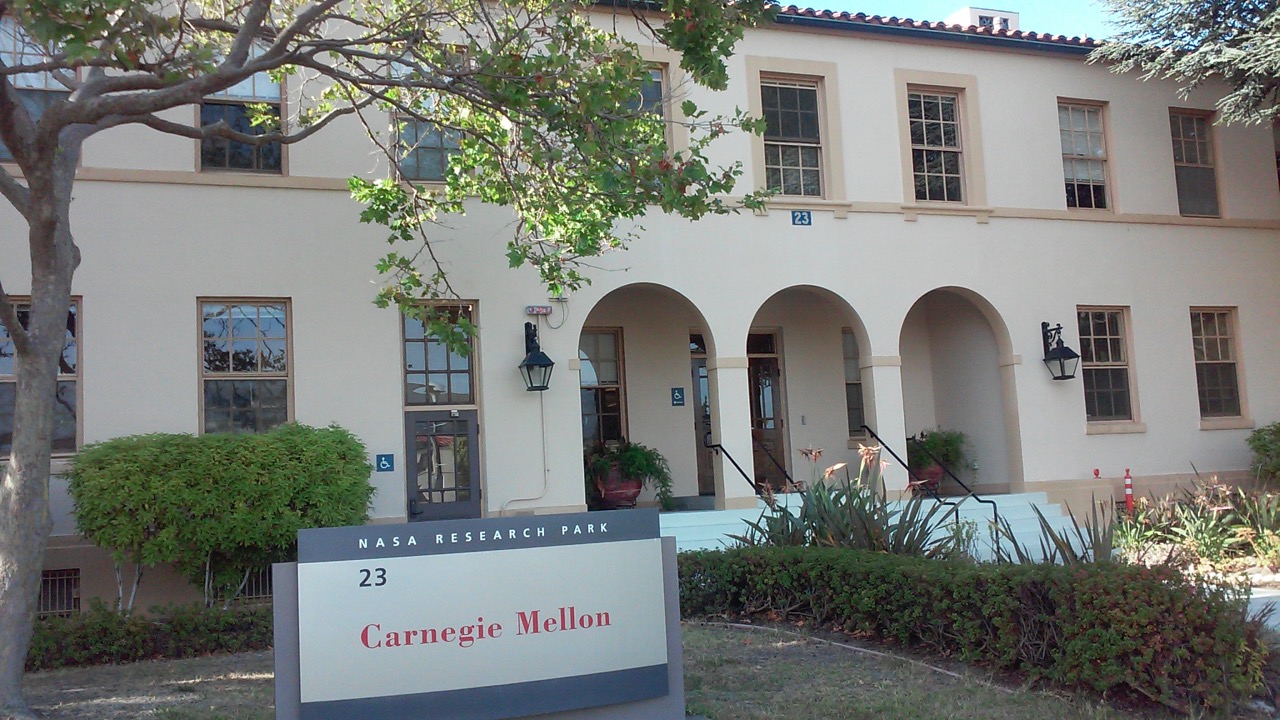
Ana Barros [AB]: I am involved in two ERIs within the CMU Portugal Program, namely the VR2Market and the E4Value. In this scope, I contacted José Fonseca de Moura, director of the CMU Portugal Program at CMU, who put me in contact with Bob Iannucci, the Silicon Valley campus director, and Jelena Kovačević, the department head of the Electrical and Computer Engineering. In Silicon Valley, the CMU Portugal Program didn’t have as much visibility but Bob Iannucci had already learned about it from Pittsburgh, and he was excited to collaborate from the very beginning. He saw the importance of this interdisciplinary collaboration that applies supply chain management knowledge to help bringing ECE products to the market. Bob was my host at the campus, he introduced me to some of the professors, and I quickly met everyone else. The campus is located in two buildings inside the NASA Ames research park in Moffett Field.

CMU Portugal Program: While there, what were you able to achieve for the two ERIs?

AB: My main focus was on the VR2Market, given the research areas pursued on this campus. One of the objectives of the project is to create a spin-off in its fourth year, which will be in two years time. While at CMU, I established links that will help us in the future to create a spin-off. For example, I got in contact with a firefighter, who has been developing an app for team management of firefighters. It was very rewarding to see that, with the help of a Software Management master student, it was possible to work on the integration between this software and the VR2Market, basically adding one of the features to the whole solution. Two other CMU professors were also involved in this integration, namely Cécile Péraire, who was the student advisor, and Stuart Evans, professor of Entrepreneurship and Innovation at the CMU Silicon Valley campus. Stuart has a class on Technology Transfer and Commercialization where he presents new technologies to the students and they have to come up with solutions regarding the market segments and a first business model idea. So, VR2Market technologies will be the object of his class next year in Silicon Valley. We also think that it will be possible to explore some synergies with the inRes initiative. Due to my presence on this campus, we were able to extend the CMU Portugal Program from Pittsburgh to Silicon Valley, and we now have concrete collaborations with three professors, and one dual degree Ph.D. student.

VR2Market_presentation

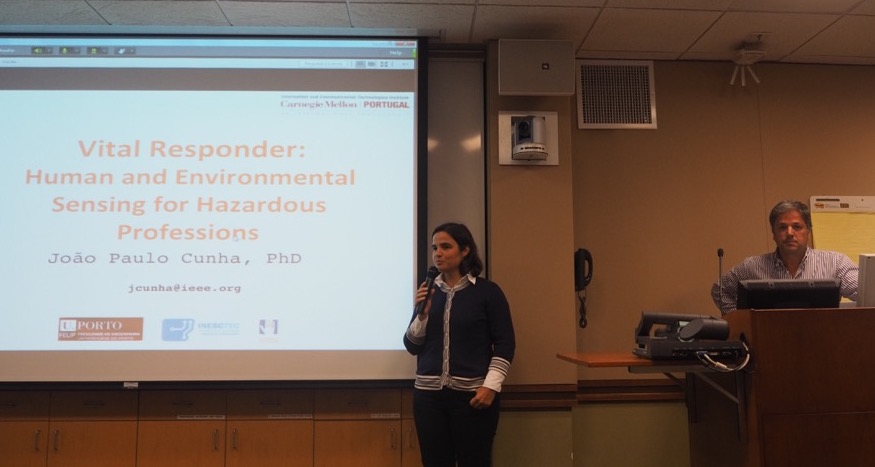
João Paulo Cunha, Principal Investigator of the VR2Market
in Portugal, gave a lecture about this ERI at the CMU SV campus.

CMU Portugal: What is your role on the VR2Market ERI?
AB: On the VR2Market, I am leading the task of defining manufacturing and supply chain strategy for startups and understanding the cost of the design iteration cycles. The design iteration cycles of the product can mean survival or death for a startup because they have very limited resources. So, the question is how can startups build flexibility into their product right from the first design, which would enable them to do these cycles, incorporating new features for different customers. If startups do this at low cost then they can do more iterations and try new markets with the same amount of money. The other task I am participating on is, in collaboration with CITE [INESC TEC’s Innovation, Technology and Entrepreneurship Center], about business model generation; working on how should the business model look like for the spin-off coming out of the project. On this ERI, we want to create knowledge on how to develop the supply chain strategy for hardware startups or physical product startups. Venture capitalists in Silicon Valley have already a lot of experience on software products and are now also investing more on physical products. This is a learning process, because the physical product iterations are, of course, more costly than software and rely on the design of the supply chain strategy decisions that have to be taken into consideration.

CMU Portugal: E4Value is quite an unique initiative in Portugal. Can you tell us more about it?

AB: The whole idea of the E4Value is to understand how a country like Portugal can be more efective and proactive on the aeronautics industry. In Portugal we already have several companies working on this field. Therefore, we plan to go beyond our borders, namely to Spain and Brazil, in order to better understand what are the drivers and conditions that lead to the creation of this industry in a region. In parallel, we aim at identifying the Portuguese technologies that may be used by the aeronautic sector. We are trying to scout for the whole country, not only companies or technologies but also research institutions. We want to understand how we can create innovation networks to bring those technologies to the market. Another question is in which spot of the aeronautic value chain (design, production, maintenance, repair and operations) Portuguese companies could make a difference in terms of competitive advantage: How to offer something that has not been done and that could be an opportunity for Portuguese companies to enter the industry? It is a competitive industry, so we are fortunate that we have now two Embraer plants in Portugal. But for now, they only have four Portuguese suppliers. This is because suppliers entering the aeronautics industry cannot work only with one customer, they have to supply several, as the volumes are much smaller then in other industries. We seek to identify companies’ needs and to understand how they can develop the capabilities in order to enter the aeronautic industry. That is the big challenge. We are launching a survey in collaboration with the Portuguese Aeronautics Industry Association (PEMAs), to better understand which products and technologies we have in Portugal that have a fit with the aeronautic sector.

CMU Portugal: Your first contact with CMU happened with the Faculty Exchange Program (FEP)?

AB: Yes, in 2012 I was at CMU, in Pittsburgh, for two months, July and August. [report available here] I was visiting Erica Fuchs, a faculty member of the department of Engineering and Public Policy. By that time, our focus was already on the idea that would eventually lead to my contribution in the VR2market, which is supply chain strategy for high tech startups. Erica Fuchs was also investigating the locations where startups or spin-offs coming out of CMU decided to locate their operations. This is one of the main decisions on supply chain strategy, and that’s why we started collaborating.

CMU Portugal: In your FEP report, you mentioned some innovative teaching ideas that you wanted to bring to Portugal, namely the study groups. Can you talk a little about this?

AB: Yes, I mimicked that the following year at INESC TEC. At that point in time, I had a group of five people working with me, three Ph.D. and two master students, and we did this every month. We held group meetings with paper presentations, followed by a discussion.

NASA_Research_Park

September 2015

João Claro Appointed Administrator of INESC TEC

National Director of the CMU Portugal Program João Claro Appointed Administrator of INESC TEC

The National Director of the CMU Portugal, João Claro, was recently appointed as a member of the Board of Directors of the associate laboratory INESC Technology and Science – INESC TEC. João Claro is very honored with this nomination, which he feels it is of great responsibility given the “30 years of strong experience in R&D and technology transfer, dynamic, and innovation path of this associate laboratory.” JoaoClaro_INESC3

João Claro is professor at Faculdade de Engenharia of the Universidade do Porto (FEUP), and holds appointments with INESC TEC, where he is now an administrator and heads the Centre for Innovation and Technology Transfer, and with Porto Business School (PBS), where he heads the Entrepreneurship and Innovation academic area. João Claro is also a mentor of the Startup Lisboa. He was a visiting scholar with the Engineering Systems Division at MIT.

João Claro holds a Ph.D. in Electrical and Computer Engineering from FEUP (2008), an MSc in Quantitative Methods in Management from PBS (2002), and an undergraduate degree in Electrical and Computer Engineering from FEUP (1993). Prior to returning to the University, he was a software engineer and project manager at Edinfor (1994-1998).

INESC TEC brings together more than 800 collaborators, of which around 300 have Ph.D. Since its creation, INESC TEC has been acting as an interface between the academic world, the world of industry and services and the public administration in Information Technologies, Telecommunications and Electronics (ITT&E).

September 2015

Filipe Condessa Receives 2015 Mikio Takagi Student First Prize

International Geoscience and Remote Sensing Symposium 2015 (IGARSS 2015)
Dual Degree Ph.D. Student Receives the 2015 Mikio Takagi Student First Prize

FCondessa 2015 99 full papers submitted by students, a panel of 50 reviewers selects the 10 finalist papers, and the decision of the 2015 Mikio Takagi Student First Prize was to the paper written by Filipe Condessa, with his two advisors, José Bioucas-Dias (IST) and Jelena Kovacévič (CMU). “It feels great to receive this recognition from the Geoscience and Remote Sensing community,” says Filipe Condessa. IGARRS is the world’s premier symposium on the subject of remote sensing.

Filipe Condessa is on his 4th year as a dual degree doctoral student in Electrical and Computer Engineering (ECE), at IST and CMU. The paper “Supervised Hyperspectal Image Classification with Rejection” introduces “a framework for robust image classification of remote sensing images (acquired by satellite or aircrafts),” explains Filipe Condessa. The first prize was endowed with US$1000.00.

Hosted by the IEEE Geoscience and Remote Sensing Society, the International Geoscience and Remote Sensing Symposium 2015 (IGARSS 2015) was held from July 26th through Friday July 31th, 2015, at the Convention Center in Milan, Italy. This is the major event in remote sensing and provides an ideal forum for obtaining up-to-date information about the latest developments, exchanging ideas, identifying future trends, and networking with the international geoscience and remote sensing community.

CMU Portugal Program: What did you felt when you received the 2015 Mikio Takagi Student First Prize (MTStP)?
Filipe Condessa (FC): I’m very happy for this achievement. It feels great to receive this recognition from the Geoscience and Remote Sensing community. Being awarded this prize while representing my two homes, Carnegie Mellon University and Instituto Superior Técnico (IST-UL), is wonderful. It is reassuring to repay the confidence CMU and IST-UL and my advisors, Jelena Kovacévič and José Bioucas-Dias, gave me for the past four years.

CMU Portugal Program: Could you explain the main findings of your paper, which was written with your advisors José Bioucas-Dias (IST) and Jelena Kovačević (CMU)?
FC: The paper introduces a framework for robust image classification of remote sensing images (acquired by satellite or aircrafts), namely hyperspectral images with very rich spectral content. Hyperspectral images are very large and prohibitively expensive to classify manually, so automatic image classification is a very popular area of research. However, automatic (and even manual) classification is a very hard task, and will not infrequently fail. The framework introduced aims to improve classification performance by selectively abstaining from classifications where misclassifications can be expected through the use of rejection, and harnessing contextual information from the image.

CMU Portugal Program: What were the main challenges of writing the paper?
FC: There is often a shorter writing cycle for papers submitted to competition. On the other hand, in competitions, you want not only to have a very good paper, but the best paper. This adds some pressure both to the paper writing stage, and to the presentation stage.

CMU Portugal Program: What makes this paper distinctive from other in this scientific area?
FC: The paper introduces the use of classification with rejection in the hyperspectral image classification domain, and combines classification with rejection with classification with context, which allows for very interesting results and behaviors at the expense of a higher complexity of the model.

CMU Portugal Program: How is this paper related with your Ph.D. studies?
FC: My Ph.D. studies are focused on the design of robust classification systems using rejection and context applied to image classification (biomedical and remote sensing). This paper is very central to my Ph.D. as it presents succinctly the main ideas I’m working on applied to the hard task of hyperspectral image classification.

August 2015

College of Engineering, CMU more

Instituto Superior Técnico (IST) more

“Everybody Has Some Kind of Aligned Objectives”

Alumnus Sérgio Pequito feels that on the CMU Portugal Program: “Everybody Has Some Kind of Aligned Objectives”

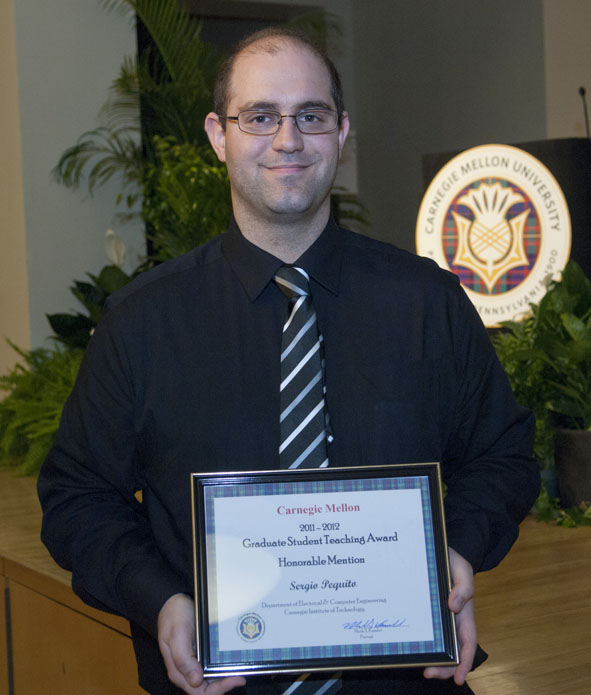
SergioPequito_AwardCeremony Sérgio Pequito is a young researcher that has been linked with the CMU Portugal Program since 2009. Eager to make the difference on his research field, and always available to foster and embrace new challenges, Sérgio Pequito finished his doctoral program in Electrical and Computer Engineering (ECE) last year, in 2014, at Instituto Superior Técnico (IST) and at Carnegie Mellon University (CMU).Sérgio Pequito’s dissertation title was: “A Structural Approach to Design, Analysis and Optimization of Large-Scale Dynamical Systems.” During his dual degree Ph.D., Sérgio Pequito was advised in Portugal by A. Pedro Aguiar (Faculdade de Engenharia of the Universidade do Porto) and Diogo Gomes (IST and Kaust University) and at CMU by Soummya Kar (ECE-CMU).

Design, analysis and optimization of large-scale dynamical systems are the research areas that Sérgio Pequito’s pursues now as a postdoctoral researcher at GRASP (General Robotics, Automation, Sensing and Perception) laboratory at the University of Pennsylvania. Every now and then he comes to Portugal to strengthen research links, by participating in meetings and giving seminars.

CMU Portugal: You were recently in Portugal to participate in research meetings and also to give a Seminar at IST about “Probes for Brain Dynamics Observability”. How do you think the research in this area is being investigated in Portugal?

Sérgio Pequito [SP]: Each time I come to Portugal I always give a talk. The thing I find interesting is that each time I come here I give a talk on a completely different topic so people wonder why. ‘Why are you now talking about brain? Why are you not doing something related to dynamical systems?’ It is interesting to show that you can use unconventional tools for us, engineers, in a completely different field. The most difficult aspect of doing so is the language. Sometimes people are talking about exactly the same but language is the problem. So there’s a need to put some effort in both sides and that is the challenge I want to communicate. Sergio_Pequito_Award

This [neurocontrol, i.e., the use of control theory in neuroscience] is a new topic that has a lot of potential, and there’s a lot of creativity here in Portugal, and a lot of talent and sometimes people underestimate themselves. Champalimaud Foundation has the Neuroscience Program that seems to be really cool, but it could be strengthen and benefit from a close collaboration with the engineering schools, such as Instituto Superior Técnico (IST).

CMU Portugal Program: Do you come to Portugal and visit Pittsburgh, where CMU is located, very often?

SP: I keep in touch with all of them, both through Skype as in person. So what happens is that I go to CMU almost every month, and I usually stay for two to four days, This way I know exactly what people are doing over there, and they know exactly what I have been doing, we also join efforts in order to understand if there is some kind of collaborations in a long run. With Pedro (António Pedro Aguiar, FEUP), something similar happens. I try to keep in touch with him every month; we have small talks through Skype. I give him an overview about what I have been doing regarding the work that is still pending from the Ph.D., as well as the new topics I have been involved with at the University of Pennsylvania. And finally with Diogo, I also keep in touch with him but a bit more occasionally. I am quite aware about what he is doing since he is also revisiting some of the things we were doing like five years ago because as the word says, it is research. So ‘re’-‘search’: search and search again. In summary, we keep in touch all the time, not only with my advisors, but also with my committee members as well, with whom I speak every month or so. After all, these days it’s more and more important to be networking.

CMU Portugal Program: Your research interests focus on design, analysis and optimization of large-scale dynamical systems. Do you see yourself working in this field in the upcoming years or do you have different plans for the future?

SP: I do imagine myself working in this field because it’s quite broad. The tools I developed during my Ph.D. were quite general so they can fit several topics that are hot topics these days. What we need to do is the language translation kind of thing. So the tools have been developed, now the question is how you are going to use these tools in looking to these different problems. I can tell you that the tools I developed during my Ph.D. they are not being used, for instance in these probes for brain; they are used to choose the leaders within the population of robots to drive the collection of these robots towards a specific goal. So the same tools are used in a variety of topics. Of course that we will never know what will happen tomorrow, but I can say that I believe that I will be working in the similar topics for the near future, at least the next five or six years.

CMU Portugal Program: In 2012, you mentioned that both a teaching career and working in industry were viable options. You are now a postdoctoral researcher at the University of Pennsylvania. What made you decide to pursue a research career?

SP: I had interviews with a couple of companies, but at the end of the day I really like to teach. During the last year of my Ph.D., I tutored some master students and I had the opportunity to advise students, and that was awesome because it is really interesting to see the evolution of the students. They start with small problems, and then they come with their own ideas. I have to struggle to understand exactly what they are saying and that’s very nice dynamic. This made me stay in the academia. But I can see the appeal in going into the industry, in particular, when the salaries are much higher than what we get as a post-doc researcher. But I always go for the things I believe in.

CMU Portugal Program: So, how has your experience at University of Pennsilvania been like so far?

SP: My experience so far has been awesome. First of all, I have all the autonomy I could expect and actually even more. We are very interdisciplinary, so everybody knows everybody and you can talk about everything. Sometimes you just chitchat during lunch and some nice ideas pop up. Suddenly, you are working in very interesting projects. For instance, when I arrived I heard about professor Danielle Bassett, who latter won the MacAuthur Fellow award [aka “Genius” award], and she was teaching a course in neuroscience, so I decided to sit in her class and try to understand about neuroscience. I sat, I learned about what they were doing and I also realized that there were a couple of problems that I would be able to contribute to. So, I started speaking with people around, and we are now working in some of these projects. The feedback all around, not only in the University of Pennsylvania, about this work has been great. So I could not expect more.

CMU Portugal Program: You finished your Ph.D. last year, so in looking back what are the key moments that you will never forget?

SP: I think the best and worst moments are somehow the same because those are moments when we are challenged. We are young, we have the feeling that we don’t know much about the field where we are getting our Ph.D.’s in. At a certain point we have to find out exactly what thrills us and we have to kind of go around, speak with people, be among others. And it can be rather challenging but once we find it, it is like: this is exactly what I wanted to do. That is definitely the moment. The other moments are also conflicting objectives, when you have deadlines to submit a paper. We work a lot, we get the result and then we feel that it is just one more paper, for example. But it’s always nice when we achieve all these small goals. And, finally, I think the best part is the people in the program. Everybody has some kind of aligned objectives, although people are working in completely different areas, and the kind of relationship that we have with the peers is priceless.

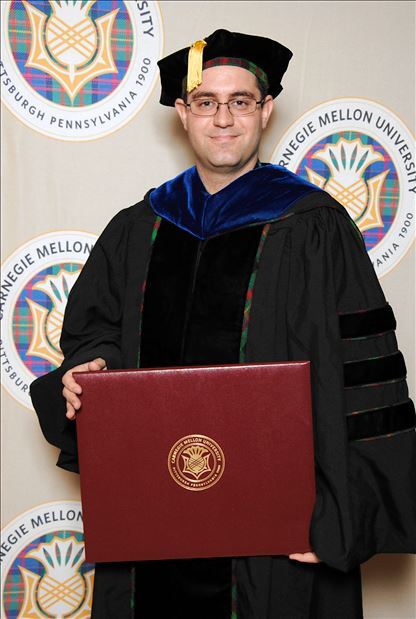
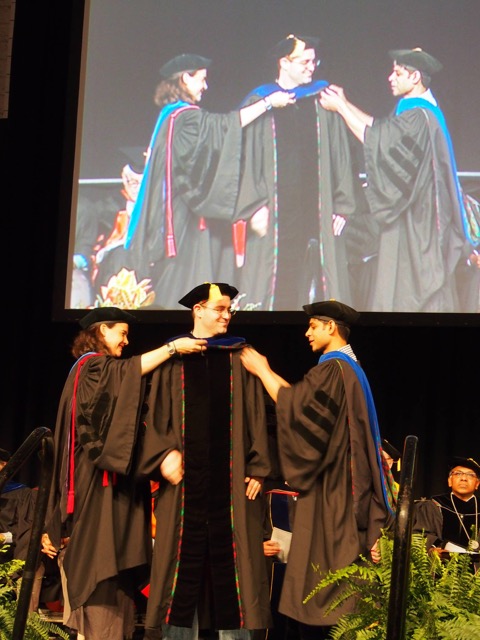
SergioPequito_Ceremony CMU Portugal: You have recently attended your Commencement Ceremony, how did it feel?SP: The commencement ceremony is a landmark in a person’s academic life. It is the public recognition that you have achieved the high academic standards. Further, it is a ceremony targets your family and aims to recognize all their efforts during this long endeavor that is the Ph.D.. Yet, it is only a beginning, since it comes with great responsibility, i.e., that of upholding the high standards across your scientific career, keeping in mind an ethic code, and the obligation of delivery this same message to those who we will teach. Therefore, I felt proud and a sense of mission that I make my best to fulfill.

July 2015

Alumnus André Martins – A Path Driven by Industry-University Collaboration

Alumnus André Martins, now working at Priberam, talks about his experience so far: A Path Driven by Industry-University Collaboration

Andre Martins The 5th Lisbon Machine Learning School starts today, in Lisbon, and finishes on July 23th, 2015. This is a key event in the Machine Learning field in the world, and one of its mentors is André Martins, our alumnus.

André Martins was the first graduate of the Language Technologies dual degree program at Instituto Superior Técnico (IST) and Carnegie Mellon University (CMU), in the scope of the CMU Portugal Program. During his studies, he was distinguished with a Best Paper Award in 2009, and the IBM Scientific Prize in 2011, having later interned at Google. When so many young researchers of his generation leave Portugal to look into for better opportunities, André Martins has chosen to stay in Portugal, and to return to the company where his career started: Priberam.

André had already been working with Priberam when he enrolled in the dual degree doctoral program, in 2007. After defending his dissertation, in May 2012, he returned with new ideas from that experience that included two years at CMU and an internship at Google for four months. Priberam Labs was one of the initiatives he spearheaded at the company, as a “bridge between industry and academia”, with the goal of putting into practice the best ideas in the field and creating new technology. It functions as an “innovation probe” that is now focusing on European projects.
One of the largest initiatives of Priberam Labs, mentored and stimulated by André Martins, is the Lisbon Machine Learning School, a week long summer school that is growing steadily in recognition and industry support. According to André Martins, it “fulfils a space in Machine Learning.” Its main purpose is to show students the latest research in the field, and have them share their work with each other; but mostly, to network with teachers, researchers and industry. This event is hosted by IST and the Spoken Language Systems Lab (L2F) of INESC-ID and sponsored by Google (that provides attendance scholarships), Priberam, Feedzai and Unbabel. André Martins credits the success of the summer school to the “core team” of speakers, like Noah Smith, from CMU, and Slav Petrov, from Google, that “consolidated the school.”

Another idea André Martins brought to Lisbon, inspired by his time at Carnegie Mellon during his PhD studies, are the Priberam Machine Learning Lunch Seminars, held every two weeks at IST. The objective is to “develop critical mass around certain topics” and provide the students with an opportunity to showcase their work and get comments on the work they are developing from peers, fostering initiative and autonomy. In their sixth academic year, the seminars have featured CMU faculty and CMU Portugal doctoral students, as well as industry people.

Keeping a close connection to academia, in particular his Portuguese alma mater, IST, is important to André Martins, where he “tries to contribute so that some of the things (practices) there can be done here.” Beyond the seminars, he advises doctoral students, including our dual degree Ph.D. student Zita Marinho. He also remains connected with his advisors, both at IST and CMU, by developing papers and overseeing Ph.D, students with João Paulo Costeira, and developing a new project with Noah Smith.

The time spent in Pittsburgh had a strong impact on André Martins, a “vibrant environment” from which he maintains many ties. The differences between the academic and corporate cultures of Portugal and the U.S. are what inspires him, “CMU has a strong connection to industry (…) a concept of doing things with a practical use.” He calls it “industrial research” which is an idea also very strong at Google, “they are obsessed with efficiency and the impact of their products.”

The Machine Learning and Computational Linguistics field is still a young one, especially in Portugal, and its research community is sparse. Research groups are emerging all over Europe in the recent years, but the multidisciplinary nature of the discipline means that are yet few graduates in Machine Learning itself. The CMU Portugal partnership’s Language Technologies program has had eight students since 2007, of which two have already graduated. André Martins was the first student accepted in this program, and the first student to graduate from it.

When asked why he stayed in Lisbon, when so many of his peers look for better opportunities in other countries, he simply replies, “I like being in Portugal”. “I feel a certain need to contribute, I have a sense of mission about it.”

July 2015

Master Student Paulo Bala Awarded First Place at CHI 2015

Dual Degree Professional Master in Entertainment Technology
Master Student Paulo Bala Awarded First Place at CHI 2015

CHI 2015 Paulo Bala MITI The innovative digital game ‘Keyewai: Last Meal,’ developed by a team of researchers from the M-ITI, won the first prize in the Innovative Interface category, at the Game Design Competition held during the 2015 CHI conference. Paulo Bala, a dual degree professional master student in Entertainment Technology, at Universidade da Madeira (UMa) and Carnegie Mellon University (CMU), led the research team that developed this game during an academic project.

In “Keyewai: Last Meal”, the players embody the role of a couple stuck on the Island of Keyewai and face its multiple dangers. The goal is to find scattered pieces of a broken radio, using only a flashlight, and assemble it to call for help. Team Keyewai, led by Paulo Bala, developed this innovative two-player computer game that is displayed in a holographic projection screen placed between the players. The game’s accompanying hardware also features two eye-trackers that detect the players’ gaze and highlights it in the screen, acting as the flashlight that the characters use in the game to reveal hidden objects. This interface design allows a novel playing experience with face-to-face social interaction and gaze-based interaction with the game.

Developed in five weeks, the game is just an academic project, according to its creators, with no aspirations to enter the market yet. Besides Paulo Bala, the team that developed the game within the Game Design class includes Lucília Nóbrega (Informatics Engineering – MEI), Guilherme Neves (MEI), Laís Lopes (Interactive Media Design – LDMI), Joana Morna (MEI), João Camacho (LDMI) and Cristina Freitas (LDMI). These students were co-supervised by faculty members and researchers Sergi Badia i Bermúdez, Yoram Chisik, and Monchu Chen, from M-ITI.

CHI is the world’s premiere conference on Human Factors in Computing Systems, organized by the Association for Computing Machinery and sponsored by some of the largest technology companies in the world. This is the fourth consecutive year that M-ITI students are awarded at the CHI conference. The conference took place in Seoul, South Korea in April.

In the scope of the CMU Portugal Program, MET is a dual master degree offered by the Entertainment Technology Center (ETC) at CMU and the Madeira Interactive-Technologies Institute (M-ITI) at University of Madeira (UMa).

April 2015

M-ITI Researcher Wins Best Ph.D. Student Award at SustainIT’2015

Dissertation Related to the SINAIS Project
M-ITI Researcher Wins Best Ph.D. Student Award at SustainIT’2015

Filipe Quintal

Filipe Quintal, researcher at the Madeira Interactive Technologies Institute (M-ITI), has recently won the Best Ph.D. Student Award at SustainIT’2015, with the paper “Exploring the Dimensions of Eco-feedback in the Wild.”

The paper, co-written with Nuno Nunes and Valentina Nisi, faculty members at Universidade da Madeira and researchers at M-ITI, presents the research conducted over the last three years in the area of eco-feedback systems, where the team collected and analyzed data from 30 homes in the Madeira Island. The results showed that, in the beginning, families using eco-feedback systems reduced their overall energy consumption. After four weeks of receiving information about the energy consumption in their homes, their attention to this information decreased. The eco-feedback system provided information through different devices (smartphones, tablets), and in different locations inside the house. The data collected showed that a few months later, the domestic consumption went back to the initial numbers. With these results, the authors showed new alternatives to keep consumers aware of their energy consumption, helping them reduce their ecological footprint.

This research, carried out in the scope of the SINAIS project, is very important in a time where the SmartGrid sector is investing in new ways to convince consumers to decrease energy consumption.

Besides being a researcher at M-ITI, Filipe Quintal is a Ph.D. student in Computer Engineering at Universidade da Madeira. His Ph.D. thesis, which addresses the use of technologies to reduce electric consumption in homes, began with a project developed within the CMU Portugal Program, funded by Fundação para a Ciência e a Tecnologia. A pilot test was implemented in 30 homes thanks to the partnership between CMU Portugal and Empresa de Electricidade da Madeira (Madeira’s electricity company).

The main goal of the 2015 SustainIT 2015 is to bring together researchers, professionals and application developers, both from industry and academia. It is one of the main international Information and Communication Technology forums applied to sustainable development research.

April 2015

Source: http://www.m-iti.org/node/2784

José Mariano Gago, Former Minister of Science, Technology and Higher Education, Dies at 66

José Mariano Gago, Former Minister of Science, Technology and Higher Education, Dies at 66

MGago at the 2009 CMU Portugal Program Conference
Mariano Gago at the 2009 Conference of the CMU Portugal Program
Prof. José Mariano Gago, Minister of Science, Technology and Higher Education between 1995 and 2002, and between 2005 and 2011, died on Friday, April 17, in Lisbon.

Prof. Mariano Gago graduated in Electrical Engineering from Instituto Superior Técnico (IST), in Lisbon, in 1971 and received a Ph.D. in Physics from the École Polytechnique – Université Pierre et Marie Curie, in Paris, in 1976. After a research appointment at CERN, in Geneva, between 1976 and 1978, he became a Professor at IST, and founded and chaired the Portuguese Laboratory for Particle Physics (LIP).

While Minister of Science, he set the foundations for the extraordinary development of Science and Technology in Portugal in the past two decades, and led the reform of the country’s Higher Education system. He also launched the Ciência Viva movement to promote the scientific and technological education of the Portuguese society.

It was under the leadership of Prof. Mariano Gago that the international partnerships with U.S. universities were launched, aiming at contributing to the internationalization of Portuguese universities and research organizations, increasing cooperation between Portuguese institutions, increasing access to high-tech R&D equipment, and promoting cultural change in the Portuguese R&D sector.

Mariano Gago with Students at CMU
Mariano Gago’s Visit to CMU in 2010

The Portuguese scientific community will honor Prof. José Mariano Gago next Monday, April 20, 2015. Researchers and other members of research centers and universities are invited to gather in front of the main doorways of their institutions for five minutes, at noon, as a public tribute to his outstanding contribution to science in Portugal.

Sources:

http://www.fct.pt/noticias/index.phtml.pt?id=109&/2015/4/José_Mariano_Gago_(1948_-_2015)

http://act.fct.pt/historia-da-ciencia/protagonistas/jose-mariano-gago-1948/

April 18th, 2015