
Pedro Oliveira’s Paper Receives 2nd Best Paper Award Innovation Management 2011

Pedro Oliveira’s Paper Receives 2 nd Best Paper Award Innovation Management 2011

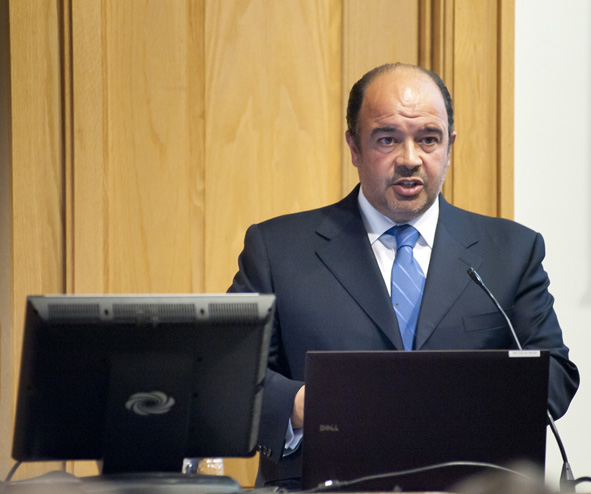
Pedro Oliveira Best Paper Award 2011 1 The paper “Users as Service Innovators: The Case of Banking Services“, Research Policy, 40 (6), 806-818) written by Pedro Oliveira, professor at the Católica – Lisbon School of Business and Economics and coordinator of the the Doctoral Program in Technological Change and Entrepreneurship (TCE), and Eric von Hippel, from Sloan School of Management (MIT), has won the 2 nd Best Paper Award Innovation Management 2011. The paper was selected out of over 40 recently published papers and the final round was held at the EBS Business School in Germany on July 26 th , where the three finalists of this challenge presented their papers.

“To the best of our knowledge this was the first study that focused on user innovation in services,” said Pedro Oliveira adding that “our findings contradict the producer-centered views of innovation management.” The authors speculate that the patterns observed in banking with respect to the major role of users in service development will prove to be quite general, and if so, “this will be an important matter: on the order of 75% of GDP in advanced economies today is derived from services.”

In the study Oliveira and von Hippel found that users (both retail and corporate users) often develop and self-provide important services before banks begin to offer them. “In 55% of commercial banking services in our sample, user firms developed and self-provided computerized versions of the services earlier than banks offered them.” The authors gave the example of the computerized payroll processing that was first developed and used in the early 1950’s as a self-service by J. Lyons and Co, a major baking and catering firm in the UK. “In 44% of retail banking services in our sample, we found that individual users of retail bank services had developed and self-provided computerized versions of these services before banks or other types of service providers offered them.” Oliveira and von Hippel gave the example of the computerized aggregation of account information across multiple institutions which was first implemented by individual “hackers” for their own use in the 1980’s. “In the case of manual versions of banking services: 92% of corporate banking services and 80% of retail services were developed and self-provided by users before being offered by banks,” said Pedro Oliveira.

The authors analyzed the period from 1975 to 2010 in the US commercial banks ”for two reasons: by looking at more recent service innovations we expect to find better data on the sources of innovation. Also, during this period banks and banking users were engaged in heavy investments in computerization of their processes,” therefore Pedro Oliveira and von Hippel expected to find a large number of software-based financial services introduced in this period. Pedro Oliveira continues: “most of the services are also available in Portugal and other countries and the results hold across borders.” In fact the authors have had the support of a major Portuguese bank for their research.

“The award was based not just on scientific merit but mainly on ‘managerial relevance’ and half of the members of the jury were from representatives from industry,” said Pedro Oliveira adding he was pleased with this award “due to the very high quality of the other finalists in this competition.”

For Pedro Oliveira and Eric von Hippel “there are clear practical implications of our findings for service producers seeking to innovate,” like “it is useful to recognize that service innovations, just as is the case for product innovations, are often first developed by lead users.”

Pedro Oliveira Best Paper Award 2011

“User Innovators” in the Development of Telecom Products and Services
This study about users as service innovations of banking services “motivated us to look at the role of users in developing new products and services for telecom and Information and Communication Technologies (ICT).” The truth is that when the authors talk about innovation in banking services, they are aware that many of these new services are built upon other ICT and telecom products and services. Therefore, Pedro Oliveira and Francisco Veloso, from Carnegie Mellon University, decided to carry out a new research project entitled “The Role of ‘User Innovators’ in the Development of Telecom Products and Services”, which has this issue as a major focus. The project is funded by the Carnegie Mellon Portugal Program, through the Fundação para a Ciência e a Tecnologia.

It involves the Universidade Católica Portuguesa (UNICEE/FCEE/UCP), Faculdade de Economia da Universidade Nova de Lisboa (FE/UNL), ISR Lisboa, Carnegie Mellon University (CMU), and the companies Ericsson Nikola Tesla and Nokia Siemens Networks. A study that it “is only possible due to the support of the Carnegie Mellon Portugal program,” said Oliveira. Pedro Oliveira and Francisco Veloso are the principal investigators of this project which involves several dual degree Ph.D. students namely Paul van der Boor (Technological Change and Entrepreneurship), Leid Zejnilovic (Technological Change and Entrepreneurship), Miguel Godinho (Engineering and Public Policy), Moinul Zaber (Engineering and Public Policy), Rodrigo Belo (Technological Change and Entrepreneurship).

August, 2011

“I Want to Give Eyes to the CoBot Robot”

“I Want to Give Eyes to the CoBot Robot”

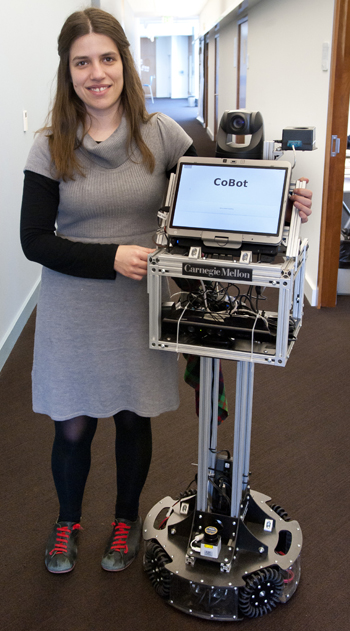
Susana Brandao with the CoBot robot CoBot is a robot carried out by the research team of Manuela Veloso, at Carnegie Mellon University. The goal of this team is to contribute to a multi-robot, multi-human symbiotic relationship, in which robots and humans coordinate and cooperate as a function of their limitations and strength.Susana Brandão, a dual degree doctoral student in Electrical and Computer Engineering (ECE), co-advised by Manuela Veloso at CMU and João Paulo Costeira, from Instituto Superior Técnico da Universidade Técnica de Lisboa (IST/UTL), is working with this robot and believes that she will help CoBot to “see” in the future.

Susana Brandão started her Ph.D. in 2009/2010 in Portugal, at Instituto Superior Técnico da Universidade Técnica da Lisboa (IST/UTL), through the Carnegie Mellon Portugal Program, funded by the Fundação para a Ciência e a Tecnologia. In the fall 2010 she went to Carnegie Mellon University. In looking back, five months behind, she was able to go by several challenges: “I wrote two papers, passed my qualifier exam, was teacher assistant in a Robotics Lab for undergraduates, and finished all the courses,” said Susana Brandão explaining that “the last four months were a marathon, but now I can be a hundred percent devoted to my research and doctoral thesis.”

During this time at IST/UTL and at Carnegie Mellon, Susana Brandão made some findings; she discovered an algorithm which combines offline with real-time images in a very effective way. She used the robot soccer team, also from Manuela Veloso research team, and made some tests using a regression learning approach. In fact, she described her results in the paper “Detection of Rotational-Invariant Objects through Regression,” wrote with her two co-advisors, João Paulo Costeira and Manuela Veloso, and published in the Proceedings of the 5 th Workshop on Humanoid Soccer Robots @ Humanoids 2010. In their paper, they explained the regression learning approach which consists “in two main phases: (i) off-line training, where the objects are automatically labeled off-line by existing techniques, resulting in learned object models through regression, and (ii) online detection, where a given image is efficiently processed in real-time with respect to the learned models.” The authors showed that “in robot soccer, it is possible to leverage past experience to create simple and adequate models of objects without the need of computationally expensive algorithms nor explicit modeling of objects.” They also found that by accumulating past images and using the current state of the art algorithms to provide ground truth, the robots gained access to an unlimited number of labeled data which can be used for training the coefficients of a regression. The resulting algorithm is faster than the one used for training but without affecting precision considerably. Furthermore, the algorithm is capable of identifying its own error, which allows for online validation of its results.

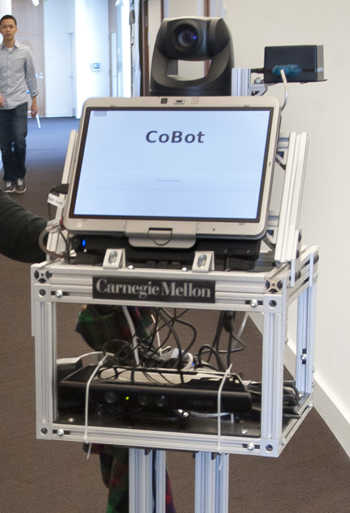
Therefore, Susana Brandão believes that it will be possible to adapt this algorithm and to make it work on the CoBot robot. The research team expects that Cobot will be a fully autonomous robot that will do multiple tasks in our everyday life. It has a multidirectional base which allows it to roll forward, backward and sideways and a platform that holds a Microsoft Kinect sensor and a tablet PC that runs software.CoBot2 can be operated remotely or locally through the same web-based interface. Susana Brandão is working specifically with the Microsoft Kinect, which gives CoBot the opportunity to distinguish image depth and light identity. Researcher in computer vision, Susana Brandão will join these characteristics to the research field in object recognition. The goal is that the CoBot can see besides pixels, i.e., Susana Brandão expects the robot to identify the entire environment. Cobot Robot

From July 5 to 11, 2011, Susana Brandão made a poster presentation at the RoboCup 2011 about “Fast Object Detection by Regression in Robot Soccer”. The paper was written by this doctoral student with her two advisors João Paulo Costeira and Manuela Veloso.

July 2011

Cloud Computing and the Malicious Insider


Francisco Liberal Rocha Francisco Rocha, alumnus of the Carnegie Mellon Portugal Program, and Miguel Correia, researcher at Universidade de Lisboa, presented a paper titled “Lucy in the Sky without Diamonds: Stealing Confidential Data in the Cloud,” at the First International Workshop on Dependability of Clouds, Data Centers and Virtual Computing Environments (DCDV 2011) [http://www.cse.ust.hk/DCDV2011/program.html], in conjunction with the 41 st Annual IEEE/IFIP International Conference on Dependable Systems and Networks (DSN 2011). The conference was held on June 27, 2011, in Hong Kong, China.

This paper results from Francisco Rocha thesis, titled “Privacy in Cloud Computing”, developed in the scope of the Master program in Information Technology – Information Security. After finishing his professional master program, Rocha continued to work with Miguel Correia, his advisor during the course, and to pursue research in the cloud computing area. His thesis focused on one of the threats that cloud computing faces, i.e., “the malicious insider”. Francisco Rocha in his thesis described that a “malicious insider could be, for example, an administrator of the cloud that goes rogue and as root access to the servers that compose the cloud.” Francisco explained that these kinds of attacks are difficult to quantify, because “when they happen companies do not want the media to report them or else their public image will be deeply affected.” Recently, this alumnus read that an administrator was convicted for compromising the servers of his previous employer.

One of the main conclusions of his thesis was that “current cloud computing services cannot be relied on to provide high confidentiality levels to the information entrusted to them by cloud users, why?,” explaining that “because the technology they use is not enough to assure the best security levels in this type of services.” Rocha continues: “in my opinion, we need to have trusted computing involved if we want to obtain a more trustworthy cloud environment. With trusted computing we can verify the integrity of code running in a machine; this is a very useful resource.”

The paper “Lucy in the Sky without Diamonds: Stealing Confidential Data in the Cloud” that Francisco Rocha will present at the First International Workshop on Dependability of Clouds, Data Centers and Virtual Computing Environments, shows that a malicious insider can steal confidential data of the cloud user, so the user is mostly left with trusting the cloud provider. In the author’s opinion, “the paper achieves this goal by showing a set of attacks that demonstrate how a malicious insider can easily obtain passwords, cryptographic keys, files and other confidential data.” Additionally, the paper shows that recent research results that might be useful to protect data in the cloud, are still not enough to deal with the problem.

Francisco Rocha believes that cloud computing is here to stay, and that industry is pushing the utilization of the cloud. Therefore, it is necessary to be aware of the problems that come with the adoption of this paradigm and to be sure of the security levels it offers before moving sensitive data (e.g., medical records) to the cloud. Therefore, he believes that “the path to follow is trusted computing”. “If we are able to come up with an architecture that is capable of providing proofs of integrity for the running software, we have a more secure system” Rocha adds. However, when companies have complex software this is not enough because the software will always contain vulnerabilities. This means that we should also use mechanisms to remove as much vulnerabilities as possible.

July 2011

2011 MSE Welcome Session: “Our Expectations are that Students Meet Their Expectations”

2011 MSE Welcome Session: “Our Expectations are that Students Meet Their Expectations”

MSE 2011 Welcome Session On June 9, 2011, the Universidade de Coimbra organized the 2011 Welcome Session for the newly enrolled students in the Professional Master program in Software Engineering (MSE). This session is organized every year by the MSE team and involves faculty, students, and alumni.

The goal of this session was to give to the new students an overview of the Program, as well as to provide some advices about the proceedings and challenges that they will have during the program. The presentations were made by Marco Vieira, the coordinator of the Program, and by one current student.

“Our expectations are that students meet their expectations!” said Marco Vieira, coordinator of the MSE Program, adding that “we want them to learn not only to deal with projects and all the technical part, but to survive dealing with teams and to get the necessary skills to overcome problems.” Marco Vieira believes that this professional program helps to develop the country through industries and continues: “we need people able to change industry, and our MSE students are the right ones to do that – that is what we prepare them for.”

The session was held at the Department of Informatics Engineering at the Faculdade de Ciências e Tecnologia da Universidade de Coimbra (FCTUC), and it was attended by several newly enrolled and current MSE students, alumnus, António Damasceno, faculty and staff, while two newly enrolled students participated in the session via skype. After the session, the new students visited the Department’s facilities.

The MSE is a dual degree program taught by the Universidade de Coimbra (UC) and Carnegie Mellon University, funded by the Carnegie Mellon Portugal Program, Fundação para a Ciência e a Tecnologia (FCT). In five years, this professional master become a reference in some companies that usual fund the training of their collaborators, such as Portugal Telecom, Novabase, Critical Software, among others.

June 2011

Send your story to news@cmuportugal.org .

Doctoral Students Do Research in Different Engineering and Public Policy Problems

Doctoral Students Do Research in Different Engineering and Public Policy Problems
EPP Students Group

The passion for Engineering and Public Policy (EPP) is a common thing to Colleen Horin, Alexandre Mateus and Brandon Mauch. Horin and Mauch are dual degree doctoral students, in the second and third year respectively. Alexandre Mateus finished his Ph.D. program in April and became the first graduate in the dual degree Ph.D. program of the Carnegie Mellon Portugal program.

Alexandre Mateus May 2011 Alexandre Mateus enrolled in Carnegie Mellon University in 2006. Later he found out about the Carnegie Mellon Portugal program and he decided to became a part of this partnership. Four and a half years later he graduated. An experience that he considers “rewarding”. Advised by two professors, Pedro Ferreira (Instituto Superior Técnico da Universidade Técnica de Lisboa) and Jon Peha (Carnegie Mellon University), Mateus studied the Copyright Violation on the Internet: Extent and Approaches to Detection and Deterrence.

Mateus says that “it is not possible to determine with accuracy the impact of Peer-to-Peer (P2P) file-sharing on sales, but it is common to say that P2P leads to fewer sales.” Mateus’ work yielded significant findings that can contribute to a better understanding of the impact of Peer-to-Peer on sales of content and to enhance the effectiveness of Deep Packet Inspection (DPI). Most of the claims are made by Music, Movie, TV, Book and Software industries. Based on the network data collected using deep packet inspection from a large-scale quantitative assessment of online exchanges of copyrighted material at the University of Illinois, Mateus found out that usually students became P2P users prior to college, and they obtain “a diverse mix of content from P2P [including music, video and software] with a heavy-tailed distribution of popularity, but close to one fourth of P2P users also purchased content from the iTunes Store, each buying about as much as iTunes Store customers who didn’t use P2P.” On the other hand, the research team found out that “current DPI technology identifies most users attempting to transfer copyrighted material, out of users whose P2P traffic it can detect.” In the future, Mateus would like to work in this area because he knows that efficient policy can improve people’s life. Based on the network data collected using deep packet inspection from a large-scale quantitative assessment of online exchanges of copyrighted material at the University of Illinois, Mateus found out that usually students became P2P users prior to college, and they obtain “a diverse mix of content from P2P [including music, video and software] with a heavy-tailed distribution of popularity, but close to one fourth of P2P users also purchased content from the iTunes Store, each buying about as much as iTunes Store customers who didn’t use P2P.”
Reconfigurable Networks and Integration of Intermittent Renewable Energy

Colleen Horin became a dual degree Ph.D. student in EPP, at Instituto Superior Técnico da Universidade Técnica de Lisboa (IST/UTL) and at Carnegie Mellon University, in 2009. Horin has a Bachelor’s degree in Aerospace Engineering from MIT and a Master’s in EPP from the University of Maryland. Her goal is to show that reconfiguration allows a grid operator to reduce operational losses and costs as well as accept more wind than a static configuration can. Therefore, she is repeating the analysis using data from a solar photovoltaic (PV) generator instead of a wind farm. Horin explains that “net present value analysis of automated switch technology shows that the return on investment when using reconfiguration for loss reduction is not positive under most conditions, but would be very attractive when reconfiguration is used to minimize wind curtailment.”

Colleen Horin is also interested in studying the effects of the electricity sector on electric cars. While she was at the University of Maryland, she carried out research to detect the effects of Vehicle-to-Grid (V2G) Technology on the Electricity Grid in Washington DC. During this study, she found out that to maximize social benefit from V2G system, plug-in hybrid electric vehicle (PHEV) purchases and optimal charging patterns must be encouraged, and charging infrastructure should be created. On the other hand, V2G reduces costs of operating the electricity grid, enables large deployment of variable renewable, efficient adaptation to carbon prices, and the adoption of PHEVs, and V2G improves utilization of existing assets, reducing need for additional generating and transmission capital expenditures.

During this study, Horin found ideas about what kind of research should be conducted in the near future: it is necessary to understand the most effective distribution of V2G benefits amongst utilities and consumers, funds required to develop changing infrastructure, appropriate subsidy levels to encourage PHEV adoption, hourly price signals to ensure desired consumers charge in an optimal fashion. Colleen Horin May 2011

Wind Power, Energy Policy and Decision Making Under Uncertainty
Enrolled in 2008, Brandon Mauch is now in his third year as a dual degree doctoral student in EPP, at IST/UTL and at CMU. Mauch holds a BS. in Mechanical Engineering from University of Kansas, and a MS. in Mechanical Engineering from University of Wisconsin – Madison. Like Colleen Horin, Brandon Mauch is carrying out research in the energy domain. His goal is to learn the cost of managing wind forecast uncertainty.

Brandon Mauch May 2011 Mauch considers that “wind power uncertainty creates reliability problems for electric grids.” “I am examining a way to deal with this uncertainty,” Mauch explains and adds “the first part of this project was to model the economics of collocating energy storage with a wind farm in order to sell wind power in the day-ahead electricity market.” Currently, he is working to quantify the cost that short term wind forecast errors impose on an electric grid. During his research, Mauch discovered that although forecasting models are becoming better at predicting wind power, uncertainty will always exist. Therefore, “the ability to determine probabilities of wind shortfalls for different conditions and incorporating these probabilistic models into reserve requirement calculations, will allow more effective use of energy resources.”

Furthermore, Mauch with his advisors Paulo Carvalho (IST/UTL) and Jay Apt (CMU), wrote a paper titled “Can a Wind Farm with Storage Survive in the Day-Ahead Market?” The research team concluded that: “At current electricity prices, selling wind power on the day-ahead market is not justifiable without subsidies.” Additionally, when they estimated electricity prices to include a carbon cost, they found that “revenue is still not enough to cover costs. Income from the day‐ahead market alone is not sufficient for wind with CAES without financial assistance.” However, “storage will provide additional income on Regulation Markets and on the Capacity Markets,” they think.

Brandon Mauch already started his internship at BOSH – Research and Technology Center, in Pittsburgh. His goal is to “try to understand how industry values the management of the demand side, and which appliances can be configured to control the reliability”. This internship will finish on August, and in September 2011, he will return to Portugal.

June 2011

Alexandre Mateus Completes Dual-Degree in April as Program’s First Ph.D. Graduate

In April 2011, Alexandre Mateus will be the first Ph.D. student to graduate from the Carnegie Mellon Portugal dual-degree Ph.D. Program. He began work on his doctorate, which is in Engineering and Public Policy, in 2006, the same year the Carnegie Mellon Portugal Program was established. Despite the significance of this milestone, Mateus keeps a sense of humor about his accomplishment.

“There’s no doubt,” he said. “Well, the doubt is if I end up taking too long, I may not be the first!”

Mateus is not a “typical” Carnegie Mellon Portugal student in that he actually began his doctorate solely in Carnegie Mellon’s Ph.D. in EPP program. He heard about the Carnegie Mellon Portugal Program in late 2008, almost two years into his degree, from Pedro Ferreira, who had worked with Mateus on his Masters in Engineering Policy and Management at the Instituto Superior Técnico (IST), Universidade Técnica de Lisboa.

Mateus entered the Program in the summer of 2008. He stayed at Carnegie Mellon until the end of that fall. In the Spring 2009 semester, he traveled to Portugal to finish out his degree. Mateus still returns to Pittsburgh every few months to meet with his advisors, but he considers IST his base, saying, “That’s where I have a desk.” Students who begin in the Program, unlike Mateus, begin their degree in Lisbon and move to Carnegie Mellon in their second year.

“At the time, I wanted to spend time in Portugal,” said Mateus, who is originally from Lisbon. He added, laughing, “And I was sick of qualifiers.”

Qualifiers are a milestone in any Ph.D. candidate’s career. One and a half years into the program, EPP students go through a two part exam: one part is producing and defending a paper, and the other is a six day test during which time the student must come up with a solution to a relevant EPP problem. Students are given all of the pertinent information to solve the problem, but must analyze technological, social, legal, and economic aspects on their own.

“Mine was actually kind of easy,” he said. “You relate to some problems more than others.”

The question dealt with the restriction of cell-phone usage and the technological and legislative issues surrounding it. For example, high-security facilities, ER rooms, airplanes, or even restaurants or movie theatres might all want to restrict cell-phone usage within their premises. Various technologies can ensure this restriction, but this raises questions of personal freedoms, emergencies in which a cell-phone would be necessary, and even whether such restrictions would affect the business of cell-phone operators. Such technology might even require everyone to have a new type of cell-phone, a problem of money and logistics. “It’s a really interesting experience,” said Mateus.

While completing his degree, Mateus wrote two research papers and is expecting to write a third before graduating. Of his previous papers, both have been submitted to journals and one is in the advanced stages of review. The final obstacle between Mateus and his Ph.D. is to write and defend his thesis.

“We [my advisors and I] are still putting things together,” said Mateus, “but it will certainly have to do with online distribution of content”

One example of this is peer to peer systems, which put a lot of pressure networks because users send more information than the network is designed to support. Mateus’s interest in this problem is twofold. On one hand, there are technological approaches to decreasing traffic and increasing efficiency that are deserving of exploration. On the other hand, there are myriad legislative questions that surround the problem, dea-ling with issues of illegal technologies and their counter-measures.

During the thesis process, students give a presentation to their advisors and select faculty members that outlines their plans. This thesis proposal is a tool to garner constructive feedback and usually occurs in person, with all faculty members present. Mateus, however, will be completing his thesis proposal over video and telephone conference because his advisors will be truly all over the world: Portugal, London, Washington, D.C., Pittsburgh, and Berkeley.

“I think it’s a sign of the times,” he said.

Also, perhaps, a sign of strengthening international ties within the Program, which is built on a precedent of a mutually beneficial partnership between Carnegie Mellon and its Portuguese affiliates. Mateus said that he thinks “it is a good initiative to bring some change to Portuguese universities,” which tend are traditionally hierarchical and focused on excellence in a single discipline. He said that the Program brings together people with different ideas of how a university should work and how collaboration can occur.

“Your work will always be mixed with something else,” Mateus said, “and produce something that’s more than the sum of individual contribution.”

July, 2010

Eight Portuguese MSE Students Spent Spring Semester at CMU

Eight Portuguese MSE Students Spent the Spring Semester at CMU

MSE Students 2011 Spring at CMU From January to April, 2011, eight students enrolled in the dual degree Professional Masters in Software Engineering (MSE) were in Pittsburgh to make their second semester in the Carnegie Mellon Portugal Program. They spent the spring semester at Carnegie Mellon University before returning to the Universidade de Coimbra, Portugal, to complete the degree.

The MSE program is comprised of 16 months of both course work and a studio project. Students begin their studies in the fall semester at the Universidade de Coimbra, moving to Carnegie Mellon in the Spring. Upon graduation the following December, they receive a diploma from both institutions in Software Engineering.

Hugo Cabral is one of the eight students. The program is designed to expose students to a multi-cultural environment, thus strengthening their communication and leadership skills. As a newcomer the Carnegie Mellon campus, Cabral is embracing the experience.

“We have had a lot of opportunities [at Carnegie Mellon],” Cabral says. “There was a real sense of a lot of things happening here.”

The dual degree component also allows students to come in contact with a diverse array of teaching and learning styles. Many students, like Joao Osorio, find the program to be intensely challenging for this reason. Osorio says that his experience in the program so far has been “very different from both my previous studying and working experiences.”

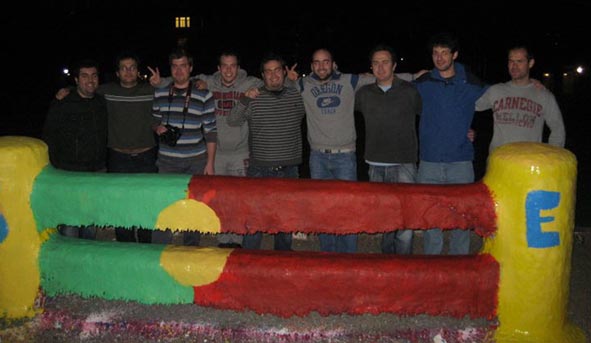
MSE Students 2011 Spring Semester The MSE Portuguese students participated in a tradition at Carnegie Mellon which involves a fence and paint. The fence is the most painted object on campus, and lies in the middle of the Cut, so it is visible to all students and faculty. The Portuguese students followed the tradition and painted the fence with the colors of the Portuguese flag.

A key aspect of the program is the studio project, which allows students to work closely with one of the Partnership’s corporate affiliates in developing and implementing a real-world project. Osorio and Paulo Patricio are currently working with Novabase, a provider of information technology services in Portugal, to develop a project called “Social Insight,” which aims to They will use the rigorous summer semester that follows their stay at Carnegie Mellon to focus on this project.

This relationship between the Partnership and its industry affiliates is an important part of the program. Many students find their way to the program having already worked at an industry affiliate; others find employment with industry affiliates through the program. Cabral, having come to the program as an employee of Portugal Telecom, will return to the company and act as an “agent of change.” Patricio has plans to work with Novabase upon graduation. Patricio also says that he would highly recommend this program.

“I have the chance to meet very different people,” he says. “Starting with the professors and mentors, going through all the support personnel and ending with the worldwide students.”

May 2011

Portuguese CEO Gave a Lecture at the Carnegie Mellon through the Engineering Leadership Speaker Series

Portuguese CEO Gave Lecture at the Carnegie Mellon through the Engineering Leadership Speaker Series

Rodrigo Costa Zon CEO April 2011 Rodrigo Costa, CEO of ZON Multimédia, SGPS spoke to an audience of faculty, staff, and graduate students about key aspects of effective management and the growth of his company on April 19, 2011. His presentation was entitled “Innovate, Compete, Motivate.”

Costa was a visionary as it relates to the development of the Carnegie Mellon Portugal Program, “who made it happen” said the Dean of CIT Pradeep Khosla, who introduced Costa. “He was a person with execution.”

ZON is currently the largest Triple Play operator (TV, Broadband Internet, and Fixed Telephony) in Portugal. The company has over 700,000 customers in the area of Broadband internet and has made innovative advances with the launch of its 360 Mbps and 1Gbps ZON Fibra bundles. The company launched a 3D channel in April 2010 making it a pioneer in true 3D technology. ZON emerged as a spin-off of Portugal Telecom.

Costa noted that in its earliest years, ZON was largely regarded as a poor customer service organization. He joked that people doing case studies would often find common ground in their shared opinion of just how “terrible” the service was. However, the company has only grown in size and influence being the only telecom company in Portugal that grew in revenue in the last three years. In April, this year ZON is ranked as one of the top performers in the Portugal stock market.

How did Costa ensure his company’s subsequent improvement? He says that he took to carrying comment cards with him so that every time a disgruntled customer complained to him about bad service he would have them write it down with their contact information, promising that he would personally see to the problem and then follow up with them. This is the kind of transparency and customer service that he strives to maintain even as ZON continues to grow.

“I probably give more advice than I take,” he said. “but overall … I think I am a good listener.”

Effective management also plays a key role in the success of any company, according to Costa. He said that good management requires thorough understanding, thoughtful planning, and “making sure we can understand all deviations” from that plan. There is a time and a place for chaos, he said, but that the key is in knowing where chaos can occur.

Costa is team-oriented and sees working with others as a reward. Collaboration and human resources were a key topic in his presentation. In Costa’s business philosophy, every individual who contributes has the potential to be a key contributor and/or leader. He encouraged audience members to respect and reward employees, to give them reason to have positive feelings about the company.

“Life is not just about money; life is about many other things that people value,” Costa said. “We need to feel good about the system we are creating and maintaining.”
Costa also commented on the importance of understanding people’s weaknesses and strengths as well as firmness in making all of the difficult decisions that come along with hiring, firing, and running a company. At the same time, he emphasized the importance of facilitating innovation and creative thinking among employees. He encouraged the audience to see every experience as a learning opportunity, to “make your brain work.” This is especially important as it relates to management and leadership.

“Let people talk,” he said, “let people dream. Create an environment that breeds imagination and creativity.”

Costa cited competition as a key factor in growth and innovation. He told audience members that his philosophy was not just to do “better,” but to do “different”—really give the competition a run for their money. Competition is universal, he said, and he has tried to use that to his advantage.

“I have a ten times better company today just because I had competition,” Costa said. “You die if you don’t move.”

This lecture was part of the Carnegie Mellon Engineering Leadership Speaker Series, a recent Carnegie Institute of Technology initiative. The series aims to bring two to three CEOs to campus every semester to offer insights into effective leadership. Following the lecture was a panel discussion with Costa, Pedro Ferreira, Assistant Research Professor at CMU, and Rahul Telang, Assistant Professor of Information Systems. Rodrigo Costa CEO ZON April 2011 b

May, 2011

How Should We Value the University Assets?

How Should We Value the University Assets?

Workshop May 2011 Specialists from the Carnegie Mellon University (CMU) visited Aveiro to present some of the best current practices in negotiation and valuation of assets created within academic contexts, such as new products, services and new start-ups. The workshop was titled «Valuation of Intangibles – Valuation of Licensing Opportunities and Early Stage Companies» and took place at the Technology Transfer Unit (UPTEC) of the Universidade de Aveiro on 10th and 11th May, 2011.

The debates covered various aspects such as capital gains, the benefits that universities can gain from start-ups and the importance of attracting entrepreneurial investors. How universities approach investors to request funding or their ability to develop business plans for new start-up companies were some of the themes discussed over the two days. Tara Branstad and Barbara Carryer, both specialists in entrepreneurialism and technology transfer at CMU, presented different models of business strategies that coincide with the objectives of the new companies and also capitalise on and optimise the advantages of inventions or creations developed at universities.

Through his own personal experience from creating five successful companies Raymond F. Vennare, the president and CEO of ThermalTherapeutic Systems, an entrepreneur and investor, demonstrated real life examples. He demonstrated how an investor or professor should present their product and/or business in terms of competitive advantages, market differentiation, the costs involved (direct and indirect), expectations and valuation – a concrete number that shows the company’s potential and their future returns. This plays a fundamental role in raising funds and in the negotiating processes with investors.

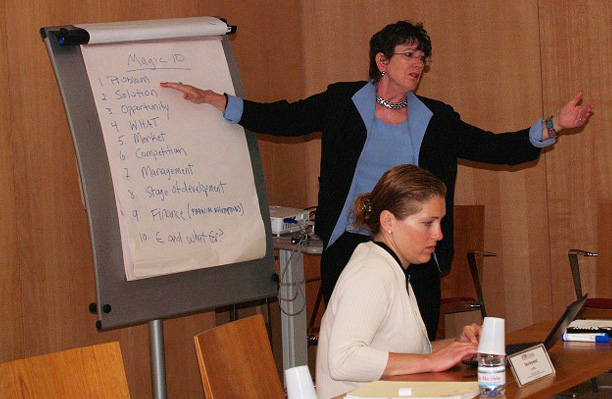
Barbara Carryer, an Adjunct Professor in entrepreneurialism and innovation advisor at the Institute of Social Innovation at CMU, highlighted how entrepreneurialism has become more apparent in universities: “the youths of today have a strong entrepreneurial spirit and we therefore need to look to the senior researchers because they are the ones that do not come looking for us as frequently”.

Workshop May 2011 group Close to 40 individuals attended the workshop including young entrepreneurs, managers of technology transfer offices at universities, professors and researchers, as well as start-up companies and large companies such as Treat U and PT Inovação respectively. The workshop looked at various case studies on subjects such as licensing processes, protecting individual property rights and valuation for start-up companies, approaching the different variables involved that are relevant for each subject.

This initiative was organised by the UTEN Portugal network in partnership with the Carnegie Mellon Portugal Programme and aims to raise awareness of the importance of adequate valuation and evaluation of tangibles for start-up companies and the information that is required for this process.

In addition to sharing CMU’s knowledge and experience in this area, the workshop was also an opportunity to encourage flexibility in evaluation and valuation processes for tangible assets. It presented various methods to help universities maximise the profits on their inventions and research results, for example through raising capital, licensing, joint-ventures or sales.

This workshop is part of a group of initiatives that was launched in 2009 within the framework of the UTEN Portugal network to strengthen knowledge and competencies in technology transfer and the commercialisation of technology in Portugal in an international context.

May 2011