Mobility Initiatives Empower Academic Community


Mobility Initiatives Empower Academic Community

Ian Oakley Ian Oakley, an assistant professor at the Madeira Interactive Technologies Institute of the Universidade da Madeira, was at the Human Computer Interaction Institute (HCII) at Carnegie Mellon University during the fall of 2012, as part of the exchange program of the Carnegie Mellon Portugal. According to the professor, ”the experience was inspiring, practically and culturally speaking,” and he strongly recommends it to other faculty members.

Between August 29 and December 21, Oakley took part in research, teaching and service activities. In the research component, he co-supervises the work of Christian Koehler, a dual degree doctoral student in Electrical and Computer Engineering, in collaboration with Anind Dey of the Human Computer Interaction Institute (HCII) at Carnegie Mellon University (CMU). “My visit allowed me to engage very closely with Christian’s ongoing work on indoor location prediction,” Oakley stated. Christian Koehler is conducting an extensive data analysis comparing the performance of a range of machine learning algorithms and analytic perspectives on both existing location data sets and one captured from participants in the Gates-Hillman Center at Carnegie Mellon. The weekly meetings with Christian Koehler “refined his research process and direction,” stated the assistant professor. The two of them are currently preparing a paper on the subject to be submitted in the spring.

Furthermore, Oakley advised two student groups of Jason Hong in the area of novel security and authentication interfaces and regularly attended a wide range of HCII research group meetings. “I also benefited substantially from the rich academic environment at Carnegie Mellon. I particularly enjoyed attending talks from Rodney Brooks (robotics), Hugh Dubberly (design) and Ed Colgate (haptics),” he added.

Oakley taught “Thinking with Things” (48-730), a nine-unit class in the Computational Design Lab at the School of Architecture. “The course aimed to introduce students to both the theory and practice of physical computing,” he explained. “The students were engaged and active throughout and it was a pleasure to develop and teach this class,” he added. He frequently met informally with other students and faculty members in the CODE lab community to whom he provided “practical instruction and advice on interfacing with sensors, developing wireless communication protocols and other physical computing topics,” he described.

Finally, the assistant professor also spoke at the annual HCII town hall and other faculty meetings. “I briefly presented the Carnegie Mellon Portugal program and, specifically, the dual-degree professional masters in Human Computer Interaction promoted in collaboration with the Universidade da Madeira. “I believe that these public presentations raise awareness of international partnerships – putting faces to names – and I hope these partnerships are enabled and encouraged in future iterations of the faculty exchange program,” he stressed.

Oakley was also invited to serve as an associate chair for the ACM SIGCHI Conference on Human Factors in Computing Systems “the largest and most important conference in my field,” he stated. “This invitation is at least partly attributed to the power of the relationships that can be built as a result of mobility initiatives, such as the faculty exchange program. My visit to Carnegie Mellon allowed me to develop my research, refine my teaching and meaningfully participate in academic service,” Oakley concluded.

February 2013

Frank Pfenning Appointed Head of Carnegie Mellon’s Computer Science Department

Frank Pfenning Appointed Head of Carnegie Mellon University’s Computer Science Department

Frank Pfenning Frank Pfenning, who has been involved in the Carnegie Mellon Portugal program since its creation, is the new head of the Computer Science Department (CSD) at Carnegie Mellon University.

As a professor of computer science, “Frank has taught an amazing array of courses. He served as director of the computer science Ph.D. program, keeping track of the progress of around 150 Ph.D. students. He also managed the committee that designed our recently introduced computer science masters program,” said Randal Bryant, dean of the School of Computer Science.

After Jeannette Wing, Frank Pfenning will be taking over to lead a distinguished faculty that was one of the first computer science departments in the U.S. and is part of the School of Computer Science, which is tied for first place among U.S. computer science Ph.D. programs in the U.S. News & World Report.

The new head of the CSD earned his master’s (1981) and doctorate (1986) degrees from Carnegie Mellon. His research focuses on applications of mathematical logic in computer science. Pfenning also developed a new course, “Principles of Imperative Computation,” that is part of CSD’s updated introductory computer science curriculum.

Pfenning has been playing an important role in shaping the Computer Science component of the program. Until recently, he oversaw all of the program activities in the School of Computer Science. Currently, he is co-advising two students in the dual degree Ph.D. program in Computer Science, namely Bernardo Toninho from the Faculdade de Ciências e Tecnologia of the Universidade Nova de Lisboa (FCT/UNL) and Flavio Cruz from the Faculdade de Ciências of the Universidade do Porto (FCUP). In addition to serving as advisor to students, Frank Pfenning collaborates on research with Luís Caires from the FCT/UNL and OutSystems, a Lisbon-based company specializing in agile development of custom enterprise web applications.

Some of Frank Pfenning’s professional accomplishments include receiving the Herbert A. Simon Award for Teaching Excellence in the School of Computer Science in 2002, serving as the Alexander-von-Humboldt Fellow at the Technical University Darmstadt, and being a visiting scientist at Ècole Polytechnizue and INRIA-Futurs. He has served on numerous boards of international professional organizations, research journals and academic conferences.

Frank Pfenning was recently in Portugal to give a talk at the inaugural symposium of the phase II of the Carnegie Mellon Portugal program. Frank Pfenning talked about creativity and entrepreneurship. On the sidelines of the event the professor said he was looking forward to continuing the deep involvement of the Computer Science Department in phase II of the program.

source: http://www.cmu.edu/news/stories/archives/2013/january/jan8_frankpfenning.html

February 2013

Mambu Startup Obtains Funds to Expand its Microfinance Service

Mambu Startup Obtains Funds to Expand its Microfinance Service
Mambu was born four years ago as the result of an idea from a Master project, developed as part of the Carnegie Mellon Portugal Program, funded by Fundação para a Ciência e a Tecnologia, and is now starting to succeed in the microfinance world. The startup that provides microfinance technology services recently received 2 million dollars (around 1.5 million euros) from Runa Capital, Point Nine (PNC) and Kizoo (three technology – focused venture capital companies) to accelerate global adoption.

Eugene and Frederik The funds will allow the team headed by Eugene Danilkis (Canadá), Sofia Nunes (Portugal) and Frederik Pfisterer (Germany) to increase their microfinance team of experts, push product development and expand their global community. The three founders, one of them from Portugal, took a master’s degree in Human-Computer Interaction at the Universidade da Madeira and Carnegie Mellon University, within the Madeira ITI. This is where Mambu was born.
For Sofia Nunes, the support and background of these institutions was essential for the founders to start paving their own way. “Carnegie Mellon University and the Universidade da Madeira created an environment that gave us the courage, confidence and initial experience to start on this road. Our professors in Pittsburgh boosted our entrepreneurial spirit and supported us in the very early days to start exploring the idea of creating a company. And Madeira provided an environment where we became friends, learned, struggled and solved problems together. We formed relationships which were essential for getting through the many long and tough days of the early stages of a company,” she stated. Sofia Nunes

The cloud based technology helps spread microfinance, allowing organizations to provide the service in an easier, faster and cheaper way, reaching more clients who need it. Mambu combines the power of emerging services such as mobile money and agent networks with an affordable, modern and online information platform.

The Berlin based company was launched in May 2011 and it currently has more than 70 micro-finance organizations in 20 countries using its SaaS, reaching over 200,000 customers, and processing thousands of transactions each day. Online, fast and secure, every day the company’s software-as-a-service solution helps microfinance organizations run their operations and process transactions, in an economic context where the need for microfinance is increasing in emerging markets and being perceived by academics and public politics as a serious issue.

“I am very excited for having the support of PNC and Runa and for what this investment will allow us to achieve,” Eugene Danilkis said referring to the financial aid provided by the two companies. “Other than the financial resources that will allow us to increase our team and improve our product, we also have the experience and contacts of many successful individuals supporting us,” he added. The support given by PNC and Runa will allow three billion people to access essential financial services.

“We built Mambu with the goal of changing the landscape of microfinance” is stated on the company’s website. And this is exactly what they are doing. As a Bamboo plant (whose name inspired the name of the company), the fastest growing plant in the world, the company only needs to ensure that there is no water shortage or, in other words, that all the right conditions are met for Mambu to keep growing.

Source:http://thenextweb.com/insider/2013/02/14/microfinance-software-provider-mambu-secures-2-million-series-a-funding-to-expand-globally/
February 2013

José Moura Elected to the National Academy of Engineering

José Moura Elected to the National Academy of Engineering

José M. F. Moura José M.F. Moura, director of the Carnegie Mellon Portugal Program at Carnegie Mellon University (CMU), has been elected to the National Academy of Engineering, one of the highest professional distinctions accorded to an engineer. University Professor in the Department of Electrical and Computer Engineering at Carnegie Mellon University, Moura was elected for his contributions to the theory and practice of statistical signal processing.

“Academy membership honors those who have made outstanding contributions to ‘engineering research, practice, or education, including, where appropriate, significant contributions to the engineering literature,’ and to the ‘pioneering of new and developing fields of technology, making major advancements in traditional fields of engineering, or developing/implementing innovative approaches to engineering education,’” explains the news release sent by the United States National Academy of Engineering (NAE).

For José M.F. Moura “it is especially rewarding this recognition by the other members of the (U.S.) National Academy of Engineers. Of course, I realize that this reflects much on my students and collaborators with whom I have had the privilege of working over the years. I look forward to joining the NAE and continue my work on making sense out of noisy data be it in medical imaging, wireless communications, reading bits from disk drives, or social networks.”

The National Academy of Engineering also elected Lorenz T. Biegler, Bayer Professor of Chemical Engineering, at Carnegie Mellon University, by his contributions in large scale nonlinear optimization theory and algorithms for application to process optimization, design, and control.

This year the United States National Academy of Engineering (NAE) elected 69 new members and 11 foreign associates, bringing its membership to 2,250 peer-elected members and foreign associates. The members of the U.S. NAE are senior professionals in business, academia, and government who are among the world’s most accomplished engineers. They provide the leadership and expertise for numerous projects focused on the relationships between engineering, technology, and the quality of life.

Source: http://www8.nationalacademies.org/onpinews/newsitem.aspx?RecordID=02072013

February, 2013

Feedzai Achieves Profitability with Application Focus

Feedzai Achieves Profitability with Application Focus

feedzai FeedZai startup, created as a result of the Carnegie Mellon Portugal Program, funded by the Fundação para a Ciência e a Tecnologia (FCT), achieved profitability 18 months after its first product availability. FeedZai’s new Fraud Prevention software protects over $85B in electronic payments per year for Global 2000 customers.

Paulo Marques and Pedro Bizarro, two faculty members of the Faculdade de Ciências e Tecnologia da Universidade de Coimbra (FCTUC), and Nuno Sebastião, product manager at the European Space Agency (ESA), embarked on the adventure to create this startup specialized in processing large volumes of data with low-latency producing actionable information in real-time.

The company credits its rapid success to its “early focus on big data analytics applications, unlike other big data start-ups that sell big data tools and platform technology and have yet to approach break-even,” states the press release.

FeedZai, headquartered in Coimbra, Portugal, launched FeedZai North America in Redwood City, California, as a wholly owned business to spearhead FeedZai’s expansion into North America. Nuno Sebastiao, CEO of FeedZai, has relocated from Portugal to the United States to build his US team with new hires across all functions of the business.

This startup also added two new US investors, SAP Ventures and Data Collective, as part of a $2.4M investment. These funds add to an initial May 2011 investment round of $1.9M from leading European investors, Novabase Capital, Espirito Santo Ventures and EDP Ventures.

February 2013

Other article:
First Start-up Launched Within the Partnership more

James Garrett is the new Dean of the College of Engineering at Carnegie Mellon

James Garrett is the New Dean of the College of Engineering

Jim Garrett The Thomas Lord Professor of Civil and Environmental Engineering, James Garrett, was appointed by Carnegie Mellon University (CMU) dean of the College of Engineering, beginning his tenure earlier this month.

Garret, who will be replacing Pradeep Khosla, has been a member of the CIT faculty since 1990 and a Carnegie Mellon alumnus. He was head of the top-ranked Department of Civil and Environmental Engineering (CEE) and co-director of the Pennsylvania Smarter Infrastructure Incubator (PSII). Garrett also established the IBM Smarter Infrastructure Lab, a research facility within the PSII. Prior to becoming head of department in 2006, Garrett worked for six years as an associate dean for Academic Affairs at the College of Engineering. His curriculum includes numerous scientific awards.

During his tenure at the Department of Civil and Environmental Engineering, the department grew very successfully. Provost and executive vice president of CMU, Mark Kamlet, stated that Garrett was chosen due to his experience in research, teaching and connection to industry. “For many years, Jim has been a leader in research that has had an impact on the world we live in. He has been instrumental in launching research initiatives, committed to creating fast, reliable monitoring systems to collect and process data about a myriad of complex networked infrastructure systems critical to both the nation’s security and daily commerce,” Kamlet said.

In response to his nomination, James Garret vowed to continue strengthening the university. “I am honored and excited to have been selected. The College of Engineering is thriving,” Garret stated. “I greatly look forward to engaging with the entire CIT community in discussions of existing and new education and research initiatives in CIT. I also plan to explore the initiatives that will improve the quality of life for faculty, students and staff and strengthen the college and university. I look forward to working together with all of you to take us to a new level of success,” he added.

source: http://www.ce.cmu.edu/news/news-archive/2012/2012-garrett-cit-dean.html

January 2013

National Director Startups won Two Awards

National Director Wins Two Awards for Startups
João Barros, national director of the Carnegie Mellon Portugal program, is the co-founder of Veniam’Works and Streambolico, respectively track winner of the Building Global Innovators Venture Competition (ISCTE-IUL and MIT Portugal) and Grand Prize winner of the 2012 BES National Innovation Award.

A faculty of the Faculdade de Engenharia of the Universidade do Porto, João Barros is also the director of the Instituto de Telecomunicações in Porto. From 2009 to 2012, he has served as the national director of the Carnegie Mellon Portugal program, which gave him the opportunity to engage with more than eighty companies, as well as a number of researchers who became entrepreneurs. One example is Paulo Marques, faculty at the Universidade de Coimbra and CTO of Feedzai, who also won a BES Inovação competition. These experiences motivated him to become an entrepreneur himself.

Veniam’Works: Track Winner of the Building Global Innovators Venture Competition
Veniam’Works is a spin-off company of the Instituto de Telecomunicações and the Universities of Aveiro and Porto, which offers vehicular mesh networking solutions for connecting vehicles to each other and to the Internet. Veniam’s main product is the vehicular Wifi (ViFi) box, a combination of hardware and software that can be installed in every existing vehicle. Each box turns its vehicle into a hotspot, puts the car data into the cloud, and builds a network between vehicles that can be leveraged for business, safety, and entertainment purposes. Veniam’s products are designed to support a variety of car apps that can leverage the unique properties of the Veniam-enabled vehicle-to-vehicle (v2v) mesh network.

The idea to create Veniam emerged from the DRIVE-In project, carried out in the scope of the Carnegie Mellon Portugal program. Both founders, João Barros and Susana Sargento, faculty from the Universidade de Aveiro and researcher of the Instituto de Telecomunicações, were co-PIs in the Drive-In project which investigates how vehicle-to-vehicle communication can improve the user experience and the overall efficiency of vehicle and road utilization. This project built a testbed with approximately 450 taxis circulating in the Porto city, Portugal.

Streambolico: Grand Prize Winner of the 2012 BES National Innovation Award
Streambolico is a spin-off of the Universidade do Porto and the Instituto de Telecomunicações, where the founding team – João Barros, Rui Costa, Diogo Ferreira and Paulo Falcão – conducted world-class research on the emerging field of network coding. The company is currently hosted by the start-up incubator of the Universidade do Porto, UPTEC.

The other founders of Streambolico are Rui Costa and Diogo Ferreira, doctoral students of the Universidade do Porto, as well as Paulo Falcão alumnus of the same University. During their studies they had the opportunity to make exploratory visits to several Universities, for example Carnegie Mellon and MIT, and also to do internships in companies such asTelefonica and NTT DoCoMo.

The technology carried out by Streambolico products offers a 10x increase in the number of users that can access video content over a single wireless hotspot. This solution can cause a revolution in the mobile sector, because current WIFI access points can only provide video content in high quality to a very limited number of clients, typically five to eight. This technology combines wireless multicasting, interactive apps and the power of network coding, to deliver the right data packets to the right costumer at the right time.

The goal of the BES Inovação Competition is to reward and promote research, development and innovation projects in application areas linked to the endogenous resources of the country, viewing the improvement of products, processes or services.

November 2012

Orientation Day in Portugal and at CMU

Orientation Day in Portugal and at CMU
On September 6 th the Fall Orientation was held at Carnegie Mellon and on October 12 th it was held in Lisbon, Portugal. The purpose of the orientation was to assist the students in getting acclimated to the new location and to begin to build rapport with other students and faculty engaged with the program. Both ICTI poles model the orientation to be consistent with the other and information is provided as it relates to an overview of the program, working effectively with advisors on both sides of the Atlantic, proper attribution, student life and expectations as it relates to immigration, scholarship, housing etc. Collectively, 24 constituents were in attendance at the Carnegie Mellon orientation and 29 in attendance at the Portugal orientation. The attendance included faculty, students, staff, and faculty exchange members affiliated with the program.

During the Orientation Day held by the ICTI@Portugal, Vasco Trigo, a well-known Portuguese reporter from the public TV channel RTP2 was in attendance to interview João Barros, national director of the CMU Portugal Program about the impact of the Carnegie Mellon Portugal Program and the renewal of the partnership for five more years. Afterwards Vasco Trigo collected the statement from Carla Costa, Ph.D. student, about her experience. Carla was one of the first doctoral students that joined the program in the academic year 2007/2008. Questioned about her experience, Carla answered that “it has been a very fantastic and rewarding experience.” The other three students that spoke with Vasco are starting their Ph.D.’s this year: João Dias Semedo (Portugal), Serban Mogos (Romania) and Jayakorn Vongkulbhisal (Thailand). Their expectations and motivations to join the program are different, but all of them agreed that the dual degree is a very positive program issue that will have impact on their future.

November, 2012

Universidade do Porto Start’s a New Partnership with Carnegie Mellon

Universidade do Porto Start’s a New Partnership with Carnegie Mellon

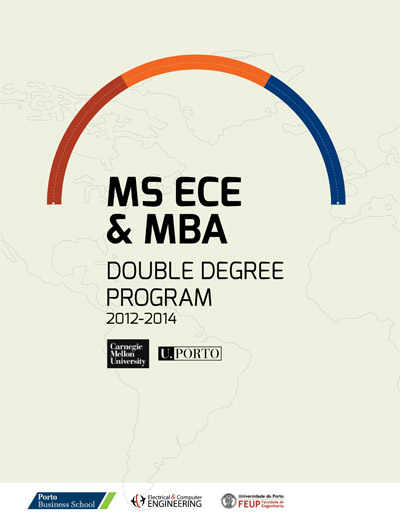
brochure MBA ECE On October 23, 2012, the Porto Business School, of the Universidade do Porto, held a public event to launch the new dual degree graduate program in engineering and business between this School and Carnegie Mellon University. CMU’s Ed Schlesinger and James Hoe joined the event.

The two-year program gives participants the opportunity of studying one year in Portugal at the Universidade do Porto (Porto Business School and Faculdade de Engenharia of the Universidade do Porto) and another year in the U.S. at Carnegie Mellon. Students are should meet academic requirements from both universities to receive a master’s of science degree in electrical and computer engineering from Carnegie Mellon and a master’s of business administration (“The Magellan MBA”) from Porto Business School. (http://www.pbs.up.pt/?page_id=9446)

“This new program builds on the long-standing relationship developed with the successful ICTI program (Information and Communication Technology Institute) in which Carnegie Mellon has partnered with a number of leading Portuguese universities,” said Ed Schlesinger, Professor and head of CMU’s Electrical and Computer Engineering Department. “We have our first students enrolled in the new program, and we expect the initiative to grow as more companies globally seek the problem-solving, managerial and technical skills acquired through engineering and business studies provided by this double MS MBA experience,” said Schlesinger.

Jorge Farinha, vice dean of the Porto Business school, said that “Bringing together Engineering and Business in this double degree program will be a major step toward preparing the next generation of highly skilled individuals that will be able to handle the most advanced technologies and related products while keeping at all times a business and managerial perspective. We expect to observe here the formation of a new breed of top engineers that are able to understand the language and practices of business and to effectively use soft skills such as communication, team management, negotiation or leadership to help companies achieve success in the marketplace in very complex organizational settings.”

The event gathered CMU’s Ed Schlesinger and James Hoe, Nuno de Sousa Pereira, dean of the Porto Business School, Jorge Farinha, vice dean of the Porto Business school, along with Sebastião Feyo de Azevedo, director of the Faculdade de Engenharia of the Universidade do Porto (FEUP), Carlos Oliveira, Portugal’s Secretary of State for Entrepreneurship and Innovation, and Allan Katz, U.S. ambassador to Portugal. The event included a panel discussion about “Technology, Entrepreneurship and Management Education” with the participation of representatives from several national and international IT companies and entrepreneurs.

Source: http://www.cmu.edu/news/stories/archives/2012/october/oct25_ecepartnership.html

October, 2012