
In the Media: USA Ambassador in Portugal Highlights Success of Partnerships with Portugal

In an interview with Jornal de Negócios,  the United States Ambassador to Portugal, Randi Charno Levine, addresses Portugal’s decision, under the former Prime Minister, to exclude high-risk 5G suppliers like Huawei from the country and the controversy that targeted American universities and the International Partnerships with Portugal – Austin Texas, Carnegie Mellon and MIT – stating that she believes that it is now “behind us”.

The news that Elvira Fortunato, Minister of Science, Technology and Higher Education in the outgoing government, was aiming to terminate the protocols with those entities sparked the controversy. However, António Costa’s government ultimately decided to extend the agreement for another year, deferring negotiations to the succeeding government.

“I sincerely hope and believe that it was just a one-off. These are solid relationships and programs that have been in existence for 20 years,” says Randi Charno Levine in her interview with Jornal de Negócios.

Credits: Pedro Catarino I Jornal de Negócios

“We recognize that Portugal is a leader in the digital transition. We recognize that it is a leader in the energy transition. We recognize that Portugal has increased the number of patent applications threefold in the last ten years. So, there are great things happening here in Portugal,” says the Ambassador.

The Ambassador also emphasized the positive impact of American universities’ investments in Portugal, citing successful ventures like Feedzai and Unbabel “American universities are very proud of the investment they have made in Portugal with Portuguese researchers”.

Moving forward, the American Ambassador expressed her commitment to meeting with the new government to present the success of these partnerships through compelling data reaffirming the importance and benefits of collaboration between the United States and Portugal: “all the wonderful information and statistics about how successful this has been for Portugal”, hoping “that information will speak for itself”.  
Mahmoud Tavakoli features in Nature’s “Where I Work”

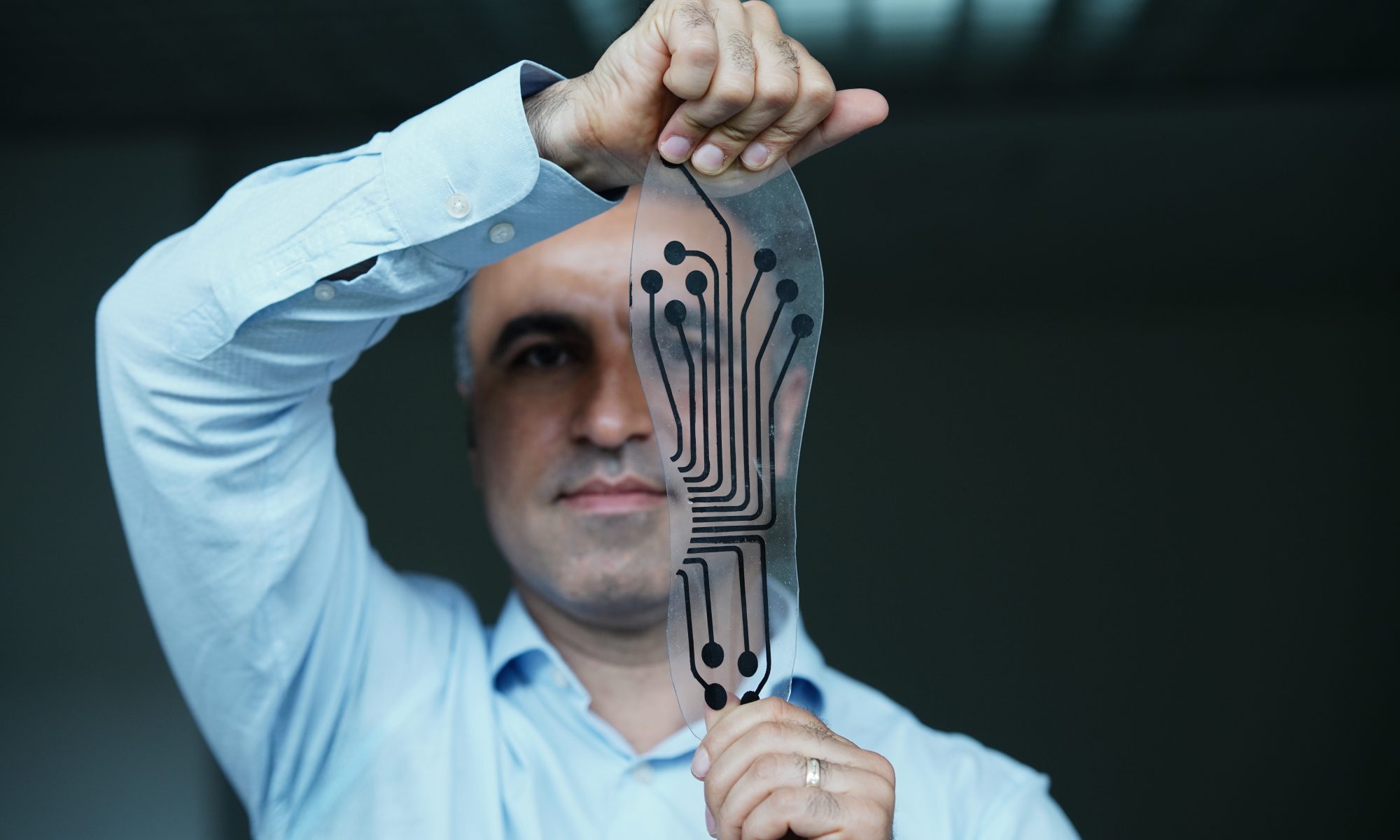
Mahmoud Tavakoli, Director of the “Soft and Printed Microelectronics Laboratory” (SPM) from the Faculty of Science and Technology of Universidade de Coimbra (FCTUC), featured in a  recent Nature article “Where I Work”.

 In the piece “How I make stretchy electronics for medicine”,  Tavakoli offers an overview of the work being developed at the SPM Lab focusing on the development of a new generation of wearable electronic devices that mimic the flexibility of the  human skin, with potential applications  in different sectors, namely healthcare. 

“We are working on a soft electronic device that can monitor internal organs. Standard electronic devices are rigid and invasive. But a soft, miniature robot might be able to move inside the gut to film, register data or deliver drugs without harming tissue”, explained the researcher to Nature.

Image Credits: Ana Paganini for Nature

Mahmoud Tavakoli manages a multi-disciplinary research team of Electrical, Chemical, Biomedical and Mechanical Engineers that combines expertise in nanomaterials, polymers, and liquid conductors to drive  applications in soft robotics, soft electronics, smart textile, smart plastics, and health monitoring. 

“We’re a team of 15 researchers in different fields such as electronic, chemical or mechanical engineering and physics. We even have a digital artist. My job is to glue all this expertise into one unit.”, shared Mahmoud.

Tavakoli’s research work has received substantial support by the CMU Portugal Program and Fundação para a Ciência e a Tecnologia (FCT). Through the Program, the FCTUC team has collaborated with the Soft Machines Lab from Carnegie Mellon University’s College of Engineering on several impactful projects: Stretchtonics, one of CMU Portugal Entrepreneurial Research Initiatives; WoW, one of our Large Scale Collaborative Projects which is led by Glintt; and the Exploratory research project Exoskins. At the moment, the team oversees the supervision of CMU Portugal Dual Degree Ph.D. students supervised by Mahmoud Tavakoli: Manuel Carneiro and Marta Freitas.

The research developed under these collaborative projects, with the support of teams at Carnegie Mellon and CMU Portugal students, has contributed to significant advancements in stretchable electronics, wearable computing, wearable patient monitoring, digital health, and digital biomarkers.

To read the full story, visit Nature here.

AddVolt distinguished by Portugal Ventures

The Portuguese Company Addvolt, was one of the winners at the 2023 edition of the Portugal Ventures Awards, an initiative aimed at startups that stood out the most in the national entrepreneurial ecosystem in 2023.

Addvolt, a company focused on Building smart and sustainable transportation worldwide, was recognized in the Startup Industry & Technology category, a testament to its innovative contributions to the field

Founded in 2014 by four alumni from the Faculty of Engineering of the University of Porto (FEUP) and launched by UPTEC, the Company was one of the selected projects of the 2014 and first edition of the CMU Portugal initiative inRES – Entrepreneurship in Residence Program – a business acceleration program for entrepreneurial teams in the area of ICT. 

Addvolt has developed a Plug-in Electric system – a groundbreaking technology already patented in several territories – that ensures the distribution of fresh and frozen products without using diesel. Additionally, it is emissions-free and operates with low noise due to the combination of a gas vehicle with the refrigeration system electrically powered by Addvolt.

The 2023 company’s distinction follows its success in 2022, where it was already awarded by  Portugal Ventures, underscoring the company’s commitment to excellence and innovation.

AddVolt Website

Portuguese platform Unbabel secures $21 million in funding

The Portuguese Language Operations platform Unbabel, a CMU Portugal longtime partner and currently one of the Program’s affiliated partners, has secured $21 million in funding. This latest funding round was made possible through the support of prominent investors including Iberis Capital, GED Ventures Portugal, Point 72, Notion, ScaleVentures Partners, and Caixa Capital. The capital injection will be used to drive Unbabel’s global growth strategy and strengthen its position on the path to profitability.

Established in 2013, Unbabel’s Customer Service Solution allows modern enterprises to understand and be understood by their customers in dozens of languages by combining human expertise and artificial intelligence (AI). Powered by AI and refined by a global community of translators, Unbabel combines the speed and scale of machine translation with the authenticity that can come only from a native speaker. 

Unbabel HQ is currently located  in San Francisco, California, and has offices in Portugal, the United States, United Kingdom, Romania, the Philippines, Germany, Bulgaria, and Israel.

The company was founded by Vasco Pedro, a graduate from CMU’s Language Technology Institute (LTI) and CMU Portugal project post-doctoral fellow. André Martins, CMU Portugal alumni, is the company’s VP of Artificial Intelligence Research. 

The company has also led one of CMU Portugal Large large-scale collaborative Projects MAIA (2020-2023), focused on developing a multilingual conversational platform supported by machine translation and dialogue systems, where AI agents assist human agents. 

Vasco Pedro, co-founder and CEO explained in a public notice disclosed by the company that “From day one, we believed that language is the way to create a common understanding among cultures, businesses, and customers worldwide. In the past year, we announced two significant acquisitions for Unbabel – the German EVS Translations and the Israeli Bablic – and this funding is another step aligned with our acquisition strategy. Making Unbabel profitable will enhance its scalability and that is what we are focused on, now with the vote of confidence from this group of investors.”

Unbabel Website

In the Media: Feedzai’s journey in Jornal de Negócios

Feedzai was featured in an article published in Jornal de Negócios with an interview with its CEO and co-founder Nuno Sebastião. As the first spin-off launched under the scope of the CMU Portugal Program, Feedzai brings together a unique blend of expertise in engineering, simulations, real-time big data processing, and high-scale distributed systems.

The article presents an overview of theFeedzai’s journey as a Unicorn company, which originated in Coimbra in 2008 and is now establishing its presence in key global hubs, including Lisbon, Porto, San Mateo, Atlanta, New York, London, Sydney, Madrid, Hong Kong, and Bogotá. Nuno Sebastião, CEO at Feedzai and one of its three founders, starts the interview by saying that “there is a thin line between a visionary and a madman”, asserting that results are what defines the right side of the line.

With a background in engineering at the European Space Agency and an MBA from the London Business School, Nuno Sebastião co-founded the company with two other visionaries: Pedro Bizarro (Chief Science Officer), ormer professor at the University of Coimbra and Carnegie Mellon University (CMU) and Paulo Marques, the Company Chief Technology Officer for 13 years until May 2022. aulo Marques, who continues to contribute as one of CMU Portugal’s Scientific Directors, played a pivotal role in the company’s early years.

All three are still strong supporters of the CMU Portugal partnership. Feedzai actively participates in the Program, most notably as a Large-Scale Project Promoter under Project Camelot and as a dedicated Affiliated Partner, reflecting its ongoing commitment to fostering collaboration and innovation.

Credits: Jornal de Negócios

More about Feedzai and CMU Portugal here.

Eco-friendly conductive ink promises to revolutionize the production of soft stretchable electronic circuits

Researchers at the Faculty of Science and Technology of Universidade de Coimbra (FCTUC) and Carnegie Mellon University, including CMU Portugal Dual Degree Ph.D. student Manuel Reis Carneiro, developed a water-based conductive ink tailored for producing flexible electronic circuits.

The technique, developed with CMU Portugal’s support, sidesteps the necessity of employing conventional organic solvents, renowned for their detrimental environmental impact due to pollution and toxicity. The results have been published in the scientific journal Advanced Science.

By being water-based, this ink is more sustainable and ecological and significantly reduces the environmental impact of existing solutions. On-skin bio stickers to monitor patients’ health or recyclable smart packages with integrated sensors for monitoring the safe storage of perishable foods are among the possible uses. 

Manuel Reis Carneiro, a CMU Portugal doctoral student in Electrical and Computer Engineering, is part of the team led by Mahmoud Tavakoli, which already has extensive experience developing stretchable electronic circuits efficiently, quickly, and cheaply.  They are now taking a new step by creating an ink that is sustainable and eco-friendly.

Manuel Reis Carneiro with Portuguese Minister Elvira Fortunato at CMU

Manuel Reis Carneiro explains: «Using a water-based ink for printing and producing flexible electronic circuits brings numerous advantages. On the one hand, it radically reduces the ecological footprint of production because it does not use polluting materials. On the other, it makes recycling and subsequent reuse of circuits much easier, which previously consisted of a complex procedure. Here, it is enough to place the circuit in alcohol. The components and metallic particles separate and are ready to be reused».

Unlike its predecessors, this innovative ink does not require refrigeration, facilitating storage and markedly reducing ecological footprints and maintenance costs. These advancements hold transformative potential in the medical and food industries. In healthcare, biomonitoring sensors and stickers can capture patient data like muscle activity, breathing, body temperature, heartbeat, brain activity, and emotions. The advent of this ink, enabling easy and affordable recycling, is especially impactful in combating electronic waste (e-waste) generated by single-use medical devices.

This innovation finds its place in the food industry’s next era of smart packaging. Applying this ink on plastic-based sensors affixed to packages of perishable goods enables real-time temperature monitoring, guaranteeing preservation and quality assurance. This approach empowers consumers by identifying storage issues and informing decisions.

Manuel Reis adds: «These “smart stickers” currently incorporate a temperature sensor that alerts users to contamination risks. The solution’s low production cost foreshadows future inclusion in perishable goods packaging to assure quality. While the focus is presently on temperature and exposure to unfavorable conditions, in the future, we hope to be able to monitor other factors such as pressure, humidity, position, or location».

These advancements exemplify the development of sustainable solutions, marrying technology and environmental consciousness. As the world leans into electronics, merging functionality and environmental stewardship emerges as a beacon of progress.

In the Media: LUSA, Observador, Sapo, LUSAObservador, SapoRTP OnlineVisão OnlineNotícias ao MinutoPC GuiaDiário de CoimbraSapo Tek

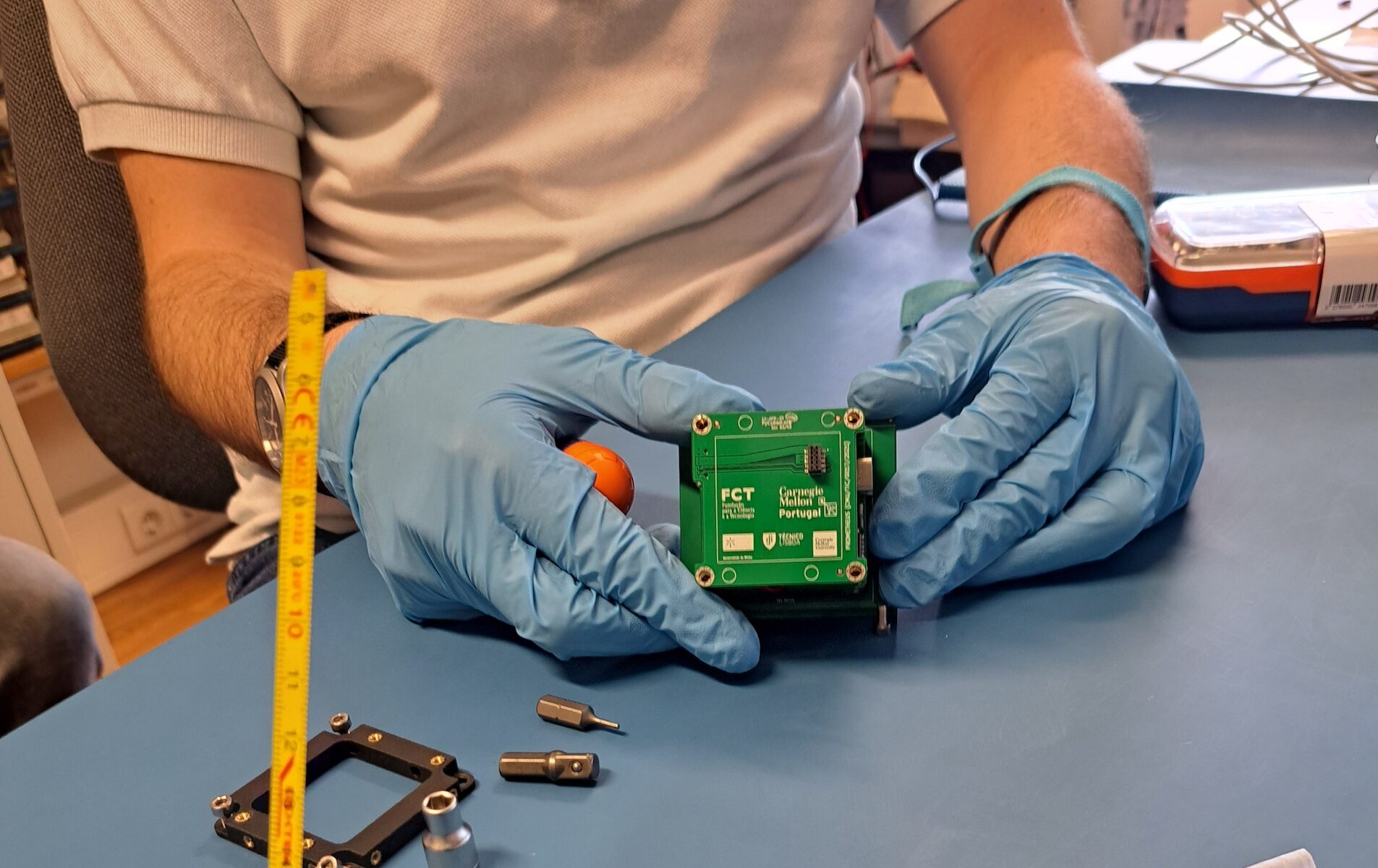
In the media: PocketQube – small and low cost cubic satellites that can go into space

CMU Portugal Exploratory Research project PROMETHEUS was featured in the online and printed edition of Exame Informática, a Portuguese Magazine on the latest technology advancements. The project was also highlighted on the TV show Exame Informática, transmitted in the Portuguese TV Channel SIC Notícias.

The project, led by Alexandre Ferreira da Silva at Universidade do Minho in collaboration with Instituto Superior Técnico (NanosatLab) and Carnegie Mellon University, is developing 5cm cubic satellites to provide easy access to space for the research and education community. According to the project PI, Alexandre Ferreira da Silva from Universidade do Minho, “These small cube-shaped satellites measuring 5 cm, called PocketQubes, are made with simple and low-cost materials, making it an accessible tool for teaching and research.”

Paulo Fisch, a Carnegie Mellon University researcher currently working under the project, was in Portugal in July to support the development of these mini satellites that are designed to be used in the classroom, from high school to college, but are also prepared to go into space. 

Even if they are only 5cm large, they have all the necessary elements to function effectively: a camera (from a mobile phone), an orientation sensor, actuators to position it in space after launch, a solar battery and a radio communication system. It also has antennas, made with measuring tape, attached to the base with fishing line that will be attached to the base, inside the rocket. 

According to Paulo “Given the simplicity of the entire process, it is easier to assemble and disassemble than many Lego toys that are offered to children,” so researchers predict that they will probably be possible to use in the classroom from high school onwards. The total cost does not exceed 500 euros and all plans are available for consultation on the open-source platform GitHub. 

Being affordable is one of the real advantages since “access to space is usually expensive and restricted to government agencies and big companies”, explains Rodrigo Ventura from Técnico adding “Currently with New Space, small and medium-sized companies already have access to space. With this project we want to expand it even more and have satellites in orbit built by students”. 

Paulo Fisch’s visit to Portugal started in Universidade do Minho where the satellites were first assembled with the support of Pedro Andrade, Ph.D. student at UMinho. They then visited Técnico’s Taguspark Campus, where the evaluation of the satellites communication system took place. 

In addition to the models intended exclusively for teaching, the team is also building a PocketQube destined to fly and be launched in low earth orbit (LEO), 400 kilometers from altitude. Certification to fly requires vibration tests and the so-called bake out in which the satellite is placed inside an oven at 80 degrees to release gasses on Earth and not in the void of space. The launch should take place aboard Space X, in a process handled by the company Spanish Fossa, with an estimated cost of twenty thousand euros. 

Alexandre Ferreira da Silva expects to start testing the use of the small satellite in the 2024/25 academic year at UMinho. 

Full article (in Portuguese)
Video Exame Informática

In the Media: Research Project IntelligentCare in “90 Segundos de Ciência”

Mário Gaspar da Silva, researcher under the CMU Portugal Large Scale Collaborative project IntelligentCare at Instituto Superior Técnico I INESC ID, was interviewed by the “90 Segundos de Ciência” Podcast on Antena 1. 
The project is developing a system capable of predicting the health progression of patients with multimorbidity (MM), which is characterized by the presence of multiple chronic diseases in a single patient, such as diabetes, hypertension, or heart failure.

Upon knowing the patient’s medical history in detail, this system will be able to define with greater precision the evolution of the disease.

“Our work focuses primarily on the analysis of information collected from patients and their clinical history over the past decades, which is recorded in the hospital’s clinical records. From this information, we will infer patterns that allow us to predict the clinical outcome for each patient currently under treatment,” explains Mário Gaspar da Silva. 

With this system, healthcare professionals will be able to predict how the health status of a patient who visits the emergency room or is seen in a medical appointment will evolve. 

The project’s goal is to improve the quality of life of these patients while finding solutions to contribute to the sustainability of the Healthcare System. 

The project is being led by Hospital da Luz Learning Health, in collaboration with Priberam Informática, Instituto Superior Técnico I ISR Lisboa, INESC ID and CMU Heinz College. 

More about the project here and link below to the podcast.

In the Media: 2023 Call for Affiliated Ph.D.s highlighted in Jornal Económico

The 2023 CMU Portugal Call for Affiliated Ph.D. Scholarships was featured in Jornal Económico Newspaper. The article presented an overview of the Affiliated Ph.D. Programs initiative through the perspective of CMU Portugal National Director, Inês Lynce and of two Affiliated Ph.D. candidates, Diogo Silva (FCT NOVA ) and Maria Eduarda Andrada (Universidade de Coimbra).

Diogo Silva shared that he was halfway through his Master’s thesis in Computer Engineering at FCT NOVA when he decided to apply to the Program: “I wanted the opportunity to have access to Carnegie Mellon University Professors and researchers, which is considered one of the best universities in the world for informatics and in particular in artificial intelligence applied to language, which is my research area”, explains the 24-year-old student. Under his Ph.D., Diogo expects to improve language generation approaches and help to break the human-machine gap in conversational agents. Encouraged by his supervisor at FCT NOVA, João Magalhães, a CMU Portugal supervisor and researcher, he pointed out “my scholarship allowed me to conduct research that otherwise would not be possible and has helped me to become more independent. The CMU Portugal Program opened new doors for me and facilitated the creation of new connections within my field of investigation”.

Diogo also has the opportunity to work in collaboration with the Portuguese Unicorn Company Farfetch under CMU Portugal’s large Scale project IFetch. Many of the selected students have the chance to cooperate with industry during their doctoral, which is, according to CMU Portugal National Co-Director Inês Lynce “one of the big advantages of these Ph.D. Programs”. “This initiative promotes a close connection between students and Portuguese ICT Companies. Even in the selection process we value candidates who present a work plan in collaboration with a company”, explains Inês. 

Launched for the first time in 2021, the Affiliated Ph.D. Programs was created “to increase the number of scholarships and diversify CMU Portugal’s educational offer.  Every student eligible for a Ph.D. in ICT-related areas from a Portuguese University can apply to these scholarships”, explained the Program’s Co-Director to Jornal Económico.

Maria Eduarda, an Affiliated Ph.D. candidate from Brazil in Electrical and Computer Engineering hosted at Universidade de Coimbra, shared her experience and reasons for choosing this Program “I applied because I believed that the partnership between a national university and one from the United States would provide me acomplete training in terms of soft skills and technical knowledge”. According to Maria “this Ph.D. already gave me a broad range of opportunities to connect with qualified professionals in my area of ​​expertise, which I would not have had if only enrolled at the University of Coimbra.”

Link to the News article and pdf

The 2023 Call for 12 Affiliated Ph.D. Scholarships is open until March 31. 

More information here.