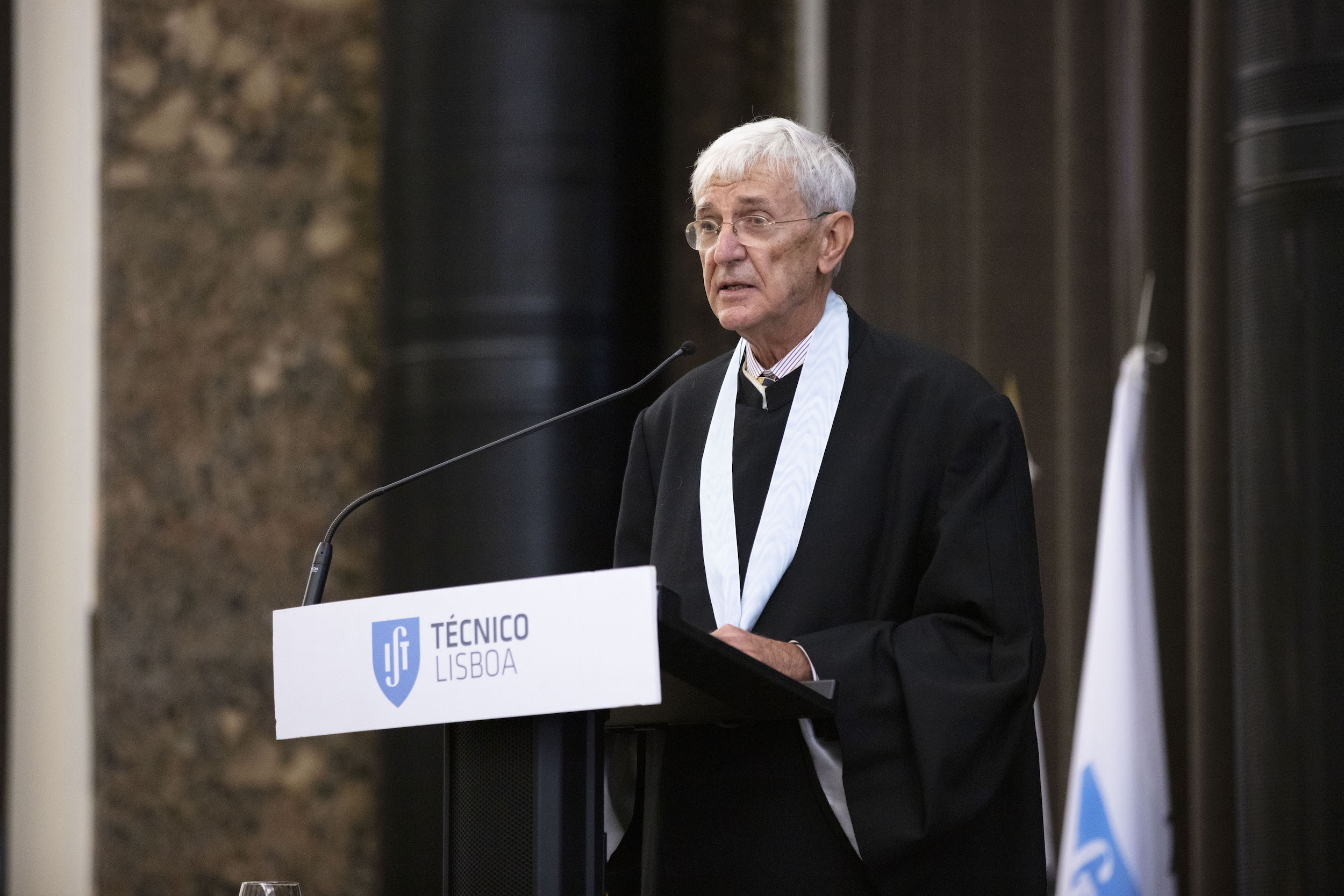
Manuela Veloso, a world renowned computer scientist and AI researcher and a Carnegie Mellon Portugal Faculty member since the launch of the partnership in 2006, was awarded the title of Doctor Honoris Causa by the University of Bordeaux (Université de Bordeaux). In the same Ceremony on October 5th at the University headquarters, Martin Vetterli, president of the École Polytechnique Fédérale de Lausanne, was honored with the same title.
The opening ceremony was hosted by the University president, Manuel Tunon de Lara, who, during his speech, emphasized the importance of this distinction in Academic life and handed Manuela Veloso the title and insignia of Doctor Honoris Causa.
In her acceptance speech, Manuela Veloso spoke about how she began doing research in AI and robotics, and highlighted the launch of RoboCup to foster worldwide research and competitions in robot soccer, an innovative initiative started in the mid 1990s, for which she was a co-founder. Notably, she also referenced a few of her personal life experiences that led to her long term dedication to the science and engineering of AI and robotics. She concluded explaining her new exciting career direction in AI and finance, which she has recently embraced as Head of AI Research at J.P. Morgan Chase.
Manuela Veloso started her pathway with an Electrical Engineering bachelor degree and a Master of Science in Electrical and Computer Engineering from Lisbon’s Instituto Superior Técnico. Upon coming to the United States in 1984, she pursued a Master of Arts in Computer Science at Boston University and a Ph.D. also in Computer Science at Carnegie Mellon University (CMU). Her Ph.D. thesis, Learning by Analogical Reasoning in General Purpose Problem Solving, was supervised by Jaime Carbonell. Manuela Veloso joined the CMU Computer Science Department as an assistant professor, to then become Herbert A. Simon University Professor. She led the CMU Machine Learning Department from 2016 to 2018, when she took a leave of absence to create and head AI Research at J.P. Morgan Chase, one of the largest financial institutions. She is now Emeritus Professor in CMU’s School of Computer Science.
She was the founder of the CORAL Research Laboratory, for research in autonomous AI agents that Collaborate, Observer, Reason, Act, and Learn, with her many students and visitors over more than 25 years. She has published more than 300 scientific articles and she has graduated 45 PhD students. She was president of the Association for the Advancement of Artificial Intelligence (AAAI), co-founder and president of RoboCup. She further received several academic awards during her career, being Fellow of the four main professional associations in her area, namely AAAI, AAAS, ACM, and IEEE.
This year she was ranked in the top 10 of 35 world’s most influential women in engineering on the Academic Influence list long side astronauts, founders and CEOs of well-known technology and researchers from around the world. The Portuguese researcher has been strongly involved with the CMU Portugal Program, advising several dual-degree Ph.D. candidates in Electrical and Computer Engineering, Computer Science, and Robotics, within collaborative projects between Portuguese and Carnegie Mellon research teams.
In a Ceremony held on September 13th José M.F. Moura was awarded the title of Doctor Honoris Causa by Universidade de Lisboa, after a proposal by Técnico, where he studied and lectured. The prestigious award recognizes his academic, scientific and professional outstanding contributions, worldwide and with a strong impact in Portugal. José M.F. Moura is CMU Portugal Director at Carnegie Mellon since its launch in 2006 and a key supporter to its foundation and throughout the years.
With a career of more than 50 years and living in the United States since the 70s he never lost the connection to the Institution where he graduated and always kept supporting research and educational initiatives between Portugal and the United States.
At the Honoris Causa Ceremony the laudatory speech was given by Professor Isabel Ribeiro, Vice-president of Técnico for Administrative Modernization, who highlighted José M.F. Moura’s “long and brilliant career”.
During his speech, José M.F. Moura stated quoting Técnico’s article: “I am deeply honored and humbled to be awarded by Universidade de Lisboa and Instituto Superior Técnico”, adding “This is also the recognition of the merit of those who over the years have accompanied me, supported me, with whom I have had the privilege to collaborate and to live with.”
About his home Institution he added “Técnico was a school guided by excellence and rigour but, above all, it was a school of life”, said the laureate. “I wanted to show that in Portugal, particularly in IST Department of Electrical Engineering, we could do research”, he said about his decision to go to MIT, and how he did not hesitate to return and stay in Portugal.
Regarding his work under the CMU Portugal program, he highlighted “the CMU Portugal program was a success due to its directors in Portugal because they were on the ground, and the professors and students, both at CMU and in Portugal”.
This distinction was a reason to celebrate and to pay tribute to his impressive career, reason why CMU Portugal asked a group of people who were part of his path in Portugal, from students to co-workers, many of whom became close friends, to leave him a testimony.
Watch the videos here (in Portuguese with auto caption available on youtube) or directly on our youtube channel.
For more about the Ceremony you can read the original article at Técnico website and video available at their Youtube page.
The 2021 CMU Portugal Doctoral Symposium took place on September 15th at Pavilhão do Conhecimento in Lisbon and gathered 24 students who presented their research work developed under the CMU Portugal Program. The welcome session had the privilege to begin with a brief speech from Rosalia Vargas (President of Agência Ciência Viva), Inês Lynce (on behalf of CMU Portugal Directors), José Paulo Esperança (Vice President of Fundação para a Ciência e a Tecnologia), and Manuel Heitor (Minister for Science, Technology and Higher Education).
Rosalia Vargas, Ciência Viva
José Paula Esperança, FCT
Inês Lynce, CMU Portugal
The main goal of this new initiative was to foster a supportive community of Ph.D. candidates and promote a collaborative research environment by providing participants the opportunity to present their work plans and discuss the results with their peers. The six parallel sessions, held simultaneously in two separate rooms (Auditorium and Library), were chaired by a diverse group including CMU Portugal alumni, scientific directors, and leading experts from the Program´s affiliated companies.
The 24 presentations were given by 13 Dual Degree Ph.D. candidates, by 3 of our new Affiliated Ph.D. candidates already involved with the Program through research projects, and 8 researchers conducting their thesis under the framework of CMU Portugal projects (ERIs, ERPs, Large-Scale projects). Together, they provided evidence for a perspective on the diverse and multidisciplinary research developed under the scope of CMU Portugal Program.
At the end of the day, the goal was successfully achieved, and the debate included the enthusiastic participation of all the panel speakers and the audience.
The first session at the Auditorium was dedicated to Language Technologies and chaired by CMU Portugal alumnus Zita Marinho, a Research Scientist at DeepMind. Presentations were led by Gonçalo Raposo (IST), Gustavo Gonçalves (FCT UNL), John Mendonca (IST) and Patrick Fernandes (IST).
João Paulo Cunha, CMU Portugal Scientific Director from FEUP, chaired the second Auditorium’s session which counted with four presentations: two in the area of Computer Science led by researchers from CMU Portugal projects TAMI and SCREEN DR both from FEUP: Maria Helena Montenegro e Almeida and Teresa Araújo. Dual Degree Ph.D. students Alex Gaudio and Manuel Reis Carneiro presented next, in the area of Electrical and Computer Engineering.
Lastly, João Abreu from Outsystems, a CMU Portugal Affiliated company and the promoter of our Large-Scale Collaborative project GOLEM led the final session. All presentations were related to Computer Science, starting with Ricardo Brancas (IST) who just joined the Program as one of our 12 new Affiliated Ph.D. students, Margarida Ferreira (IST), Luís de Sá (FCT UNL) and Claudio Gomes (FCUP), all Dual Degree Ph.D. candidates.
To watch the Auditorium sessions, please visit our YouTube:
Three other sessions were organized at the Library, starting with a group of 4 Dual Degree students which included Daniel Ramos (IST), Maria Casimiro (IST), Paulo dos Santos (FCUL) and Pedro Valdeira (IST), and Abdelghafour Abraray conducting his PhD research at Universidade de Aveiro, under the scope of the ERP “Intelligent Beamforming Metasurfaces for Future Telecommunications.” The chair of this session was Feedzai’s CTO and co-founder, Paulo Marques, who has a long-lasting relationship with the Program, now as our Scientific Director and in the past as Visiting Faculty and adjunct professor at Carnegie Mellon University. Feedzai, a Portuguese Unicorn company, was one of the first startups created under the scope of the CMU Portugal Program and is now one of our Affiliated partner companies.
Lia Patrício, from FEUP, is CMU Portugal most recent Scientific Director and took part for the first time in a CMU Portugal event. This debut started in a great way in a session focused on Engineering and Public Policy where our Dual Degree students Afonso Amaral and Jihoon Shin shared the work that they are developing under the scope of their Ph.D.
Finally, the last session at the Library centered on health issues with three of the speakers involved in CMU Portugal research project TAMI from INESC TEC, Joana Rocha, Sofia Pereira and Wilson Silva, who promoted a fruitful discussion moderated by Francisca Leite from Luz Saúde. Moreover, at the end of the day Francisca Leite was highly impressed with their work leaving a door open for future collaborations. Fernanda Famá, one of the three CMU Portugal Affiliated Ph.D. candidates, was the last speaker of the day presenting work that she will now develop under her Ph.D.
To watch the Library sessions please visit our YouTube:
After being awarded on September 13th the title of Doctor Honoris Causa by Universidade de Lisboa at a Ceremony held at Técnico, Professor José M.F. Moura shared his life experience and knowledge at a Lecture held at Técnico.
On September 16th under the title “Uma história que se tece detetando dados em discos rígidos”/ “A story that weaves itself by detecting data on hard drives” the Philip L. and Marsha Dowd University Professor of Electrical and Computer Engineering at Carnegie Mellon University shared the story around one of his inventions and won over the audience with his expertise.
The lecture opened with a brief introduction from Técnico President Rogério Colaço and the audience included numerous colleagues, former students and admirers of the Carnegie Mellon University faculty member.
During his speech, the CMU Portugal Director shared the story behind one of his inventions and patents, going beyond the most technical details focusing on the context in which it emerged and sharing the contours of the seven years of litigation in U.S. Federal courts around this technology.
José M.F. Moura guided the audience through a timeline starting in the early 1990s when he was part of a CMU team that, with support from the US National Science Foundation, set to develop in ten years a hard disk drive that increased by two orders of magnitude (a factor of 100) the magnetic recording density – meaning that, in the same volume, it became possible to store 100 times more data.
José M.F. Moura’s part of the deal was to come up with a detector, i.e., the contraption that accurately read those bits recorded in ever-small magnetic domains that became the PhD thesis of his student Alek Kavcic. In 1997, CMU filed a provisional patent on the Kavcic-Moura design with the US Patent Office. Two patents were issued in the early 2000s.
The technology of these two patents is now used in more than three billion hard disk drives in 60% of all computers sold in the world. Those patents were the subject in 2016 of a $750 million settlement between CMU and a semiconductor manufacturer in the largest-ever settlement in the IP area.
During his talk, José M.F. Moura explained what he learned from the various interactions with industry and with CMU, from the main steps in the seven years litigation in US Federal courts, to the largest ever verdict in information technology (roughly, US$ 1.5Billion (thousand millions), and finally, in 2016, the US$750M settlement between CMU and a chip designer, the largest intellectual property (IP) settlement ever.
At the end of the Lecture, Isabel Ribeiro, Vice-president of Técnico for Administrative Modernization, thanked Professor José M.F. Moura for sharing this story in public for the first time.
On September 13, José M.F. Moura, CMU Portugal Director at Carnegie Mellon University was awarded the title of Doctor Honoris Causa by Universidade de Lisboa in a Ceremony at Instituto Superior Técnico.
José M.F. Moura, who leads the CMU Portugal Program since its beginning in 2006, is the Philip L. and Marsha Dowd University Professor of Electrical and Computer Engineering at Carnegie Mellon University. He was full professor at Técnico in the 1980s and president of the Institute of Electrical and Electronics Engineers (IEEE).
During his career, Professor Moura has met an impressive number of people In Portugal ranging from students to co-workers, many of whom became close friends, and who have contributed to his remarkable career.
To honor the academic man but also the friend, here are some testimonies from people who were part, in many different ways, of his path.
LxMLS – Team of attendees at the University of Copenhagen.
The 11th edition of the Lisbon Machine Learning Summer School (LxMLS 2021) took place on July 7- 15th. Over eight days, participants dive straight into a range of Machine Learning (ML) topics, from theory to practice, that are important in solving Natural Language Processing (NLP) problems that arise in the analysis and use of Web data.
LxMLS do no requires previous deep knowledge of ML or NLP. Still, the attendants are assumed to have some essential background in mathematics and programming. Organizers take the first day to review basic concepts and introduce the necessary tools for implementation exercises, while specialists in machine learning and natural language processing lead the following sessions. The next days are split into lectures in the morning and lab sessions and practical talks by experts in the afternoon.
LxMLS had a record number of 774 applications, 245 registered attendees (39% female) from 24 countries, 17 speakers, and 23 monitors. Participants were able to attend all the lectures and participate in the Q&As and labs remotely through Slack for communication about the school, Zoom for lectures and Q&A, Youtube for live and record talks and Gather. town for social interaction with the speakers and among participants. This year’s edition was entirely remote, similar to last year, due to current COVID-19 restrictions. However, organizers are expecting to welcome everyone in Lisbon for the 2022’s edition.
The virtual school results from a partnership between by Instituto Superior Técnico, Instituto de Telecomunicações, Instituto de Engenharia de Sistemas e Computadores, Investigação e Desenvolvimento em Lisboa, Lisbon Unit for Learning and Intelligent Systems, Unbabel, Priberam , Carnegie Mellon Portugal and sponsored by Google and Cleverly.
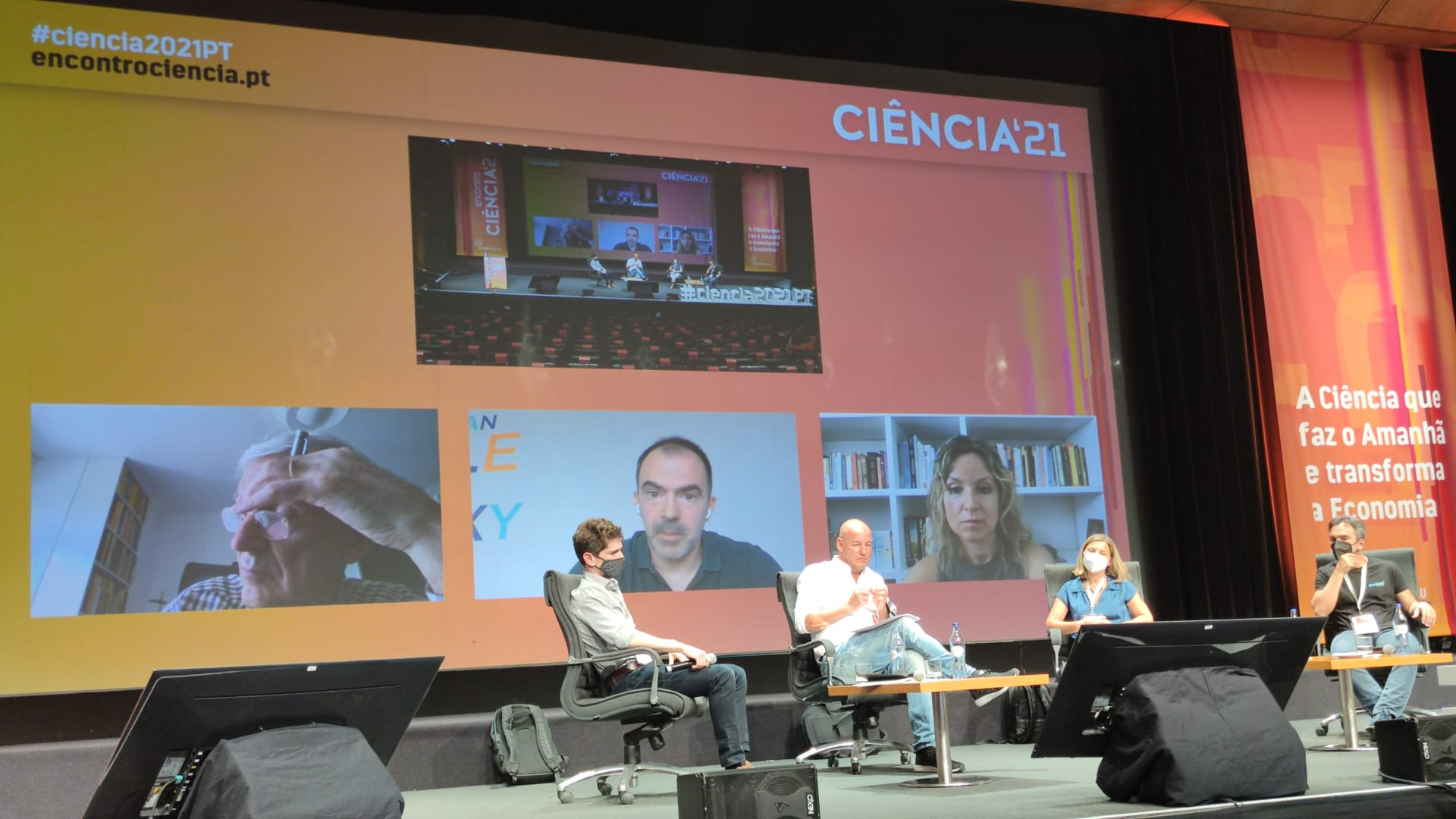
On June 28th, the CMU Portugal Program held the Session “The contribution of the CMU Portugal international partnership for the high-tech ecosystem in Portugal” at Encontro Ciência 2021 Summit, a discussion focused on the importance of the collaborations established under the Program throughout the years, in order to promote an innovation ecosystem that connects highly innovative companies of the data-driven economy.
Encontro Ciência is the central Science Conference in Portugal promoted by the Ministry of Science Technology and Higher Education (MCTES) along with Fundação para a Ciência e Tecnologia (FCT). This edition was organized in a mixed format both online and onsite, due to the current pandemic situation limited seats were available.
The session started with a brief presentation from Inês Lynce and Nuno Nunes, CMU Portugal National Co-Directors, who introduced in first-hand the brand new video of the 12 new Large- Scale Projects with an overview of the research projects that are now being developed under the Program and that are, for the first time, led by a Portuguese company.
To summarize the industry involvement of the Program since its beginning in 2006, José M.F. Moura, CMU Portugal Director at CMU, offered an overview of the initiatives established throughout the years to promote Industry collaborations.
Since 2006, CMU Portugal has promoted 74 projects, most of them in collaboration with companies extending the network of the program to over 150 companies. The involvement with companies is also supported by 168 Ph.D. and 247 Masters students directly supported by the Program’s research projects and PhD and Masters scholarships. From these, 80% of Masters and 54% of Ph.D. alumni are now part of leading organizations and companies.
Additionally, since the third phase of the Program which began in 2018, 16 CMU Portugal Industrial Affiliates have committed to actively contribute to the advanced education and research programs of the partnership by investing in R&D, in advanced training of human resources, and in building a highly-skilled workforce dedicated to innovation activities. CMU Portugal Industry Affiliates includes three Portuguese Unicorn companies (Farfetch, Talkdesk, and Outsystems), three CMU Portugal startups (Feedzai, Unbabel, and Veniam), and ICT leaders (Accenture, Altice, CEiiA, NOS, Priberam, REN, Remote, Tekever, Thales, and Uniplaces). Furthermore, Farfetch, Feedzai, Outsystems, and Unbabel reinforced their commitment to the Program by leading four out of the twelve CMU Portugal Large-Scale Projects that started in 2020. CMU Portugal has also been a hub for faculty members, students, and alumni to launch their entrepreneurial initiatives. The Program has supported the creation and development of twelve startups and these companies have created over 1,000 highly skilled jobs.
To offer a broad insight of the Program’s involvement with Industry, the session counted on the participation of four leading ICT companies with a strong bond to the Program that shared their point of view on this association: Farfetch, Feedzai, Mambu and Outsystems. These four companies, all valued above $1 billion, are all highly involved with the Program: some are part of the CMU Portugal Industry Affiliates list, others are Large Scale project promoters, or even startups created under the scope of the Program.
The discussion panel was composed by Luís Carvalho from Farfetch, João Abril de Abreu from Outsystems, Pedro Bizarro from Feedzai, and Sofia Nunes from Mambu who began by summarizing their involvement with the program and the advantages of this partnership. The discussion was moderated by the two CMU Portugal National co-directors, Inês Lynce and Nuno Nunes.
First, João Abreu who is responsible for the Innovation and Academic Relations at OutSystems, spoke about the company’s connection to the CMU Portugal Program as an Industry Affiliate company since 2018 and now leading the Large-Scale project GOLEM, an initiative to create enterprise applications with no code through Artificial Intelligence (AI) and a rich set of language abstractions.
Luis Carvalho, Senior Vice President of Technology at Farfetch, introduced the company’s vision of the collaboration with the Program since 2018 as an Industry Affiliate company. The luxury fashion platform is now leading the CMU Portugal Large Scale project IFETCH and expects to revolutionize the whole online shopping experience by changing how customers access information and make shopping decisions.
Pedro Bizarro is co-founder and CSO of Feedzai, a company with a long-lasting relationship with CMU Portugal: it was the 1st startup created under the scope of the Program; leads the CAMELOT project; is one of our Industry Affiliate companies; both founders were visiting faculty at CMU; and Paulo Marques is one of the CMU Portugal Scientific Directors. Pedro Bizarro spoke among other topics about the importance of talent acquisition that is made possible through the Program and stated that CMU Portugal touched Feedzai in many different ways throughout the years.
Sofia Nunes, one of the Mambu founders, has a background in Clinical Psychology and holds a Master’s in Human-Computer Interaction, an interdisciplinary experience that Nuno Nunes pointed out as an advantage to launch the idea for the company that started as the result of the research work developed by Sofia and two other colleagues during the CMU Portugal Master at ITI in Madeira. The Unicorn company is now based in Germany.
The dialogue continued focusing on some key issues related to Industry and University collaborations, emphasizing strengths and challenges. The four representatives offered a valued perspective and inputs on how these collaborations may be enhanced in the future under the attentive eye of Manuel Heitor, Minister for Science, Technology and Higher Education who was in the audience. The topics under discussion will surely allow all participants to define some action items to implement in future initiatives.
For more information you can watch the full video of the session available on our youtube channel.
The CMU Portugal Program was also represented in other sessions, namely with Inês Lynce as moderator at the Session “Artificial Intelligence, Data Science and Virtual Reality” (June 28 I 11:30-13:00), Nuno Nunes (June 29 I 14:00-15:30) as part of the session “Research and Development in Creative Industries” talking about “The new European Bauhaus” and Faculty members Ana Paiva, Mário Figueiredo, Arlindo Oliveira, André Martins and Industry Affiliated companies Feedzai and Unbabel (June 29 I 15:30). Our Large-Scale project Bee2wasteCrypto led by FutureCompta in collaboration with Técnico, Carnegie Mellon University, 3Drivers and NOVA IMS also presented on June 29 by Ian Scott.
Additionally, Inês Lynce was interviewed by the Event’s organization on the importance of this Science Summit and the proficient work being done by the Program to build solid Industry collaborations.
Paulo Marques is one of Feedzai founders and has been highly involved with the Program since day one, being the first faculty member from Coimbra to be certified as an adjunct professor at CMU. He was the first Director of the Master’s in Software Engineering from the Portugal side and continues his affiliation now as a CMU Portugal Scientific Director. Here’s his interview at Encontro Ciência where he referred to the Program as a transformative initiative:
João Abril de Abreu from Outsystems, who was part of the CMU Portugal Panel was also interviewed after the Program’s Session:
To watch other sessions or interviews you can visit the Event youtube at:
https://www.youtube.com/c/encontrocienciapt
Developing a supportive community for all researchers pursuing their PhDs under the scope of CMU Portugal initiatives
The CMU Portugal Program is organizing on September 15th, a Doctoral Symposium directed to all dual-degree CMU Portugal Ph.D. candidates, Affiliated Ph.D. Programs candidates, and all Ph.D. candidates conducting their doctoral thesis under one of the CMU Portugal research Projects (ERIs, ERPs, Large-Scale projects). The main goal of this initiative is to foster a supportive community of Ph.D. candidates and promote a collaborative research environment by providing participants the opportunity to present their work plans and discuss the results with their peers.
In addition to more than 20 students, the event will count on the participation onsite of both CMU Portugal National Directors, Inês Lynce and Nuno Nunes and CMU Portugal Director at CMU, José Fonseca de Moura.
Location: Pavilhão do Conhecimento, Lisbon and Live Streaming Date: September 15th / 2pm to 6pm (Lisbon) / 9am to 1pm (Pittsburgh)
CMU Portugal Ph.D. Educational offer
The Carnegie Mellon Portugal Program currently offers, with the support of the Foundation for Science and Technology (FCT) and in a partnership with various higher education institutions in Portugal and Carnegie Mellon, two different types of Ph.D. programs and scholarships: Dual Degree Ph.D. Programs available since the start of the international partnership in 2006 and the Affiliated Ph.D. Programs launched for the first time in 2021. Upon completion of the Dual Degree Ph.D., students receive a dual degree as students from both Carnegie Mellon and a partner University in Portugal. Under the Affiliated Ph.D. Program students will be hosted exclusively at a Portuguese University, with a research period at Carnegie Mellon up to 1 year. CMU Portugal also hosts diverse funding instruments for research projects through which Ph.D. candidates are supported at several Portuguese universities. These students conduct their thesis within the researcher topics close to the CMU Portugal action areas and often in collaboration with CMU researchers.
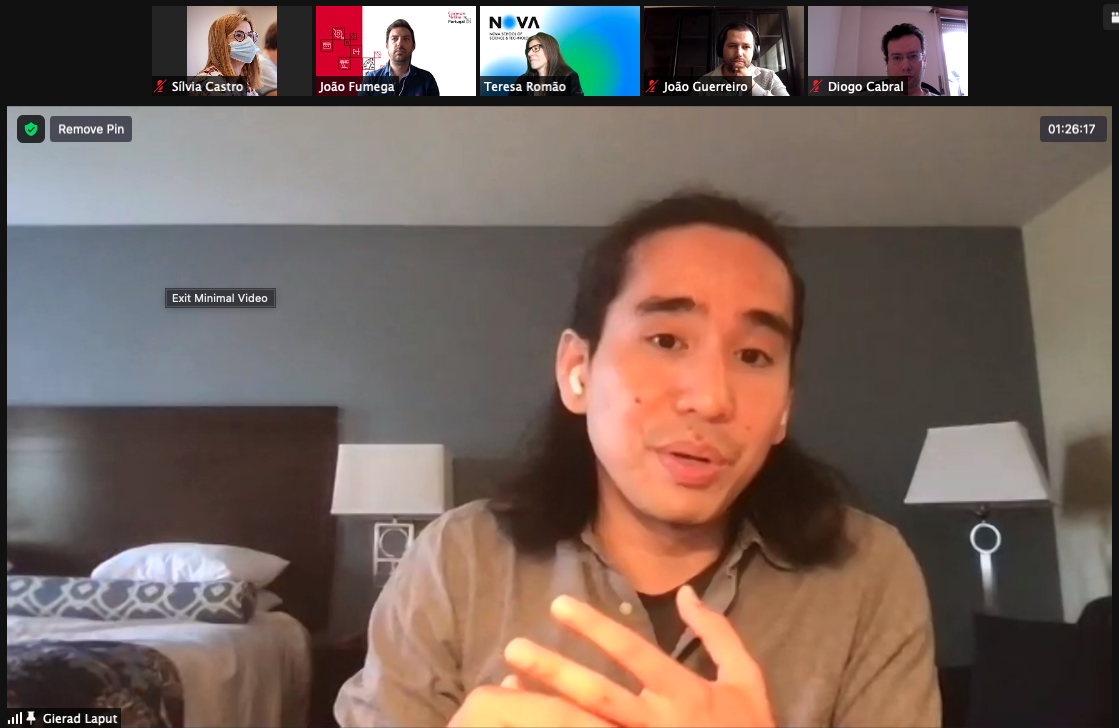
The session was presented by CMU Portugal Education officer João Fumega and Teresa Romão (NOVA School of Science and Technology) who welcomed the participants and introduced Gierad Laput, the speaker of the CMU Portugal initiative’s closing session “Context-Driven Implicit Interactions” .
Dr. Gierad Laputis a Research and Engineering Manager at Apple, where he leads the Sensing Technologies Group under Machine Learning and AI. The group mission is to explore and build technologies that profoundly impact millions of people through research and development in sensing and AI. Applications of the group’s work include health technologies, context-driven systems, and natural + assistive interactions. Gierad completed his Ph.D. and M.S. in Human-Computer Interaction at Carnegie Mellon University, and a B.S. in Electrical Engineering at the University of Michigan. He is also an Affiliate Faculty at Carnegie Mellon University’s School of Computer Science.
During this session, he spoke about the importance of having systems that understand and take into account people’s context of use, regardless of whether the platform is a mobile device, a wearable, or embedded in the environment. Context offers an implicit dimension that will become highly important to power more human-centric experiences. He focused on constructing and evaluating of sensing technologies that can be practically deployed and enhance contextual awareness, primarily drawing upon machine learning to unlock a wide range of applications and by introducing examples developed by his team’s recent work at Apple.