A Portuguese team won the second prize at the 2022 Alexa Prize TaskBot Challenge . Promoted by Amazon USA, the ten university teams in competition had to develop bots to assist customers in completing cooking or do-it-yourself home improvement tasks requiring multiple steps and decisions. The awarded team was led by CMU Portugal Faculty member, João Magalhães, professor at the Department of Informatics at NOVA School of Science and Technology (FCT NOVA)and researcher at NOVA LINCS, and counted, among others, with the participation of 3 CMU Portugal Ph.D. students: Diogo Tavares, Diogo Silva and Gustavo Gonçalves.
After nearly a year of research, the three best conversational assistants were announced and the FCT NOVA Portuguese team has proudly won second place. Their bot TWIZ, a conversational Task Wizard with multimodal curiosity-exploration, stood out by introducing curiosity to the challenge and mentioning curious facts related to the tasks being performed, which increased customer engagement. João Magalhães and David Semedo led the Portuguese team composed by Diogo Tavares and Diogo Silva (CMU Portugal Affiliated Ph.D Students), Gustavo Gonçalves (CMU Portugal Dual Degree Ph.D.) and 6 other students (Rafael Ferreira, Hélder Rodrigues, Mariana Bonito, Frederico Vicente, Rui Margarido, Paula Figueiredo).
The opportunity to participate in the 2021 edition of the Alexa TaskBot Challenge was possible thanks to the research work that was already being developed on conversational assistants under the CMU Portugal large-scale collaborative project IFetch, which is being led at FCT NOVA by João Magalhães. Under this project, the FCT NOVA team is supporting the development of a multimodal conversational agent for the online fashion marketplace with the company Farfetch.
Regarding CMU Portugal contribution to this achievement João Magalhães explains that “the Program played a key role as an enabler, both through the iFetch program and through the CMU Portugal funded PhD students. The iFetch team at NOVA University had already a running solid research program in multimodal conversational agents, so this was a natural step. Now, this outstanding achievement was mainly due to a combination of several groundbreaking AI advances invented by our students: the robust dialog understanding Transformer algorithm, and the language generation algorithms capable of talking about curious facts and algorithms to answer questions about the recipe and its video.“
Being part of this competition had, according to the team leader two very rewarding aspects “first, the access to real-world data and real-world users. This offered us a great opportunity to push the frontiers of the state of the art. Second, working with an amazing team towards this goal was extremely fulfilling.”.
About the Alexa Taskbot Challenge, sponsored by Amazon, João Magalhães states that it “was a great test-bed to validate multimodal conversational assistants that guide users in executing complex tasks like fixing a broken chair or cooking a chocolate cake. There were 10 universities participating world-wide and our solution was among the top three systems. “
The first place went to GRILLBot, a “multimodal task-oriented digital assistant to guide users through complex real-world tasks” developed by a team of graduate students at the University of Glasgow. A team from Ohio State University (OSU) won third place with its TacoBot.
The prize money for the top three was $500,000 for first place, $100,000 for second, and $50,000 for third.
Team Europe was the winner of the 1st International Cybersecurity Challenge (ICC 2022) concluded on Friday, June 17, in Athens, Greece. After two days of competition, the European team, which included CMU Portugal Dual Degree Ph.D. student Nuno Sabino as captain and his Supervisor, Pedro Adão, as one of the team trainers, took the trophy home.
The E.U. team counted fifteen young talents from twelve different European Union and EFTA countries, aged between 21 and 27, including Nuno Sabino: “the whole thing has been an adventure, and I feel honored to have been part of it. I was captain of the team, together with Danique, a player from the Netherlands. Part of our responsibilities involved assigning people to tasks, helping whoever is stuck on a challenge or find someone else to help, deciding who to attack (mainly in the second competition), and trying to solve some challenges ourselves.”
Team Europe
It all started in March 2021 when ENISA, the competition organizer, began selecting who would be part of Team Europe. Each country nominated 2 to 4 young people to be part of the initial pool of candidates. Nuno Sabino was nominated along with Manuel Sousa, both from Instituto Superior Técnico, for performing well on the European Cyber Security Challenge (ECSC). Both applications were accepted and became part of the initial pool of around 40 to 50 people from all around Europe, and all trained together in four in-person bootcamps. Through individual competitions, 15 people from 12 countries were selected to represent Europe in the 2022 ICC event.
From June 14 to 17, all worked together and did their best to achieve this fantastic result. “We played together and developed tools together for the final event. Everyone was experienced in programming and knew the usual techniques we learned in college. But somehow, I felt that each of us was bringing something different from our own countries and cultures, something that improved the overall state of our tools. I learned a lot from my team, and I feel honored to have been part of a group with such great talents,” shares Nuno.
The 2022 ICC event consisted of two main competitions. A Jeopardy-style, which consists of static challenges that each team needs to solve, and an Attack-Defense competition, a more dynamic game where each team has a common set of services running on a server and must attack other teams and patch services so that they can no longer attack you.
“This competition was also a great way to improve my leadership skills, study cybersecurity in a very practical context, and we might also open-source some of the tools we developed for common use of all CTF teams.” Nuno Sabino
At the prize-giving ceremony the team was, according to Nuno, extremely nervous: “I noticed some were shaking at least as much as me, as we had practiced intensely to be there and perform well. When they announced that Team Asia took second place and in third place was Team USA, our main competitors, we knew immediately we had won it.”
“I never had experienced so much enthusiasm and sense of accomplishment as the day when we found we were world champions.” Nuno Sabino
Team Europe at the Prize giving Ceremony
Nuno Sabino is currently a CMU Portugal Dual Degree Ph.D. student in Computer Science at Instituto Superior Técnico and at Carnegie Mellon, Computer Science Department, supervised in Portugal by the competition trainer, Pedro Adão (Técnico) and by Rui Maranhão (FEUP). His thesis is focused on detecting and exploiting DOM-XSS vulnerabilities, and regarding his future in Cybersecurity, he is sure to say, “definitely yes. I am not sure what I want to do after my Ph.D., but my passion is for Cybersecurity, and I intend to keep working on this area.”
Nuno Sabino – Team Europe Captain (Portugal)
Pedro Adão – Team Europe Trainer (Portugal)
The next “International Cybersecurity Challenge” (ICC) will take place in August 2023, hosted by ENISA from the U.S. Department of Homeland Security and CISA in the United States of America.
The 4th Webinar of the AIDA Webinar Series I Improving 5G Management promoted by the team of the Large Scale Collaborative project AIDA with the support of the CMU Portugal Program took place on June 8 with José Flora, (University of Coimbra) and Cláudia Brito (INESC TEC and University of Minho) and Justine Sherry (Carnegie Mellon University) as moderator.
The session named “Protecting the Security of the AIDA platform and the Privacy of its Data” was focused on how to prevent attacks to AIDA software, both for the security of the platform as for the privacy of the data subject whose data is being exposed and/or used. To achieve that, AIDA will be using state of the art security mechanisms, studied, and evaluated by the researchers of the project team, considering the new risks that rise from the migration to an Edge architecture and the employment of 5G. The webinar presented and explained these issues within the AIDA platform, but also the mechanisms of intrusion detection and tolerance used, as well as for monitoring and adaptation of the platform. The talk has also addressed how secure communications were achieved, never forgetting the privacy of the data subject and secure processing.
To watch the Webinar #4, click below.
The “AIDA Webinar Series I Improving 5G Risk Management” will count with a total of five (5) Webinars held every two months from December 2021 to September 2022, gathering leading experts from academia to industry involved with the project.
The next and last Webinar of this Series will take place on September 30, 2022.
For more information about this initiative and about the previous Webinars available at the AIDA Website.
Between May 16th and 18h, the CMU Portugal Program participated at theEncontro Ciência 2022 Summit to promote its latest initiatives to the public and present some of the research projects developed under the Program. Ciência 2022 is a major Science Conference organized by the Portuguese Government through the Ministry of Science Technology and Higher Education (MCTES), FCT and Ciência Viva held annually in Lisbon to highlight the main achievements in science and technology in Portugal.
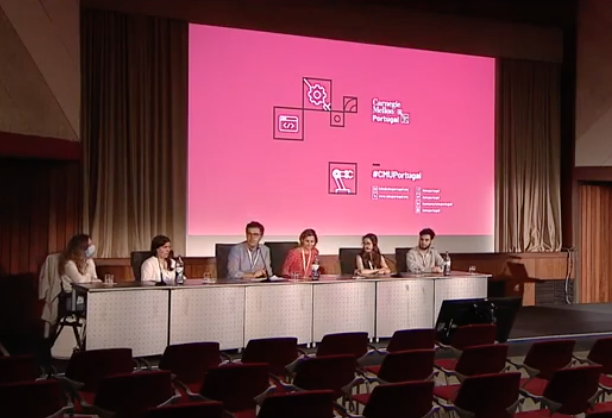
On May 16th, CMU Portugal hosted the session “Knowledge Creation and Talent Development under the CMU Portugal Program” and, throughout the event, demonstrations from three CMU Portugal projects (Safeforest, iFetch and MAIA). To present and discuss the Program’s Education initiatives and Doctoral Programs of the 3rd Phase, the CMU Portugal Session counted with five Ph.D. students and alumni who shared an enthusiastic overview of their research work and their experience under the dual-degree and affiliates Ph.D. initiatives.
The session started with a brief presentation from CMU Portugal Co-Director Inês Lynce, one of the two panel moderators, who shared an overview of the Program’s Educational activities throughout the years. João Magalhães, session co-moderator and CMU Portugal Faculty member at FCT UNL introduced the first speaker, John Mendonça.
John Mendonça, a CMU Portugal Affiliated Ph.D. candidate in Electrical and Computer Engineering specializing in Natural Language Processing at Técnico, was one of the first 12 students selected under the 1st edition of the Affiliated Ph.D. Programs initiative. John has a MSc in ECE and worked during his master’s at Defined.ai, developing methods to detect crowdsourcing fraud. He is currently working on CMU Portugal Large Scale project MAIA at INESC-ID and led by Unbabel.
In his presentation he briefly introduced his research work that consists of developing a multilingual chatbot using machine translation.
Being an affiliated Ph.D. student, I can spend up to one year at CMU, where I plan to do research with my co-supervisor in the United States, Alan Lavie, and obviously connect with other like-minded Ph.D. students and faculty at the Language Technologies Institute with Dialogue Systems research in mind. John Mendonça
Maria Casimiro is a Dual Degree Ph.D. candidate in Software Engineering at Técnico/INESC ID and CMU. She received her MSc in Electrical and Computer Engineering in 2018 from Técnico and has been focusing on the problem of understanding the cost/benefits trade-offs of retraining Machine Learning (ML) models, a task now relevant for most companies. Her research is also focused on fraud detection and has been contributing to CMU Portugal Project CAMELOT led by Feedzai. Last year she was invited to do a summer Internship at the company, and she is currently using their use case of fraud detection in her research work. During her presentation, she highlighted how this experience was important to learn the differences of doing research in a company or academia, to see how they organize and plan to adapt their best practices in her research methods.
Double CMU Portugal journey has been extremely fruitful, and I am thrilled to be part of the Program and to have been given this opportunity. Maria Casimiro
Alex Gaudio is a 5th-year CMU Portugal Ph.D. student in Electrical and Computer Engineering at FEUP and CMU. Alex completed his bachelor’s degree in Music at Bard College but gave up on being a jazz musician to search for an industry that was more in demand, and Software Engineering was at the top of the list. He soon started working as a Data Scientist and Engineer in some NYC startups, where he co-founded the non-profit NYC Makerspace. At the time, not satisfied with where he was professionally, he decided to give himself a 6 months break to think about his future and at some point, someone suggested he do a Ph.D.
That was a turning point in my life in many things. I realized that at some point you must stop riding a wave and to do things for yourself. Right then and there,
I set the direction to apply for a Ph.D. Alex Gaudio
Five years after starting his Ph.D., he is still happy with his choice. Alex’s research work is focused on explainable machine learning. He was previously participating in the CMU Portugal ERI project SCREEN DR focused on ML applied to Diabetic Retinopathy Detection. Currently, Alex integrates the research team of CMU Portugal’s project TAMI that is developing next-generation explainable machine intelligence in medical image analysis.
Susana Brandão, is a CMU Portugal Alumnus in ECE with a background in Physics who started her Ph.D. in 2009. After her Masters she decided to get a job in Space Engineering, where she was well paid but soon got bored, so she decided to go back to her previous dream of getting a Ph.D. At that time, she met a colleague working at Instituto Superior Técnico with CMU Portugal faculty member João Paulo Costeira and suggested that she would talk to him. He introduced her to the CMU Portugal Program, and she loved the opportunity of studying abroad while maintaining a connection to Portugal.
It was very important for me this opportunity to go abroad and have a degree by Carnegie Mellon but also to be in Portugal to finish my Ph.D. That meant that I would be able to create a network in Portugal and this is very important.People probably underestimate the power of networking, but I think this is really valuable. This is what CMU Portugal offered me. To go abroad and build a network there but, since I wanted to stay in Portugal, I also had the opportunity to have it here. Susana Brandão
She defended her Ph.D. Thesis on Multiple 3D View Object Recognition, in June 2015, supervised by Manuela Veloso at CMU and João Paulo Costeira in Portugal. After finishing her Ph.D., she worked at Siscog in optimization and afterward at NOS as a Lead Data Scientist. According to her, “lots of doors open when you have a Ph.D. from Carnegie Mellon” and she recently transitioned to Feedzai as an Expert Data Scientist. She is also an Invited Professor at Nova School of Business and Economics and Católica.
Zita Marinho was the last speaker of the day. She is a CMU Portugal program Alumnus in Computer Science/Robotics who graduated in 2018. Her research areas are machine learning and optimization with applications in Robotics and Natural Language Processing. Her thesis was centered on spectral methods for prediction and planning tasks. According to her, one of the best things about CMU is the people you meet. One of the best pieces of advice she got at the time was “talk to everyone. Everyone around you is super interesting and are doing great things. In the future, you might be able to collaborate, so just be friends with them”.
Your Ph.D. is a marathon, don’t tire yourself out in the first minutes. (…) it will be hard but if you manage to finish you will gain a lot of things, you gain the knowledge and the tools you learn along the way but also the resilience you will need in the future. Zita Marinho
When she finished her Ph.D., she was looking for a regular job but soon after she started, she wanted to go back to research. “It’s ok to fail and make the wrong decisions; you can always correct them”. Zita is currently a Research Scientist at Deepmind and previously worked as Head of Research at Priberam Labs. She is affiliated with the Institute for Robotics and Systems at the University of Lisbon, Portugal.
The session was a great platform to share experiences and disclose what students can expect during their Ph.D. and also after graduation, thanks to the testimonies of the two Ph.D. alumni. At the end of the session there was still time for questions by the audience in a discussion led by Inês Lynce and João Magalhães.
During the event, the CMU Portugal Program held a stand to promote its initiatives to the public and show some demonstrations of its Large-Scale Collaborative projects:
May 16: SAFEFOREST, developing a way to control and reduce large forest fires
The Safeforest project is developing an advanced robotic system for Forest Cleaning and Fire Prevention. The project intends to create semi-autonomous mobile platforms that can execute a land clearing mission to drastically reduce costs associated with the maintenance of private or public forests, plus control and reduce the propagation of large forest fires.
Promoter: INGENIARIUS Industrial Co-Promoter: SILVAPOR Academic Co-promoters: ISR Coimbra and ADAI CMU: Robotics Institute
May 17: iFetch, creating a new generation of task-oriented conversational agents
The iFetch project proposes to deliver a new generation of task-oriented conversational agents that interact and support users seamlessly using verbal and visual information. This innovative project will allow interaction with consumers through a multimodal interface, providing an experience close to the one you have in a physical store.
Promoter: FARFETCH Academic Co-promoters: FCT NOVA and Instituto Superior Técnico CMU: Language Technologies Institute
May 18: MAIA, enabling chats to develop multilingual conversations The MAIA project will develop a multilingual conversational platform supported by machine translation and dialogue systems, where AI agents assist human agents. This approach will overcome the limitations of existing customer service.
Promoter: UNBABEL Academic Co-promoters: Instituto de Telecomunicações and INESC-ID CMU: Language Technologies Institute
Additionally, CMU Portugal Affiliated Ph.D. student Tamás Karácsony at FEUP and INESC TEC submitted a poster now being displayed at Encontro Ciência with the title “3D Motion capture technologies for clinical patient monitoring – a short summary” that was exhibited at Ciência 2019 digital screens.
On Friday, May 13th, Manuel Heitor received an honorary Doctor of Science and Technology degree from Carnegie Mellon University. He also delivered the keynote address at the Commencement ceremony for 2020, 2021, and 2022 master’s and doctoral degree graduates.
Manuel Heitor has served as Portugal’s Minister for Science, Technology and Higher Education between 2015- 2022 and as the Portuguese Secretary of State of Science, Technology and Higher Education between 2005-2011. Heitor has been a longtime supporter of the CMU Portugal Program and of all its initiatives, strengthening the relationship between Carnegie Mellon and the Portuguese scientific and innovation ecosystem throughout the years.
Manuel Heitor’s commencement speech, titled “Your choice, you and the others: Networks of Opportunity and our common goods in times of uncertainty”, highlighted the importance of always being a learner, a motto that he adopted during his career. Manuel Heitor conveyed three main messages to the recent graduates:
Keep learning, by being ambitious and innovative. Change the world, making use of your knowledge, but guaranteeing that all others are also ambitious and innovative
Keep learning, by being responsible, green, and inclusive across all disciplines. Understand emerging collective behaviors and our common responsibility to secure the life of future generations in times of emerging decentralized digital networks and AI-enabled innovations
Keep learning, by being human and fostering solidarity: your choice, your body, your mind with your knowledge and our common scientific understanding, guaranteeing that all others have the same opportunities for their own choices and their own bodies
“[You should] guarantee that your parents and the parents of your friends really don’t understand what you are doing,” Heitor told the graduates. “[This] is probably the best indicator of progress in any society. It means each generation explores new things and has the collective opportunities to do so. It is a generational changing movement in a dynamic and continuously learning environment.”
Manuel Heitor, May 13th, 2022
CMU President Farnam Jahanian conferred 5,364 degrees for the Class of 2022 and congratulated alumni from 2021 and 2020 who returned to CMU to participate in person after their respective commencement ceremonies were virtual or altered due to the COVID-19 pandemic.
Members of the CMU Portugal delegation visiting CMU in honor of Commencement also participated in the ceremony as faculty, including Joana Mendonça, Associate Professor at Instituto Superior Técnico, and President of ANI; Valentina Nisi, Associate Professor at Instituto Superior Tecnico; Pedro Russo, Assistant Professor at Leiden University and Ciência Viva Board Member; and Nuno Nunes, Full professor at Instituto Superior Técnico and the President of the Interactive Technologies Institute (ITI) and National Co-Director of the CMU Portugal Program. The Portuguese delegation was completed by Pedro Conceição, Director, UNDP; Rosalia Vargas, President Ciência Viva; Sílvia Castro, CMU Portugal Executive Director; and guests Teresa Heitor, Full Professor at Instituto Superior Técnico and Joana Valsassina, Curator.
The Commencement Ceremony video for Master’s and Doctoral Graduates, including Manuel Heitor’s speech is now available. The full text of Manuel Heitor’s speech is available here.
The recording includes footage of pre-show videos and the processional (the beginning of the ceremony at min 0:47:00; awarding of the honorary degree, followed by Heitor’s address at 1:16:00).
On Friday, May 13th the CMU Portugal Program hosted a Workshop where CMU Portugal researchers and Ph.D. students addressed their ongoing research work in collaboration between Portugal and CMU. The researchers presented to Professor Manuel Heitor and the Portugal delegation visiting Pittsburgh in honor of the CMU Commencement Ceremony.
Professor Manuel Heitor was accompanied by Joana Mendonça, Associate Professor at Instituto Superior Técnico, and President of ANI; Rosalia Vargas, President Ciência Viva; Pedro Russo, Assistant Professor at Leiden University and Ciência Viva Board Member; Pedro Conceição, Director, UNDP; Teresa Heitor, Full Professor at Instituto Superior Técnico; Valentina Nisi, Associate Professor at Instituto Superior Técnico; Joana Valsassina, Curator; Nuno Nunes, National Co-Director of the CMU Portugal Program; José M.F. Moura, Director of the CMU Portugal Program at CMU; Sílvia Castro, CMU Portugal Executive Director in Portugal; and Megan Berty, CMU Portugal Associate Director at CMU.
The session included presentations from Professor David Garlan (CSD), PI of the Large Scale Collaborative Research Project CAMELOT via Zoom; Professors Lining Yao (HCII), Carmel Majidi (MechE), and Michael Vinciguerra (PhD, MechE), PIs of the Exploratory Research Project Exoskins and the Large Scale Collaborative Research Project WoW. Professors Limin Jia (ECE) followed with a presentation on the recently awarded Exploratory Research Project DIVINA; followed by Professor Jodi Forlizzi (HCII) on shiftHRI. Professors Ruben Martins (CS), Justine Sherry (CS, ECE), Erica Fuchs (EPP), and Granger Morgan (EPP), shared the research work they are conducting with their respective Dual Degree PhD students, Margarida de Almeida (CS) Miguel Ferreira (ECE), and Afonso Amaral (EPP). Professor Manuel Heitor closed the session with remarks on governing data ecologies, knowledge and innovation in times of uncertainty.
The session was followed by a Networking Reception with the CMU Portugal Dual Degree PhD students currently at CMU, CMU Faculty and Advisors, CMU Portugal Alumni, and Visiting Students from Portugal.
Later in the day, Professor Manuel Heitor received an honorary Doctor of Science and Technology degree from Carnegie Mellon University. He also delivered the keynote address at the Commencement ceremony for 2020, 2021, and 2022 master’s and doctoral degree graduates.
Manuel Heitor has served as Portugal’s Minister for Science, Technology and Higher Education between 2015- 2022 and as the Portuguese Secretary of State of Science, Technology and Higher Education between 2005-2011. Heitor has been a longtime supporter of the CMU Portugal Program and of all its initiatives, strengthening the relationship between Carnegie Mellon and the Portuguese scientific and innovation ecosystem throughout the years.
The discussion panel “Get future-ready: innovation trends for your radar” started with keynote speaker Shivvy Jervis, an international top futurist speaker, advisor, and broadcaster, who spoke on how digital progress and innovation must lead us towards humanity 5.0, the next wave of human-centered progress. According to her, it is important to put people at the center of technology, with adaptive artificial intelligence, believing that we have to put digital information in the real world, using augmented reality. After her keynote speech, Inês Lynce and Bruno Casalinho from Capgemini Engineering participated in the discussion panel led by journalist Cristina Esteves.
Credits: APDC
During her intervention Inês Lynce spoke about the importance of attracting and encouraging young children to invest in ICT starting with math’s but also supporting gender diversity and attracting young women to this sector. According to her, AI has historically gone through several winters and is now facing a huge explosion, the big question is where this will lead. In Artificial Intelligence, most of the theory that is still used comes from the 50’s, what changed is the computing capacity and the exponential access to data that we now have.
Additionally, the CMU Portugal Director referred to the importance of responsible #AI giving as an example the innovative JEDI course at Carnegie Mellon School of Computer Science “Intro to Justice, Equity, Diversity, and Inclusion in Computer Science”, a required course for first-year Ph.D. students.
Credits: APDC
The APDC Conference started with a video message from the Portuguese President, Marcelo de Sousa, and an opening speech by Lisbon City Mayor, Carlos Moedas. The first session “Tech and Economics” was led by Rogério Carapuça, president of APDC and member of the Board of Directors of the CMU Portugal Program, along with Paulo Portas, the Congress President.
This year’s edition of the APDC Congress was focused on how economies can recover in the post-COVID era and face the recent challenges placed by the war in Europe, focusing on the impact of new technologies and their meaning for humanity.
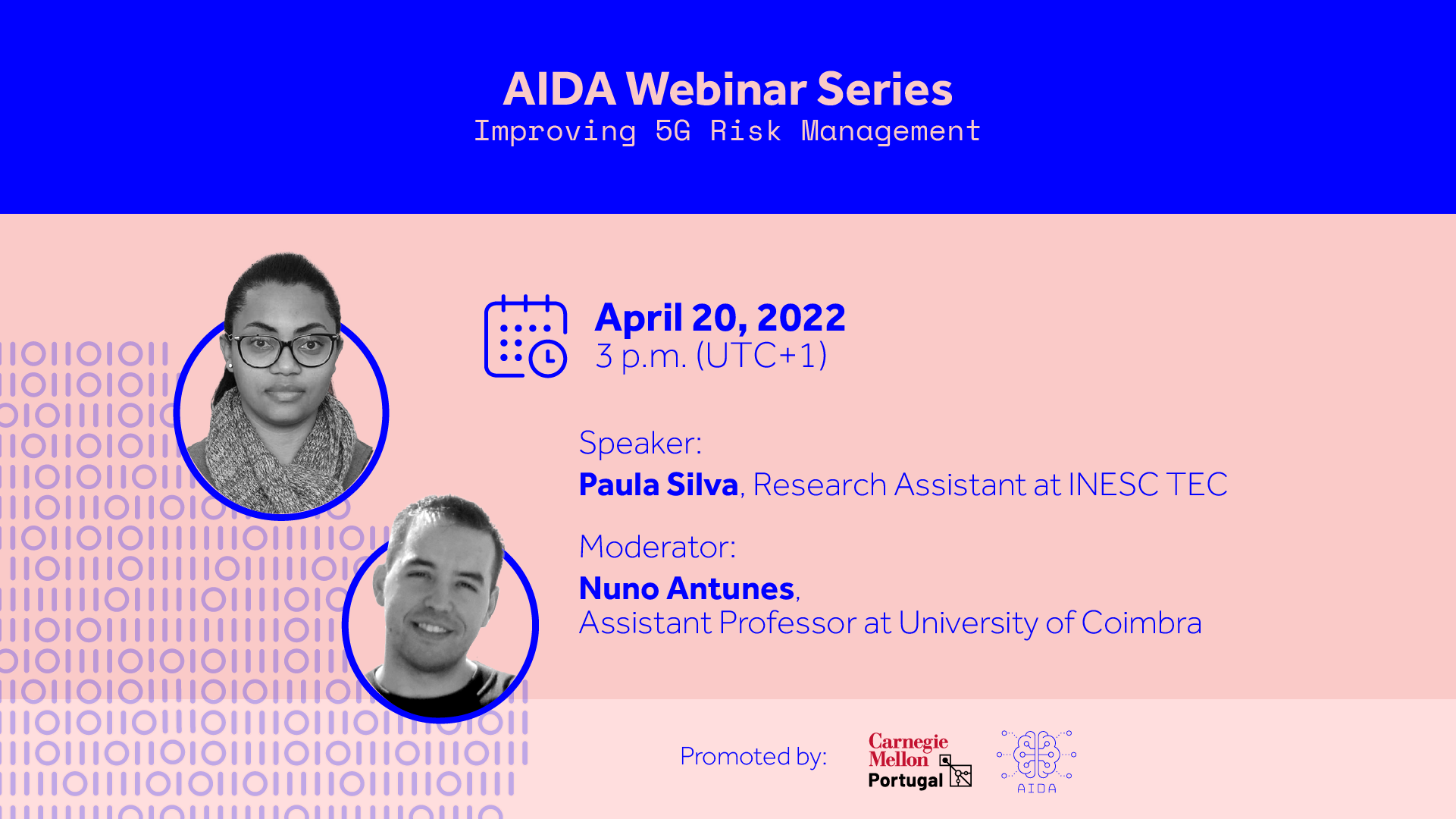
The third Webinar of the AIDA Webinar Series I Improving 5G Management promoted by the team of the Large Scale Collaborative project AIDA with the support of the CMU Portugal Program took place on April 20 and counted with over 20 participants.
The session named “Federated Learning: Methods, Applications and Challenges” had Paula Silva (Research Assistant at INESC TEC) as speaker and Nuno Antunes (Assistant Professor at University of Coimbra) as moderator.
Webinar #3 Summary: The last few years have been strongly marked by artificial intelligence, machine learning, and telecommunications networks. As a result, several challenges arose in data science regarding how data can be accessed and stored. For example, sharing of telecommunication network data, for example, even at high aggregation levels, is highly restricted nowadays due to privacy legislation and regulations and other critical ethical concerns. It leads to scattering data across institutions, regions, and states, inhibiting the usage of AI methods that could otherwise take advantage of data at scale.
The Webinar #4 will take place on June 8 at 3pm (UTC+1) named “Protecting the Security of the AIDA platform and the Privacy of its Data” with Nuno Antunes (Assistant Professor at University of Coimbra) and Cláudia Brito (Research Assistant at INESC TEC) as speakers.
The “AIDA Webinar Series I Improving 5G Risk Management” will count in the total of five (5) Webinars held every two months from December 2021 to September 2022, gathering leading experts from academia to industry involved with the project.
To watch the Webinar #3, click below.
For more about this Webinar Series visit the AIDA Website.
The 2022 Lisbon Machine Learning Summer School (LxMLS 2022) will take place between July 24th and July 29th at the Congress Center of Instituto Superior Técnico. For the second year, CMU Portugal proudly associates with this yearly reference event.
This year’s edition returns as an in-person 6-day event after two years online due to Covid restrictions. The deadline for applications is May 15th, 2022, and the application form is available online.
Important Dates
—————
* Application Deadline: May 15, 2022
* Decision: June 1, 2022
* Summer School: July 24 – 29, 2022
Topics and Intended Audience
—————
The school will cover a range of Machine Learning (ML) topics, from theory to practice, that are important in solving Natural Language Processing (NLP) problems that arise in the analysis and use of Web data.
The target audience is:
* Researchers and graduate students in the fields of NLP and Computational Linguistics;
* Computer scientists who have interests in statistics and machine learning;
* Industry practitioners who desire a more in depth understanding of these subjects.
Features of LxMLS
|—————
* No deep previous knowledge of ML or NLP is required, but the attendants are assumed to have some basic background on mathematics and programming;
* Days are divided into morning lectures and afternoon lab sessions and practical talks;
* The guide for the labs will be provided one month in advance. You can check here the guide used in previous editions.
* A day zero is scheduled to review basic concepts and introduce the necessary tools for implementation exercises
* Lecturers are leading researchers in machine learning and natural language processing





 The Safeforest project is developing an advanced robotic system for Forest Cleaning and Fire Prevention. The project intends to create semi-autonomous mobile platforms that can execute a land clearing mission to drastically reduce costs associated with the maintenance of private or public forests, plus control and reduce the propagation of large forest fires.
 The iFetch project proposes to deliver a new generation of task-oriented conversational agents that interact and support users seamlessly using verbal and visual information. This innovative project will allow interaction with consumers through a multimodal interface, providing an experience close to the one you have in a physical store.
 May 18: MAIA, enabling chats to develop multilingual conversations
 Additionally, CMU Portugal Affiliated Ph.D. student Tamás Karácsony at FEUP and INESC TEC submitted a poster now being displayed at Encontro Ciência with the title “3D Motion capture technologies for clinical patient monitoring – a short summary” that was exhibited at Ciência 2019 digital screens.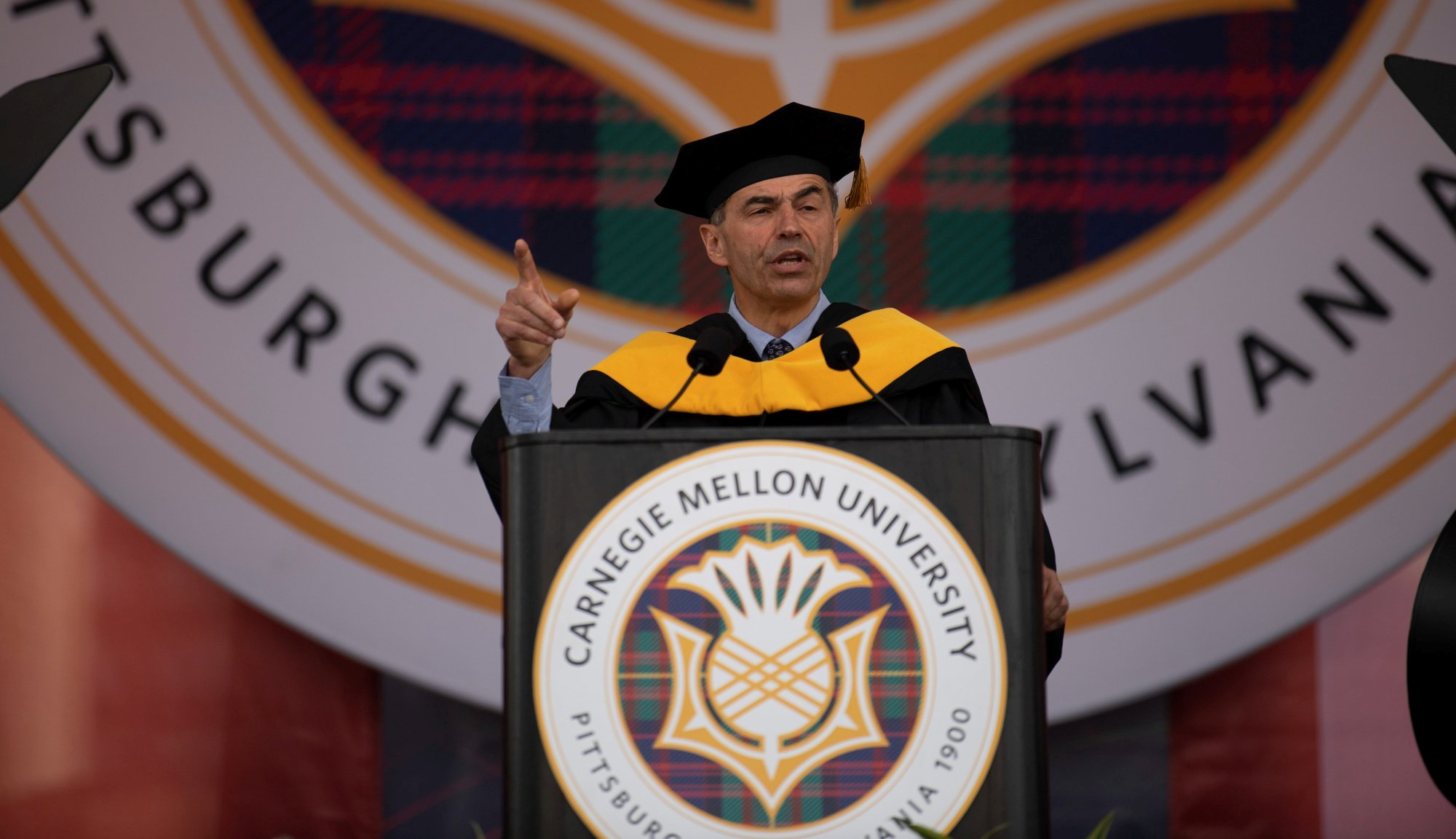

 On Friday, May 13th,