The CMU Portugal Symposium 2017 Reached its Goals

The 2017 symposium had over 200 attendants
The CMU Portugal Symposium 2017 Reached its Goals
opening_FCT

The CMU Portugal Program hosted one of its biggest events yet, the CMU Portugal Symposium 2017. With the presence of the External Review Committee (ERC) members, some of the most illustrious names in Portuguese and American academia and over than 200 participants, it was a great day of networking and sharing of knowledge.

The opening session kicked off the event, with the welcoming words of João Claro, the National Director of the Carnegie Mellon Portugal Program (CMU Portugal); James Garrett, the Dean of the College of Engineering at Carnegie Mellon University (CMU); Paulo Ferrão, the President of the Fundação para a Ciência e a Tecnologia (FCT), and Sebastião Feyo de Azevedo, the Rector of the University of Porto (U. Porto).

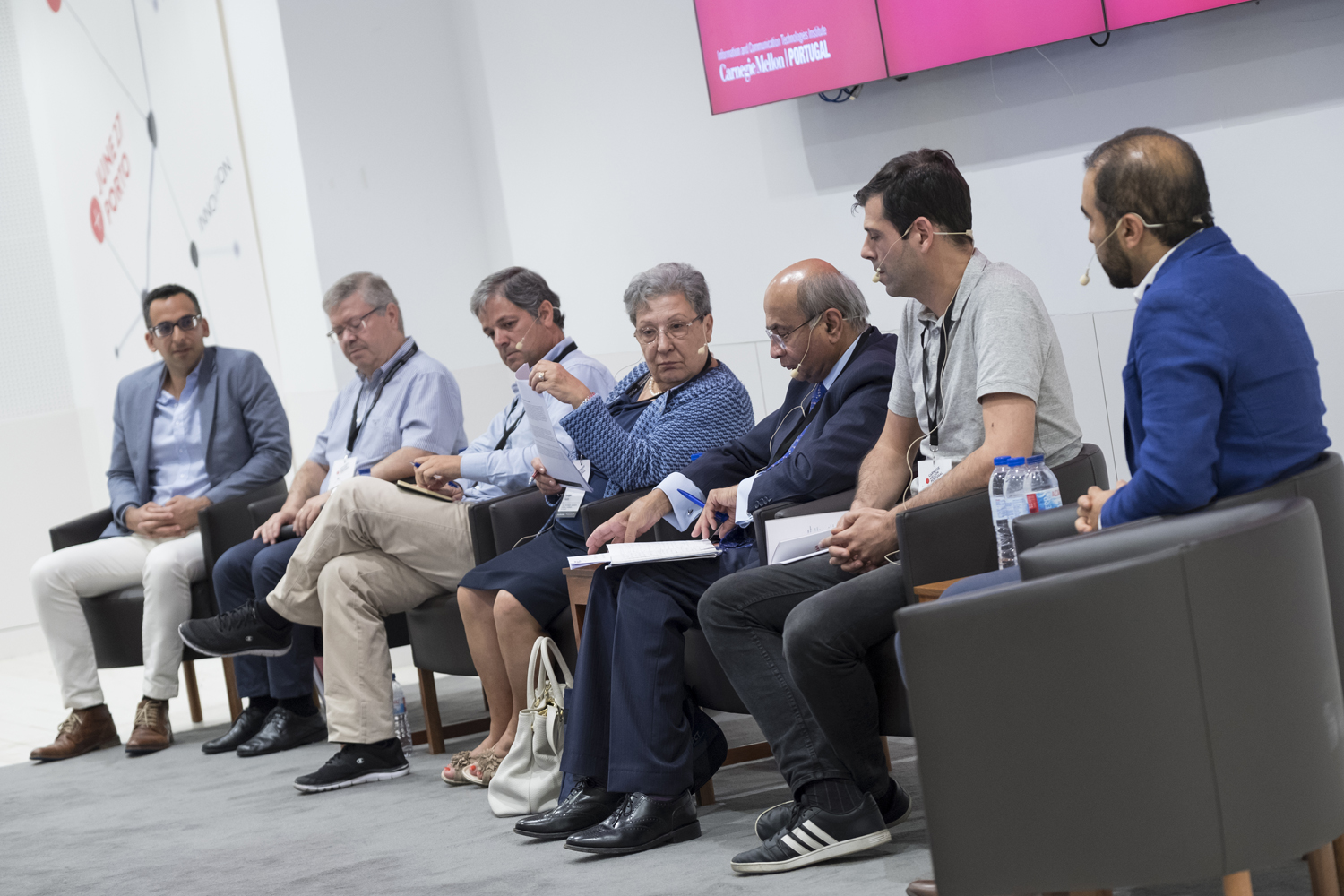
The first panel, titled ‘Building knowledge and talent’, was a discussion on the current state of higher education, faced with the challenge of preparing students for the digital future. The panel was composed of two recently graduated CMU Portugal doctoral students, Susana Brandão and Leid Zejlinovic that provided their perspective of someone who just entered the job market and shared their CMU Portugal Program personal experience; and Professors Manuela Veloso, Head of the Machine Learning Department at CMU and Pedro Guedes de Oliveira, from Faculdade de Engenharia of the University of Porto (FEUP). Panel1_discussion

The speakers talked about the teachers’ concerns and how fast computer science has evolved in their lifetimes. They seemed to agree that the primary concern of educators, in the face of an ever-changing area of study, should be to teach students to be flexible, approaching problems in novel ways, and to find solutions and information for themselves. The panel was moderated by the Dean of FEUP, Professor João Falcão e Cunha.

After the first coffee break, Jelena Kovacevic, the Head of the Electrical and Computer Engineering Department at CMU, lead the second panel on the theme ‘Building technologies and ventures’. This session had the participation of four entrepreneurs as speakers, three of them with an academic background, but they all had in common at least one of the CMU Portugal Program initiatives – experiences that influenced their entrepreneurial paths in a positive way. Symposium_panel 2

Paulo Marques was the first participant of the Faculty Exchange Program (FEP) and later funded the highly successful Feedzai. Frederico Carpinteiro is the CEO of Adapttech who participated in the 2015 edition of inRes, a two-person team with his co-founder Mário Saenz Espinoza. Professor Pedro Oliveira evolved a CMU Portugal lead project into the Patient Innovation platform, a ‘Non-Profit Startup of the Year’ in the 2016 Healthcare Startup Awards. João Paulo Cunha, Principal Investigator of the VR2Market Entrepreneurial Research Initiatives (ERI), is a candidate to be the next to spin off the results of research into a company, as a team from this ERI will be taking part of the inRes challenge this year.
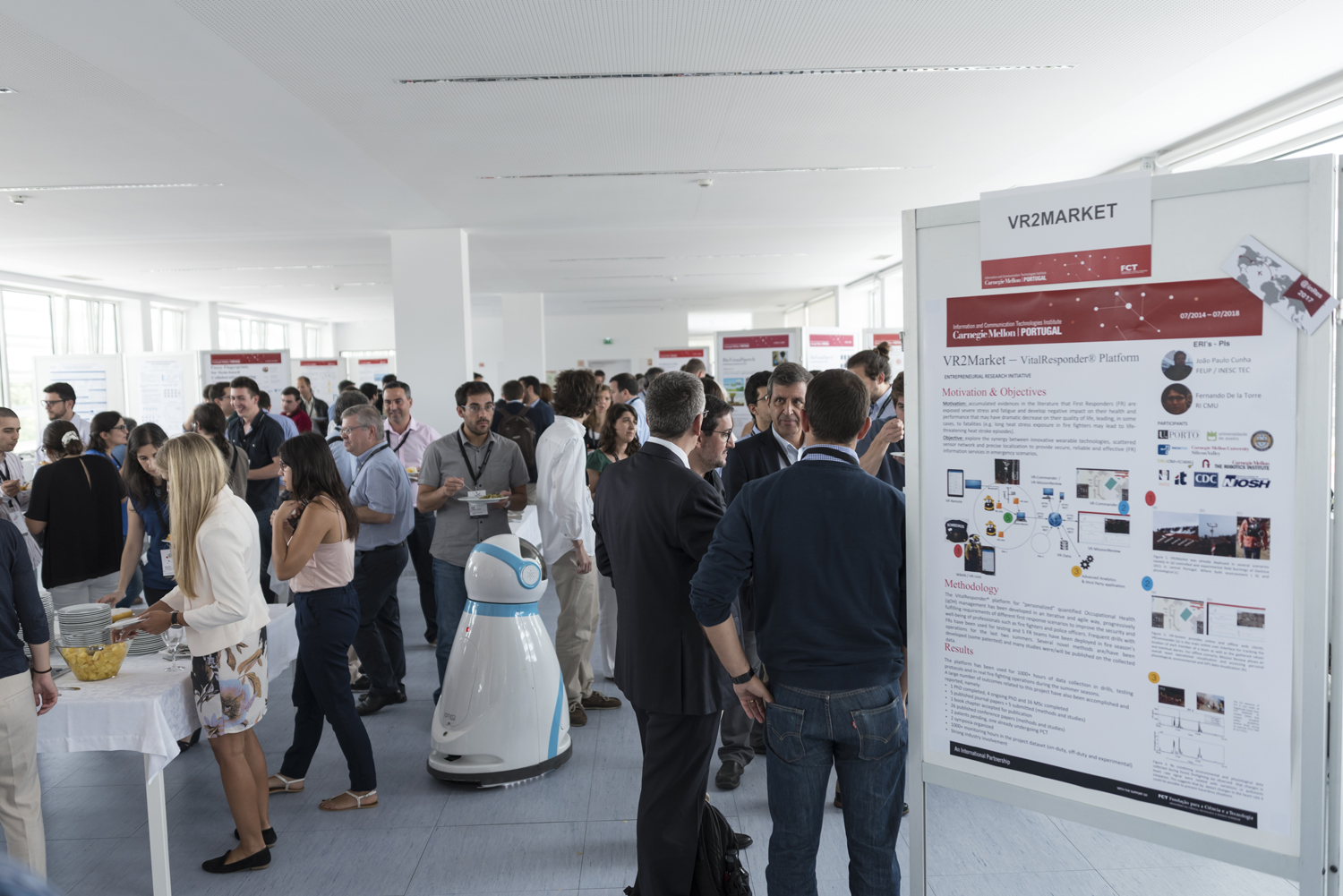
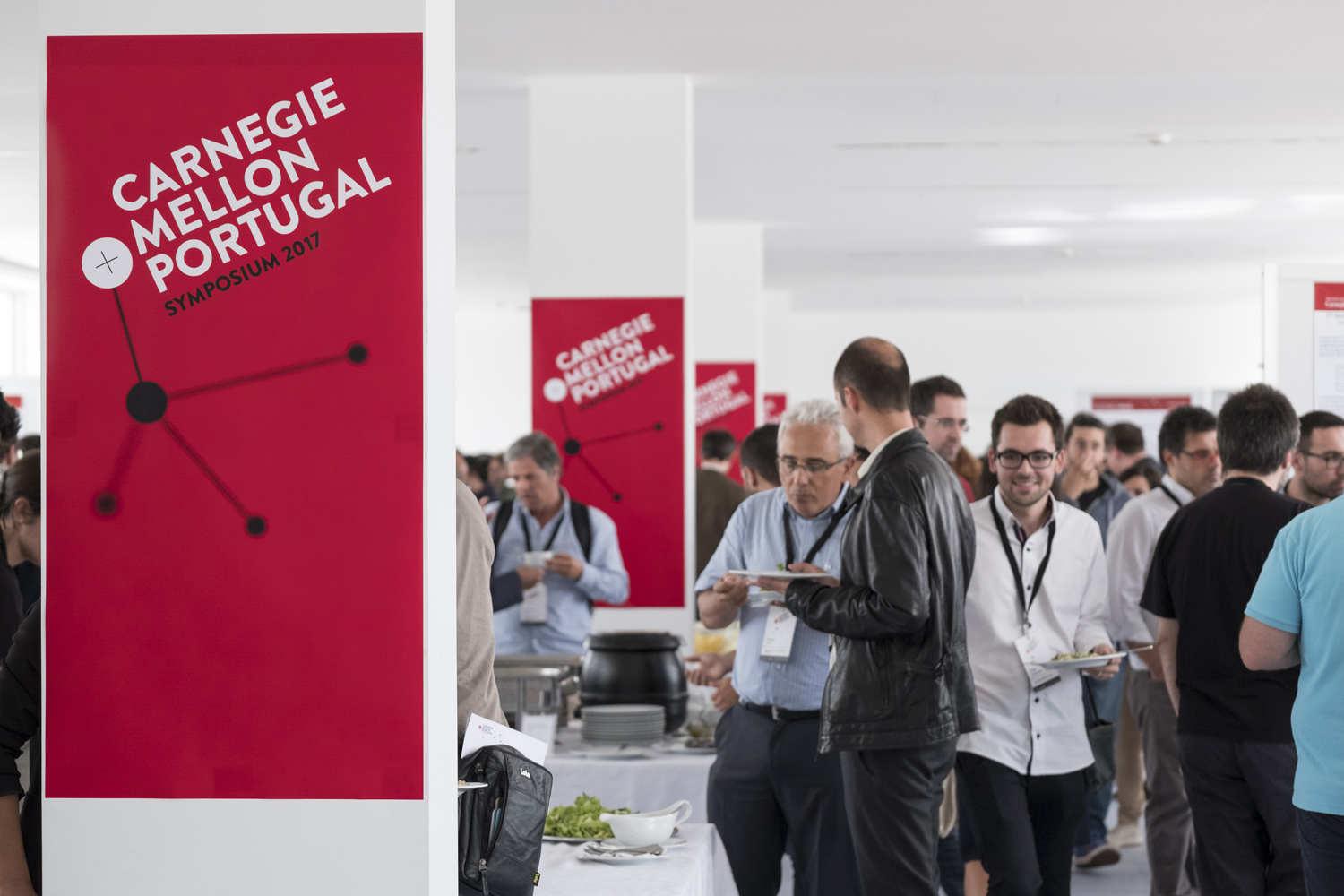
Lunch_overview The posters and demos session featured the ongoing ERIs and took place at the fourth floor space, alongside with lunch. Among the many researchers presenting their work, one would find several types of ground breaking technology, including two interacting robots, and also an agility game projected on the floor that entertained many of the visitors.

The posters and demos session featured the ongoing ERIs and took place at the fourth floor space, alongside with lunch. Among the many researchers presenting their work, one would find several types of ground breaking technology, including two interacting robots, and also an agility game projected on the floor that entertained many of the visitors.

All of the ERIs projects had a booth to display their research and ten out of twelve had demonstrations for the public, ranging from the aforementioned robots and interactive experiences, to more simple formats, like videos, testimonials, and graphs to illustrate what they have achieved so far. The room was almost covered with posters, 38 in total, both from the projects that highlighted different parts of the research, but also from CMU Portugal dual degree Ph.D. students.

After this very successful session, the panels continued during the afternoon in the first floor auditorium, this time with presentations of each of the ERIs and a discussion on the projects, open to the public and attended by the External Review Committee.

The first panel of the afternoon, ‘Sensing and Networks’, was led by two ERC members, Professor Luigia Aiello from Università di Roma and Professor Tariq Durrani from University of Strathclyde. The projects presented were Hyrax: Crowd-Sourcing Mobile Devices to Develop Edge Clouds, VR2Market: Towards a Mobile Wearable Health Surveillance Monitoring Product for First Response and other Hazardous Professions, and STRETCHTRONICS: Soft and Stretchable Mechatronics for Wearable Devices: Fabrication, Implementation and Applications. Panel3_discussion

The PIs presented their projects, followed by a discussion among all. The Hyrax project was represented by the Portuguese PI Fernando Silva and a research team member Hervé Paulino. VR2Market was presented by PI João Paulo Cunha and Stretchtronics had PI Carmel Majidi and Mahmoud Tavakoli as representatives.

Symposium_panel 4 The following panel, ‘Humans and Machines’, also had the moderation of Professor Aiello, but this time with the collaboration of Professor Helmer Strik from Centre for Language and Speech Technology of Radboud University.The same format was applied here: PIs Alexandre Bernardino and Asim Smailagic presented AHA: Augmented Human Assistance, INSIDE: Intelligent Networked Robot Systems for Symbiotic Interaction with Children with Impaired Development was showcased by PI Francisco Melo and Pedro Lima, and BioVisualSpeech: An Interactive Platform for Speech Therapy with Visual Bio-feedback was introduced by PI Sofia Cavaco and Margarida Grilo. After a brief intermission, the fourth panel, titled ‘Our Data Dominated World’, featured the projects GoLocal: From monitoring global data streams to context-aware recommendations, SCREEN-DR: Image Analysis and Machine Learning Platform for Innovation in Diabetic Retinopathy Screening, and S2MovingCity: Sensing and Serving a Moving City. In a session moderated again by Professor Helmer Strik and Professor Scott Acton from Virginia Image and Video Analysis Laboratory of University of Virginia, the projects were exhibited by: for GoLocal, Pável Calado and Rodrigo Rodrigues; for SCREEN-DR, PIs Aurélio Campilho and Asim Smailagic; and for S2MovingCity, PI Susana Sargento. Symposium_panel 5
Symposium_panel 6 The day’s last panel, focused on ‘Management and Policy’, had Douglas Sicker, the Head of the Engineering and Public Policy Department at CMU and Björn Asheim from the Centre for Innovation, Research and Competence in the Learning Economy of Lund University as hosts. As for the ERIs, TEIPL: Technology, Entrepreneurship and Innovation Policy Lab was represented by its PIs, Pedro Oliveira and Helena Canhão; E4VALUE: Innovation Dynamics in Aeronautics and Embraer in Évora brought PI Miguel Amaral and Ana Barros; and +ATLANTIC: Science and Technology Policy and Innovation Analysis to Maximize the Economic, Environmental and Social Benefits of Deep Sea Exploration and Oil and Gas Development in the South Atlantic Region had the presentation of PIs Ramiro Neves and Scott Matthew.
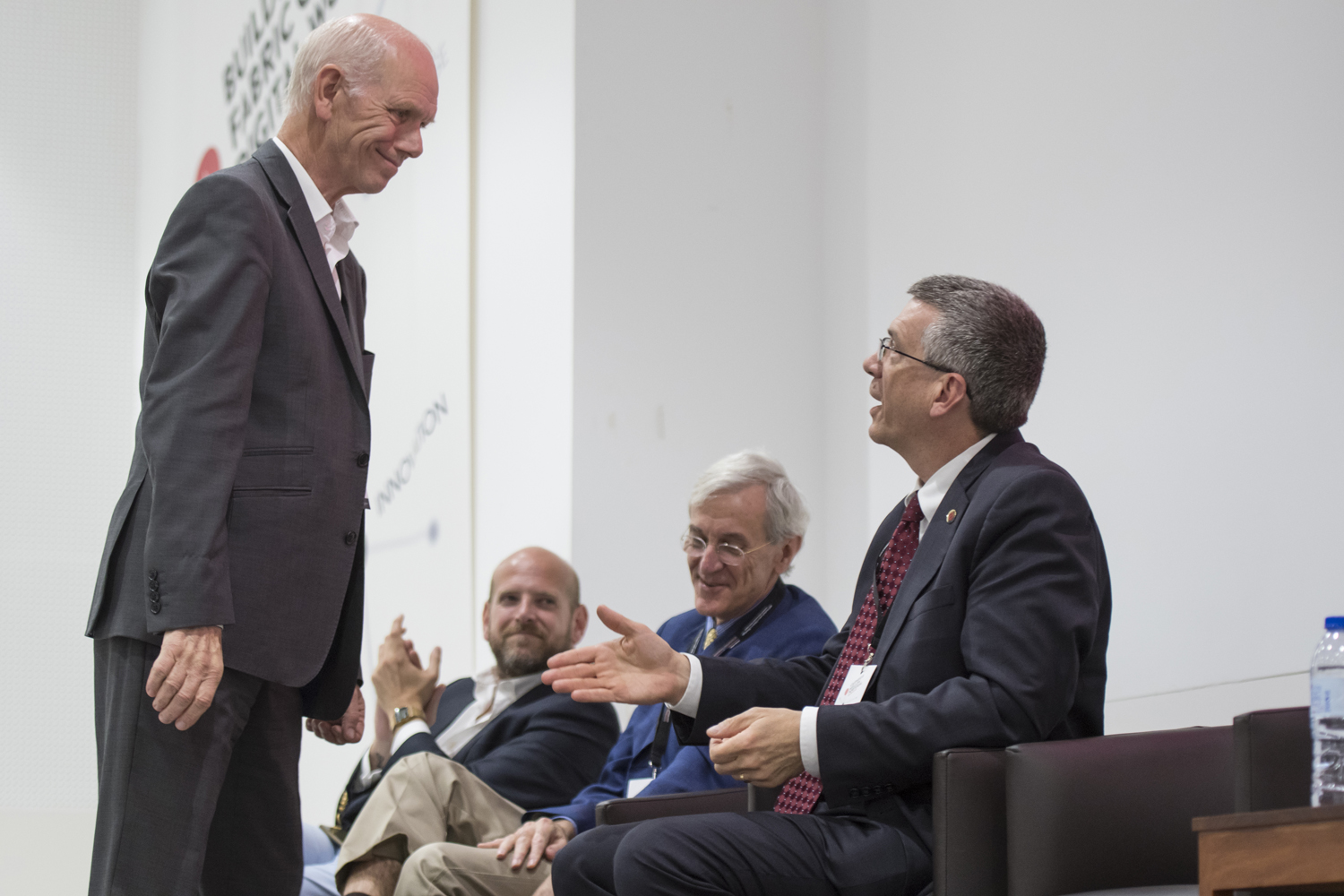
To end the day on a positive note, André Jacques, the Chief Marketing Officer of Porto Business School, was the first keynote of the closing session, followed by José Fonseca de Moura, the CMU Portugal director at CMU and James Garrett. The event was concluded with the words of the ERC Chairman, Sir John O’Reilly, from University College London, SERC, A*STAR, Singapore. Symposium_closing session

June 2017

Symposium_coffee break Lunch
Panel3_JPC Panel1_MV

Carnegie Mellon University President meets with Portuguese Minister of Science, Technology and Higher Education and the President of FCT

CMU visits CMLA delegation led by the President of Carnegie Mellon University (CMU) is in Portugal on July 16 and 17, 2017. The visit is an initiative of the Portuguese Minister of Science, Technology and Higher Education, Manuel Heitor, and the President of the Fundação para a Ciência e a Tecnologia (FCT), Paulo Ferrão, with the purpose of discussing the future of the partnership between Portugal and a CMU.
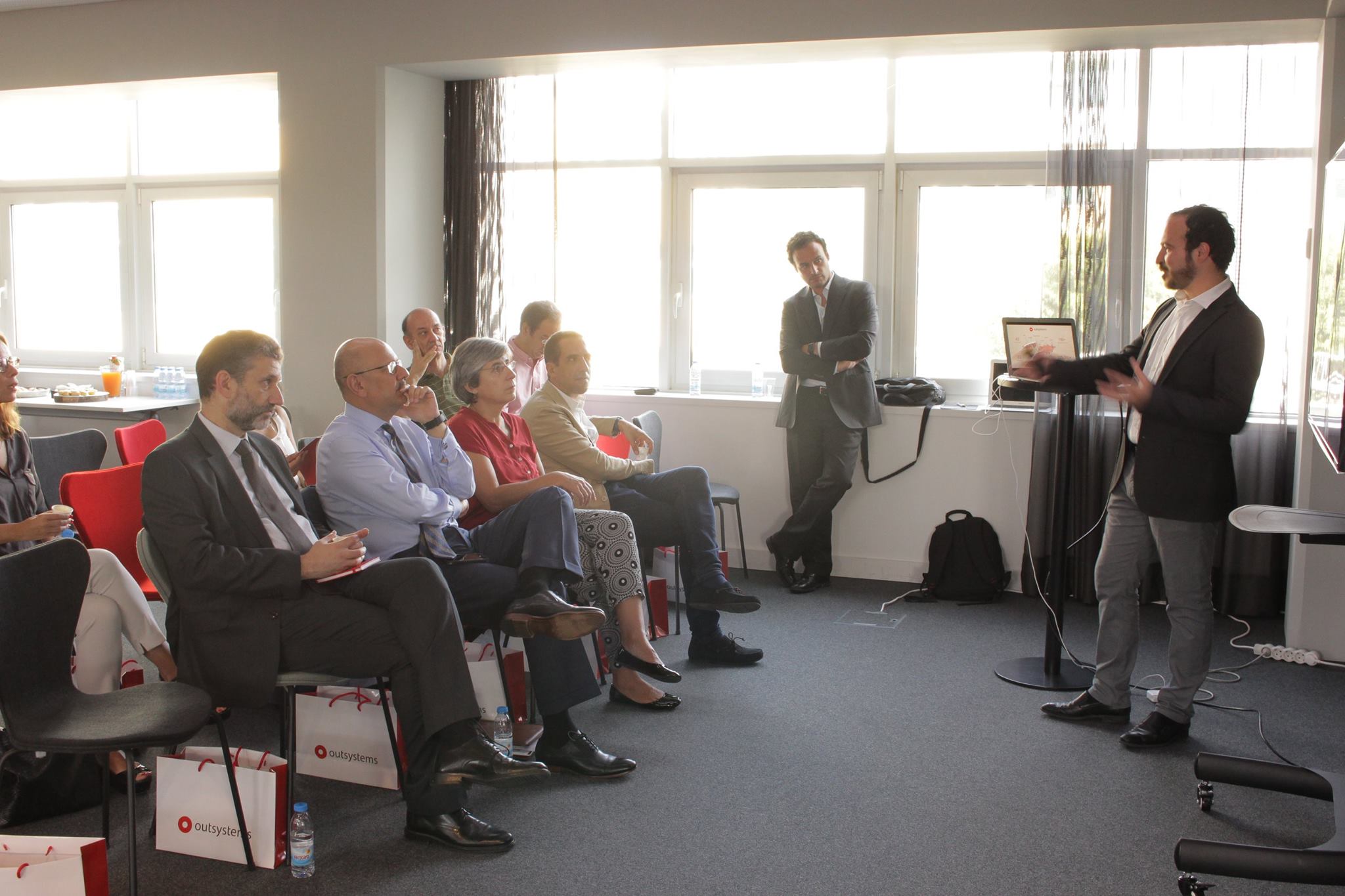
Farnam Jahanian, the President of CMU, has a scheduled meeting with Manuel Heitor, the Portuguese Minister of Science, Technology and Higher Education, and with Paulo Ferrão, the President of FCT.

Also on the agenda are meetings, visits to companies, and an extended debate with representatives of Portuguese universities and research institutions, as well as entrepreneurs, business leaders, and representatives of other public institutions.

“The partnership between CMU and the Portuguese universities has already created a fertile international ecosystem, in capturing talent, in research, and the flow of ideas and people, between academia and companies, that has already resulted in a unique culture that goes from science to innovation. This spirit has given rise, for example, to 11 startups within the scope of the Program, with hundreds of jobs in cutting edge technologies in the country and that have already attracted a very significant foreign investment. The purpose of this visit is to deepen the collaboration between Portugal and CMU as an agent of change, by developing activities that are significantly different from those traditionally associated with the university and which reinforce the entrepreneurial spirit and innovation of Portuguese academics, creating jobs of high quality and wealth in Portugal”, states the director of the partnership at CMU, José M. F. Moura.

The Carnegie Mellon delegation, in addition to the President, Farnam Jahanian, is composed of Manuela Veloso, Head of the Machine Learning Department; Jodi Forlizzi, of the Human-Computer Interaction Institute and the School of Computer Science; Raj Rajkumar, Department of Electrical and Computer Engineering, and Director of the Metro 21 initiative and the GM Collaborative Research Lab; Rick Siger, Director of Strategic Initiatives and Engagement at CMU; and José M. F. Moura, Director of the CMU Portugal Program at CMU.

July 2017

CMU visits Outsystems 2017

Carnegie Mellon University President meets with Portuguese Minister of Science, Technology and Higher Education and the President of FCT(2)

CMU delegation visits Portugal to discuss the future of the Partnership Carnegie Mellon University President meets with Portuguese Minister of Science, Technology and Higher Education and the President of FCT
CMU visits CML

A delegation led by the President of Carnegie Mellon University (CMU) is in Portugal on July 16 and 17. The visit is an initiative of the Portuguese Minister of Science, Technology and Higher Education, Manuel Heitor, and the President of the Fundação para a Ciência e a Tecnologia (FCT), Paulo Ferrão, with the purpose of discussing the future of the partnership between Portugal and a CMU.
Farnam Jahanian, the President of CMU, has a scheduled meeting with Manuel Heitor, the Portuguese Minister of Science, Technology and Higher Education, and with Paulo Ferrão, the President of FCT.

Also on the agenda are meetings, visits to companies, and an extended debate with representatives of Portuguese universities and research institutions, as well as entrepreneurs, business leaders, and representatives of other public institutions.

“The partnership between CMU and the Portuguese universities has already created a fertile international ecosystem, in capturing talent, in research, and the flow of ideas and people, between academia and companies, that has already resulted in a unique culture that goes from science to innovation. This spirit has given rise, for example, to 11 startups within the scope of the Program, with hundreds of jobs in cutting edge technologies in the country and that have already attracted a very significant foreign investment. The purpose of this visit is to deepen the collaboration between Portugal and CMU as an agent of change, by developing activities that are significantly different from those traditionally associated with the university and which reinforce the entrepreneurial spirit and innovation of Portuguese academics, creating jobs of high quality and wealth in Portugal”, states the director of the partnership at CMU, José M. F. Moura.

The Carnegie Mellon delegation, in addition to the President, Farnam Jahanian, is composed of Manuela Veloso, Head of the Machine Learning Department; Jodi Forlizzi, of the Human-Computer Interaction Institute and the School of Computer Science; Raj Rajkumar, Department of Electrical and Computer Engineering, and Director of the Metro 21 initiative and the GM Collaborative Research Lab; Rick Siger, Director of Strategic Initiatives and Engagement at CMU; and José M. F. Moura, Director of the CMU Portugal Program at CMU.

July 2017

CMU visits Outsystems 2017

Co-Design Problem Paper from CMU Portugal Alumni Awarded

Co-Design Problem Paper from CMU Portugal Alumni Awarded
Sérgio Pequito and two colleagues received the O. Hugo Schuck Best Paper Award at the 2016 American Control Conference.

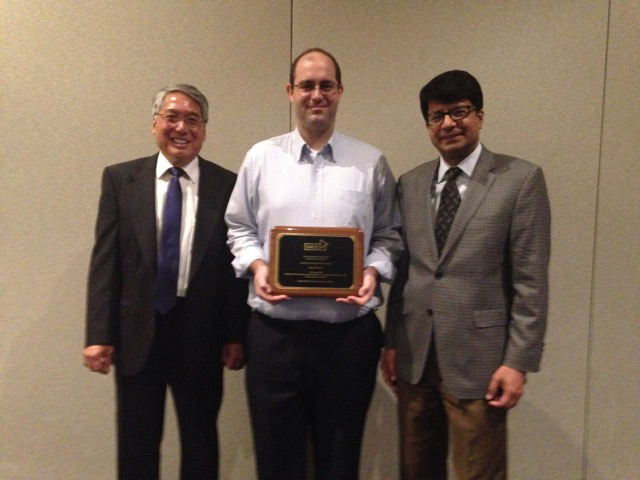
SergioPequito_Award_AACC The paper “Minimum Cost Constrained Input-Output and Control Configuration Co-Design Problem: A Structural Systems Approach,” written by CMU Portugal Alumni Sérgio Pequito, CMU Alumni Soummya Kar, and George J. Pappas, the Joseph Moore Professor and Chair of the Department of Electrical and Systems Engineering at the University of Pennsylvania, received the O. Hugo Schuck Best Paper Award at the 2016 American Control Conference, that took place last July.

“I was pleased, honored and humbled to accept this award since it is one of the major recognitions in my field. Also, being recognized for your hard work motivates you to work even harder to excel”, recalls Sérgio Pequito.

The former CMU Electrical and Computer Engineering PhD student highlights that this award was only possible due to his previous research.

“I received the O. Hugo Schuck Best Paper Award at the 2016 American Control Conference for a paper that was only possible due to the techniques developed during my PhD”, refers Sérgio Pequito.

“We gave new insights in what to measure and control, and to which actuator do we need to provide the measurements; thus, unveiling a relationship that remained elusive for quite some time”, explains Sérgio Pequito.

According to the American Automatic Control Council, “the O. Hugo Schuck Award is given to recognize the best two papers presented at the previous Automatic Control Council. One award is for a paper emphasizing contributions to theory and the other emphasizing significant or innovative applications”.

Pequito’s co-authored paper was selected thanks to the written and oral presentation, the technical contribution, timeliness, and practicality.

Sérgio Pequito is a postdoctoral researcher in general robotics, automation, sensing & perception laboratory (GRASP lab) at University of Pennsylvania. Sérgio has been linked to CMU Portugal Program since 2009, as a dual degree doctoral student at the Instituto Superior Técnico of the Universidade de Lisboa and CMU. He received his BSc and MSc in Applied Mathematics from the IST.

Pequito’s research consists of understanding the global qualitative behavior of large scale networked systems from their structural or parametric descriptions and providing a rigorous framework for the design, analysis, optimization and control of large scale (real-world) systems. He was awarded with the best student paper finalist in the Conference of Decision and Control 2009, the ECE Outstanding Teaching Assistant Award at CMU and Carnegie Mellon Graduate Teaching Award (university-wide) [Honorable Mention], both in 2012. Besides the 2016 O. Hugo Schuck Award in the Theory Category, Pequito was finalist at the 2016 EECI European PhD Award on Control for Complex and Heterogeneous Systems.

Related articles:

Sérgio Pequito Gives a Talk on “A Framework for Structural Input/Output and Control Configuration Selection of Large-Scale Systems”

Sérgio Pequito Receives ECE Outstanding Teaching Assistant Award at CMU

Carnegie Mellon University Gives Two Awards to Sérgio Pequito

August 2016

The Dual PhD Adventure: Great Synergies From Both Sides

Dual Degree PhD :: Filipe Condessa The Dual PhD Adventure: Great Synergies From Both Sides

After five years of doctoral studies in the scope of CMU Portugal Program, the Mikio Takagi best student paper award at the International Geoscience and Remote Sensing Symposium (IGARSS 2015) and a thesis titled – “Robust Image Classification with Context and Rejection”, the Azorean researcher Filipe Condessa successfully concludes his PhD. Congratulations for this great achievement.
When asked about this long journey, Filipe Condessa highlights the synergies created with both sides – Portugal and US – and the way this dual degree influenced his studies, professional career and also at a personal level.
To know more about Filipe Condessas’s experience read the following interview.
Filipe Condessa
Filipe Condessa Profile
Filipe Condessa began his pathway through the engineering world at the Universidade de Lisboa and in 2011, finished a Master’s in Biomedical Engineering. In the same year, Filipe Condessa started his “relationship” with Carnegie Mellon Portugal Program (CMU Portugal): he initiated the dual degree PhD in Electrical and Computer Engineering (ECE) at Carnegie Mellon University (CMU) and Instituto Superior Técnico of the Universidade de Lisboa (IST/UTL). During the PhD, his advisors were José Dias (IST/UTL) and Jelena Kovacevic (CMU).

CMU Portugal: What are your research interests?
Filipe Condessa: My main research interests are in the area of robust classification.The core idea of robust classification is to adapt the behavior of classification systems to adapt on problems where errors may appear, thus avoiding errors.

Our work in robust classification was applied on the frontier area of ill-posed image classification problems, with applications both in medical image classification and in remote sensing.

Filipe Condessa 1 CMU Portugal : How do you describe your PhD experience?
Filipe Condessa: My PhD experience was overall very positive!
I have met interesting professors and colleagues from both sides of the Atlantic.
There were clear synergies from both sides, and I believe I would have not been able to produce such interesting work just by staying in one side of the Atlantic for the five years.

CMU Portugal: What are the main aspects/differences of the CMU Portugal Partnership?
Filipe Condessa: I think the main aspect of the CMU Portugal Partnership is the contact with two different cultures.
Usually, one adapts to the surrounding environment, often without much choice to the adaptation.
A PhD student at IST will adopt many traits associated with IST, some better and some worse, and a PhD student at CMU will adopt many traits associated with CMU, some better and some worse.
By being in contact with two different work cultures (in Portugal and at CMU), I believe I was able to develop a more balanced work culture, trying to capture the best from each side.
On the other hand, there is also the CMU Portugal superstructure supporting continuously the students. This does not happen in one-sided PhD programs in Portugal, the students are left to their own devices to communicate with the funding institution.

Filipe Condessa 2 CMU Portugal: What were your main achievements?
Filipe Condessa: In terms of the achievements of our work, I think we developed a very interesting framework to deal with uncertainty in classification and that we set the corner stone for a significant amount of future work related with cost-efficient improvement of classification performance (at the cost of being able to deal with uncertainty instead of just spending more resources on improving the classifiers).
On a personal level, I would say my three main achievements during the PhD program were: (1) being admitted to the PhD program; (2) concluding the PhD program; and (3) being awarded the best student paper award at an Institute of Electrical and Electronics Engineers (IEEE) flagship conference while demonstrating the benefits of the use of robust classification in remote sensing.

CMU Portugal: Would you recommend this opportunity to other students?
Filipe Condessa: I would, I did, and I will keep recommending!

CMU Portugal: Would you like to share with us what your future professional plans will be or if you have any professional offer?
Filipe Condessa: I will be starting, in August 2016, a post-doctoral degree in CMU, advised by Professor Radu Marculescu.
The work will focus on network dynamics. There is a wide area of applications ranging from the now ever so prevalent social networks to biological networks. The core idea is to figure out how can these complex and massive networks be controlled.
This work will have a duration of two years.


PhD Thesis: “Robust Image Classification with Context and Rejection”

Abstract
Classifications systems are ubiquitous; despite efforts going into training and feature selection, misclassifications occur and their effects can be critical. This is particularly true in classification problems where overlapping classes, small or incomplete training sets, and unknown classes occur. In this thesis, we mitigate misclassifications and their effects by adapting the behavior of the classifier on samples with high potential for misclassification through the use of robust classification schemes that combine context and rejection. We thus combine the advantages of using contextual priors in classification with those of classification with rejection. In classification with rejection, we are able to improve classification performance at the expense of not classifying the entire data set. We thus add the following tools to the robust classification toolbox: 1) we derive performance measures for evaluating of classifiers with rejection; 2) we create a family of convex algorithms, SegSALSA, to classify with context; 3) we design architectures for robust classification with context and rejection that encompass interactions between context and rejection. We validate our approach on two different real-world data sets: histopathological and hyperspectral images.

Carnegie Mellon mentors confirmed for CMU Portugal’s inRes 2017 Workshops

The workshops with invited experts of the 2017 edition of inRes, CMU Portugal Program’s Accelerator, start this Thursday, July 6, in Portugal
Carnegie Mellon mentors confirmed for CMU Portugal’s inRes 2017 Workshops

Entrepreneur-in-Residence at Carnegie Mellon University (CMU), and founder and former president of startup company NoWait, recently acquired by Yelp, Robb Myer ; Kit Needham, also Entrepreneur-in-Residence at CMU and Associate Director of the “Project Olympus” accelerator; Tara Brandstad , from CMU’s Center for Technology Transfer and Business Creation (CTTEC); and Reed McManigle , Mentor in Residence and Senior Manager of Business Development and Licensing at CMU’s CTTEC are the university’s experienced mentors confirmed for the 2017 edition of inRes, Carnegie Mellon Portugal (CMU Portugal) Program’s Accelerator.

This year’s selected teams Connect Robotics – Drone2.Me ; Partida, Lagarta, Fugida ; Tourinsta – Swipe your way; and VR2Market will participate in CMU Portugal’s inRes, funded by the Foundation for Science and Technology, and have the opportunity to go through this business acceleration experience in Portugal and in the United States of America.

In Portugal, the initiative will run in the cities of Porto and Lisbon, with workshops with two CMU experienced mentors in July and August, and the coordinators of the initiative, João Claro , national director of the CMU Portugal Program, and Alípio Torre , also from CMU Portugal.

The 2017 inRes workshops with invited experts start this Thursday and Friday, July 6-7, at Porto Business School, in Porto, with Robb Myer . Kit Needham will be working with the teams on July 25-24 and August 24-25 in Porto and in Lisbon. The core team of experts from CMU, also includes the Executive Director of the Swartz Center of Entrepreneurship, Dave Mawhinney , who has been with the inRes program since its beginning.

The second phase of the program is a seven-week immersion in the United States, first in Pittsburgh and then in Silicon Valley. This is an intensive phase of validation of the business model, tuning of technological solutions and contacts with companies and investors.

João Claro , national director of the CMU Portugal Program, highlights the network of contacts that inRes allows the teams to develop, as a “decisive value added, given that these almost two months of contacts with specialists, mentors, potential users, customers and investors, have many positive consequences for the projects, as we have seen in previous editions”.

The four teams selected for the 4th edition of inRes are:

Connect Robotics – Drone2.Me – Drone delivery service, which includes a standalone air traffic management technology for drones. Eduardo Mendes, Raphael Stanzani, and João Lima are the team behind this idea, which is currently incubating at UPTEC.

Partida, Lagarta, Fugida – Digital games to develop mathematical skills. An idea from Rita Quintela and Sara Martinho.

Tourinsta – Swipe your way – App that uses the best Instagram photos next to a specific geolocation to improve the tourist experience. This startup from Braga was founded by Luca Sanfelici and Tainara Freitas.

VR2Market – Development of solutions, with real time mobile data collection and monitoring of physiological, environmental and geolocation data that support an informed decision making process, to increase operational efficiency and reduce health risk (short and long term) of first responders, such as firemen, police, lifeguards, etc. This solution, being customizable, can be extended to other professions of risk (in the sectors of Oil & Gas, Aviation, Army, etc.). Representing the project, with connection to U. Porto and INESC TEC, are Rui Rosas and Duarte Dias.

July 2017

workshop2_inres2 workshop2_inres6
workshop2_inres4 workshop2_inres3
workshop2_inres7 workshop2_Partida Lagarta Fugida

Symposium 2017 – Submission of Posters and Demos Available

Symposium 2017 Submission of Posters & Demos Available
Symposium_2017

Are you planning to participate in the 2017 Symposium of the Carnegie Mellon Portugal Program, Building the fabric of our digital world, that will be held at Porto Business School, in Porto, Portugal, on June 27, 2017?
If your answer is yes, it is now time to apply for Posters & Demos. If you are a Ph.D. student or an ERI member and you would like to present a poster concerning your research, or to showcase a prototype or technology that you are developing, this will be your opportunity.

Applications must be submitted until June 20: . For more information and to register for the event, go to

We hope to see you at Posters & Demos session.

Vital Responder might be a Spin-off – an Idea presented at VR2Market Symposium

Entrepreneurial Research Initiative :: VR2Market Vital Responder might be a Spin-off – an Idea presented at VR2Market Symposium

vr2market The Vital Responder Symposium, which took place on January 15 in Porto, brought together researchers involved in the VR2Market Entrepreneurial Research Initiative of the CMU Portugal Program, as well as some researchers interested in the theme. João Paulo Cunha, the Portuguese PI of the project and Professor at Faculdade de Engenharia of the University of Porto (FEUP), and other researchers presented some of the preliminary results of the project. It was also said that the next steps are to validate the prototype in a real environment and to put this mobile wearable health monitoring product in the market and this can be done through a spin-off.

The Vital Responder is a jacket designed for fire-fighters, who face the most demanding professional scenarios among first responders. This project has generated a large number of devices, methodologies and know-how that can be used for other professionals, such as policemen and paramedics.
The Co-Founder and CEO of IncidentAid, Sean Lanthier, was a guest at the event and besides presenting his company and product, he provided real stories and valuable advice from his 30 years of experience as a firefighter and paramedic.
After Sean Lanthier’s presentation about cloud-based mobile technologies for improving first-responder safety, João Paulo Cunha presented the whole VR2Market team and the project’s consortium.
The researchers Pedro Brandão, from Faculdade de Ciências of the University of Porto and from Instituto de Telecomunicações, José Maria Fernandes, from Instituto de Engenharia Eletrónica e Telemática of the University of Aveiro, and Ana Rita Tedim, researcher at INESC TEC and PhD student at FEUP, presented the results obtained so far on areas such as system architecture, connectivity, cloud integration, business concept validation, among others.


What is the Vital Responder?
The Vital Responder explores the synergies between innovative wearable technologies, scattered sensor networks and precise localization to provide secure, reliable and effective first-response information services in emergency scenarios’ management. With this technology based on wearable vital signs and ambient parameter sensing, one can monitor different factors (temperature, carbon monoxide, etc.) that teams of professionals are exposed to and relate them to inner-body physiological responses, such as electrocardiogram parameters, body energy expenditure, body temperature or skin sweat level, among others.

vr2market2

January 2016

CMU Portugal organizes symposium on the digital world

Symposium 2017 CMU Portugal Organizes Symposium on the Digital World
Symposium_2017

The Carnegie Mellon Portugal Program (CMU Portugal), funded by the Fundação para a Ciência e a Tecnologia (FCT), is promoting its annual event on June 27, 2017 under the theme “Building the fabric of our digital world”.

Taking place at Porto Business School (PBS), the symposium will showcase and discuss the key technological developments that are shaping the present and future digital world, in a dialogue with the Program’s community. The event will focus on topics such as robotics, sensors and advanced communications, data science, language technologies, and other relevant developments with applications in several key areas such as health, cities and industry, together with its impact on people, private and public organizations, public policies and society in general.

The event will be attended by representatives of the Portuguese higher education and research institutions and Carnegie Mellon University (CMU), as well as the President of FCT, Paulo Ferrão, the University of Porto Rector, Sebastião Feyo de Azevedo, the Executive Director of Novabase Corporate, Rogério Carapuça, the Dean of the School of Engineering at CMU, James Garret, and the Vice Provost for CMU’s International Strategy and Programs, Jimmy Hsia, all members of the Program’s Board of Directors.

The presences of several professors, researchers, students and entrepreneurs are also confirmed, who will be presenting preliminary results of the work developed within the initiatives promoted by the Program.

The National Director of the CMU Portugal Program, João Claro, states that “the objective of the symposium is to start the debate on the great challenges and opportunities presented to our society in the construction of what is and what will be our digital world.” The Director of the CMU Portugal Program at CMU, José Manuel Fonseca de Moura, points out that “this event will also allow us to show the positive contributions that the Program has given to this construction over the last few years.”

The one-day symposium will include six panels, that in the morning will focus on “Building knowledge and talent” and “Building technologies and business”, and the afternoon, on “Humans and machines”, “Sensors and networks”, “Our world dominated by data”, and “Management and Public Policy”. In parallel, there will be a demonstration of technologies developed in projects underway in the scope of the Program, and a poster presentation, with the main results of these projects.

Participation is free, but subject to prior registration at http://symposium2017.cmuportugal.org/.