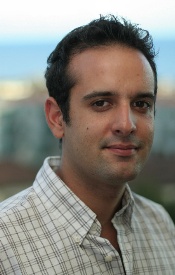
Paulo Veríssimo named ACM Fellow 2009

Paulo Veríssimo named ACM Fellow 2009

Paulo Verissimo 2010 Paulo Veríssimo, a professor and researcher at the Universidade de Lisboa’s Faculdade de Ciências (FCUL), was named 2009’s ACM Fellow (Association for Computing Machinery) for his contributions to dependable and secure distributed computing. Two years ago, Veríssimo was awarded with the title of IEEE Fellow (Institute of Electrical and Electronics Engineers). For Veríssimo these distinctions are a sign that in his 20 years of hard work, he and his team have made important advancements in the field of dependable and secure distribute computing.

Q. What is the importance of this distinction?
A. According to ACM, the ACM Fellowship is awarded for “outstanding accomplishments in computing and information technology, and/or outstanding service to ACM and the larger computing community.” So, this is an enormous honor to me, especially after having been named IEEE Fellow two years ago.

Q. What have been your contributions to dependable and secure distributed computing areas? Could you give some examples?
A. Judging from the opinion of the colleagues who were kind enough to propose and back me, I guess that works like Delta-4, that probably launched the field of modular and distributed fault tolerance, and later MAFTIA, which I guess advanced intrusion tolerance pretty much, being in essence one of the first comprehensive attempts at distributed trustworthy computing. And some other things in between…
___________ “I have been extremely lucky with the people that I have recruited over the years, not only people who are with us now, but others who left and made extremely well.” _________
Q. In some interviews, you said that your team is very important in all the work you are developing. Why are they also important?
A. Well, for two things actually. Firstly, because these fields are complex, my group has actually been moving on a hinge between theory and systems, and we love to do proofs-of-concept of almost everything we conceive or predict theoretically. If you don’t have a dream team, then your chances are smaller. They are a dream team. I have been extremely lucky with the people that I have recruited over the years, not only people who are with us now, but others who left and excelled extremely well – like for example Werner Vogel’s, Chief Technology Officer and Vice-President of Amazon. Secondly, because one of my mottos has been to show that you can have Portugal-based teams, with people trained in Portugal (be they Portuguese or foreigners) working at the highest world level, peer-to-peer with the best groups. If you get the point, the successes of the individual team members at international level are my proof of concept. And the greatest fun was doing all this while living in Portugal: good weather, food and wine, sea and sailing…

Q. What will be the next step in your career? New research projects? Developing new areas?
A. Oh, you never stop. I try to have one great idea every x years (the x is because in between you generate a lot of lousy ideas…), one that will feed our imagination and inspire us to do a thread of research. This is better than doing impulse or opportunity papers, because the sequence of projects and papers makes sense and we, a small team, may ambition to make the difference in a niche. Yes, we have quite a few new projects accepted and a few others proposed, national and international. But we are currently in such a change point after a very successful decade, so, about new areas: yes, but it´s a secret for now.
Faculty from Different Portuguese Institutions joined the Faculty Exchange Program

Faculty from Different Portuguese Institutions joined the Faculty Exchange Program

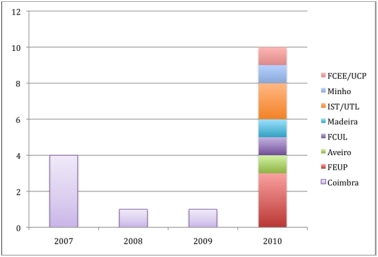
Faculty Exchange Program graphic
Estimated Number of Faculty Members who spent or shall spend at least one term at Carnegie Mellon.
The Carnegie Mellon | Portugal Program implemented in the Fall of 2009 a Faculty Exchange program, by which Portuguese academics can spend one term or more working on research and teaching at Carnegie Mellon to experience the atmosphere and culture of a top university in the United States. Carnegie Mellon professors are also given the opportunity to spend time in Portugal to engage in teaching, and research activities with local institutions of higher education and research labs.

In January 2010, five faculty from Portuguese institutions went to Carnegie Mellon under the Faculty Exchange program, namely: Nestor Cataño from the Universidade da Madeira (Uma), Jaime Cardoso and Ricardo Morla from the Faculdade de Engenharia da Universidade do Porto (FEUP), Alysson Bessani from the Faculdade de Ciências da Universidade de Lisboa (FCUL), and João Xavier from the Instituto Superior Técnico da Universidade Técnica de Lisboa (IST UTL).

The goal of the Faculty Exchange program is to accelerate the adoption of best practices through cultural immersion giving the opportunity to adopt, adapt, propagate, and consolidate the best practices of top universities.

During their time, faculty members from Portugal are exposed to the same environment and working conditions as a colleague at Carnegie Mellon University. The visitor receives a formal appointment as a visiting faculty member, is hosted by a research group, joins the teaching team of a course (undergraduate or graduate level) in a specific area of interest, and is invited to participate in various activities. The same applies to faculty members of Carnegie Mellon who join a Portuguese university for a given period of time.

It is worth noting that the University of Coimbra has been sending assistant professors for extended stays at Carnegie Mellon since 2007 in the context of the Master program in Software Engineering . All together 6 faculty members participated in this effort. The faculty exchange program increased significantly the number of extended visits to Carnegie Mellon by Portuguese faculty members, who now come from many different institutions.
_________
Statements in January 2010_

“One purpose of this action is to bring this experience to Portugal, helping to implement and consolidate same practices of teaching and research, adapting them to the Portuguese reality.” Jaime Cardoso (FEUP)

“Deepen the range of scientific contacts and collaborations at Carnegie Mellon and other U.S. universities through meetings, joint publications, and co-supervision of Ph.D students.” Ricardo Morla (FEUP)

“First, I want to gain teaching and educational experience from a top US University to be put in practice in the joint Master in Human Computer Interaction (MCHI) offered by Carnegie Mellon and the Universidade da Madeira. Second, I want to work closely with the people in the Carnegie Mellon Portugal research projects I am involved, and start new research collaborations in various research topics.” Nestor Catãno (Uma)

March 2010

Rui Meireles Reflects on his Experiences as an CS Ph.D. Student in the Carnegie Mellon Portugal Program

Rui Meireles Reflects on his Experiences as an CS Ph.D. Student in the Carnegie Mellon|Portugal Program

Rui Meireles Rui Meireles is a student of Computer Science working in his Ph.D. through the Carnegie Mellon | Portugal Program. He learned about this program while looking into Master of Science programs in Portugal. Having earned his undergraduate degree and completed an internship as a software engineer, Meireles says that he wanted to further pursue his education at the graduate level.

___________
“I realized I wanted to continue learning and not get into some routine work that would leave me unfulfilled,” said Rui Meireles.
___________
He visited the website for the Faculdade de Engenharia da Universidade do Porto and it was there noticed an announcement about a partnership between Universidade do Porto and Carnegie Mellon University.

“Like many things in life, it was a fortunate accident,” said Meireles. “A Ph.D. at one, if not the, best university in Computer Science seemed like one of those ‘once in a life time’ opportunities.” Through the Carnegie Mellon | Portugal Program, Meireles is currently involved in the research project Drive-In – Distributed Routing and Infotainment through Vehicular Inter-Networking, which is developing a way for messages to be routed between moving vehicles. “Think of two vehicles preventing an accident by exchanging trajectory information with one another,” said Meireles. The project team is working on extending the power of wireless communications to automobiles, allowing cars to exchange information with one another and the internet at large. After the successful completion of this project, Meireles is interesting in exploring other protocols and applications specific to this type of networks.

In conjuction with this project and others, Meireles has three co-advisors: one at Carnegie Mellon (Peter Steenkiste) and two at the Universidade do Porto (João Barros and Michel Ferreira). Their role is to mentor him “through the ups and downs of research.” Meireles explained that “they suggest problems for me to work on, help me when I am stymied by something and provide much valuable constructive criticism to make sure my work is as solid as can be.” Meireles says that his experience so far has been demanding but ultimately beneficial. Through his courses, he feels that that he has become an expert in his area of study and a versatile student in Computer Science.
___________
“Also, everyone is very enthusiastic and motivated about their research,” said Meireles. “In the end, there are no magic tricks, it’s all hard work.”
____________

March 2010

Mate Boban Reflects on his Experiences as an ECE Ph.D. Student in Porto

Mate Boban Reflects on his Experiences as an ECE Ph.D. Student in Porto

Mate Boban in Porto Mate Boban went to Carnegie Mellon University as a Fulbright Visiting Researcher in Electrical and Computer Engineering (ECE), a position he held from August 2007 to January 2009. It was during those 18 months that he found out about the Carnegie Mellon | Portugal dual Ph.D. Program.

“The idea of studying and doing research on two continents appealed to me instantly,” said Boban. He applied for the Program and was accepted in the spring of 2009, when he began his nine month stretch of doctorate studies at the Faculdade de Engenharia Universidade do Porto. Boban said that he immediately fell into step with life in Portugal, attending lectures, exploring the city, working with other students, and getting to know the people of Porto.

“I quite liked the warmth and the selflessness of the people in Portugal,” he said. “Furthermore, having awesome lab mates which are always up for whiteboard discussions, no matter how wacky the discussed idea seems to be, is simply priceless.”

Boban’s main research interests pertain to broad areas of computer networks. He is particularly interested in applied networks such as Vehicular Ad Hoc Networks (VANETs), which provide communications among vehicles and between vehicles and roadside equipment. Recently, he has been working in areas such as routing, quality of service, and feasibility of real-time applications. Boban is currently researching ways to efficiently implement the VANET signal behavior in the state of the art simulators.

Boban is also currently enrolled in Project DRIVE-IN (Distributed Routing and Infotainment through VEhicular Inter-Networking). The goal of this project, is to investigate how vehicle-to-vehicle communication can improve the user experience and the overall efficiency of vehicle and road utilization. Last summer, Mate’s project demonstrating how vehicular networks can support real time applications was featured on Portuguese national television. The video can be watched at the following link: https://cmuportugal.org/tiercontent.aspx?id=2210.

As part of Project DRIVE-IN, Boban also works in a research group that deals with VANETs. He coordinates bi-weekly UP VANET research meetings. UP VANET is a research group that deals with VANETs. The group is composed of approximately 20 members: 3 of them are professors and the remaining members are Ph.D. students. “On these meetings we discuss various topics related to vehicular networks by giving semi-formal presentations and then brainstorming the ideas that were presented.”

Through the Carnegie Mellon | Portugal Program, Boban has two advisors: one at Carnegie Mellon and one at the Unversidade do Porto. Advising is a collaborative program. Meetings generally occur through videoconference, although occasional “in-person” meetings do take place. “Both of my advisors are constantly involved in my research,” Boban said.

Since his enrollment in the program, Boban has worked on three major papers. One of those papers, titled “Unicast Communication in Vehicular Ad Hoc Networks: A Reality Check,” was published in IEEE Communication Letters in December 2009. The second paper, which dealt with “feasibility of interactive multiplayer games in VANETs” (“Multiplayer Games over VANET: a New Application”) has been accepted for publication in Elsevier Ad Hoc Networks journal. The last paper is currently under review by IEEE Journal on Selected Areas Communications.

In regard to his future goals, Boban is looking to keep an open mind. “In essence, I am open to any position that would allow me to have fun while working by exploring new ideas and trying to make them a reality.”

Vikram Gupta received a Best Paper Award at an International Conference

Vikram Gupta received a Best Paper Award at an International Conference

Vikram Gupta Vikram Gupta, a Ph.D. student in the Electrical and Computer Engineering (ECE), under the Carnegie Mellon | Portugal Program, received a Best Paper Award at ACM Sensys 2009 – Conference on Embedded Networked Sensor Systems, the flagship conference of the wireless sensor networks community. Gupta is the co-author of the paper titled “Low-power clock synchronization using electromagnetic energy radiating from AC power lines,” written also by Anthony Rowe and Ragunathan (Raj) Rajkumar, researchers at Carnegie Mellon University.

Before joining the Ph.D. program, Gupta was working as an associate researcher at Indian Institute of Technology (I.I.T.) Delhi, India, where he focused on Performance Assessment and Interoperability of WiMAX (802.16) on a Campus based Test Bed. Gupta is graduated of Visvesvaraya National Institute of Technology (VNIT) in Nagpur, India.

Question (Q.) What are the main goals of this paper?
Answer (A.) In this paper we designed a low-power hardware module which tunes to the Electromagnetic (EM) energy from the AC power lines in the buildings. As the frequency received from this electromagnetic energy is constant in wide geographical areas, having this common signal can help nodes in a Wireless Sensor Network to remain synchronized without exchange of radio messages. This allows considerable savings in power consumption in sensor networks, because otherwise the nodes have to exchange messages frequently to remain synchronized. The hardware module we designed is extremely low-powered and can be used with any kind of sensor nodes without any hardware compatibility issues.

Q. In your opinion, what is the implication of this paper to the research that it is done in this area?
A. This paper provides a novel out-of-band synchronization technique which wirelessly uses frequency of AC power lines with extremely low power consumption. This approach is very practical in sensor networks where the devices are extremely low powered and operate at very duty-cycles. As the AC power lines are ubiquitous, this technique is highly scalable to very large networks, which makes communication overhead for synchronization to be very minimal.

Q. How did you feel when the announcement became public?
A. I was extremely happy when I came to know about this award. I was confident that we have done good research work for this paper, but getting the best-paper award at such a reputed conference was quite remarkable.

Q. How has your experience in the Carnegie Mellon | Portugal program helped and benefited your paper?
A. Because you are co-advised by Raj Rajkumar, Carnegie Mellon, and by Eduardo Tovar, CISTER/ISEP, and the first one is the trailing author. The Carnegie Mellon | Portugal program has been very helpful with my research. The experience of doing collaborative research with advisors both at Carnegie Mellon and Portugal has given me a great opportunity of sharing knowledge with diverse yet focused research groups. Prof. Raj Rajkumar and Prof. Eduardo Tovar provided valuable guidance for my research. Their constant feedback was important in solving the research problems addressed in the paper.

Read full paper at: http://www.andrew.cmu.edu/user/agr/pubpg/sensys-09.pdf

January, 2010

Jerónimo Rodrigues and his Qualifier Exam Experience

Jerónimo Rodrigues and his Qualifier Exam Experience

José Jerónimo Moreira Rodrigues Jerónimo Rodrigues is a Ph.D. student in Electrical and Computer Engineering (ECE), under the Carnegie Mellon | Portugal Program. In an interview, Rodrigues talks about his Ph.D. Research and about the qualifier exam experience.

Question (Q.) After just two months of study at Carnegie Mellon University, you have taken your Ph.D. qualifier in ECE. What are your thoughts on this experience?
Answer (A.) It is good to know early on that we meet the requirements that Carnegie Mellon sets for a student. However, looking behind in time, I feel that I could have done better if I had postponed it. Since I did it just two months after arriving at Carnegie Mellon, it was not veary clear how I should prepare for the exam. By postponing the exam for one semester, you will have time to talk with other students who took the exam, to interact with faculty members, and to research before taking the exam. Therefore, you will perform better.

Q. What advice do you have for your colleagues?
A. My first advice is related with the qualifier. Given its importance, you should be sure that you know all the steps and requirements of the qualifier and the main capabilities that are expected from the student who is taking the exam. This link may help: http://www.ece.cmu.edu/graduate/forms/ECEQualSummaryForStudents.pdf . Also, reviewing the background area related to the work that you will present is very important. My second advice is that you take one course in the first semester. If you are not sure about the course that you like most, subscribe to several, but be sure that you choose one of them within the first two weeks. The advice that I emphasize the most is that you must have frequent meetings with your Carnegie Mellon University advisor, right from the beginning, even if he/she is very busy. I also emphasize that you should maintain good contact with your Portuguese advisor(s). Although it may not be easy, given the spatial distance, it is important! The last thing that I recommend is that you should go to the Carnegie Mellon University orientation, occurring in the first week. It is important to meet people the right people in the beginning. It is also an easy way to know some important information about the university (EGO, ICC, Physical Education, OIE, HUB, etc..).

Q. What is your current research project?
A. I am currently working in a Vision algorithm compiler, for the Honda industries. The ultimate goal of this project is to create a vision system that automates the process of inserting parts onto an assembly line.

Q. What are your main goals?
A. Learn as much as I can with the project, understand the important research topics behind it, and contribute with my ideas and my work.

Q. You have two advisors, one at Carnegie Mellon and other at IST. What kind of role do they have in your research?
A. Since I am a student pursuing a Ph.D., my advisors play a very important role ion the way that my research evolves. The guidance provided by each one of my advisors is complementary and change my way of learning in a very positive way.

Q. How do you comment your work with your advisors?
A. I tend to generate several ideas for discussion during the meeting. I think that the role of an advisor is to stress important research topics, give advice about new research directions, and help in developing ideas. Therefore, discussing several ideas/problems in the meetings is what I consider the best way to evolve in my research.

Q. What do you think of your experience of being part of the Carnegie Mellon | Portugal Program?
A. I consider the experience of doing my Ph.D. in these two universities, Carnegie Mellon and Instituto Superior Técnico, very enriching. I have found in each one a complement of the other, which makes me consider this Ph.D. more valuable than doing it just in one of the universities.

Q. What are your goals in the future?
A. I want to find topics where I can give good contributions with my research, I want to improve my relationship with my advisors, and I want to improve the way that I learn about new topics and address new challenges.

January, 2010

João Mota and his Qualifier Exam Experience

João Mota and his Qualifier Exam Experience

João Mota João Mota, a Ph.D. student in Electrical and Computer Engineering (ECE) in the Carnegie Mellon | Portugal Program, talks about his Ph.D, his research, and the qualifier exam experience.

Question (Q.) Two months after being at Carnegie Mellon University, you took your Ph.D. qualifier in ECE program. What are your thoughts on this experience?
Answer (A.) I cannot say that the qualifier is a pleasant experience. In fact, in ECE, it consists of three people trying to find flaws either in your research or in your background knowledge. In my case, they focused on the applications of my research, which is its weakest part, since what I am doing is something that nobody else had tried before. Besides that, they also asked me very specific questions related to my work and background knowledge

Q. What is your current research project?
A. I am trying to develop distributed algorithms to solve a problem that arises in the very recent theory of compressed sensing. More specifically, compressed sensing is a new paradigm in the acquisition of signals that states that it is possible to acquire signals in an already compressed form (in the usual paradigm the signals are compressed only after their acquisition). This theory has countless applications. My favorite one is a camera that has just one pixel. The applications I have in mind with my work are compressed sensing in sensor networks, namely distributed reconstruction of signals; and fast algorithms for multi-processor ambience (think for example in modern computers: how can you use efficiently all the processors?)

Q. What are your main goals?
A. My main goal is to develop distributed algorithms that are as fast, or faster, than the centralized ones. Also, I would like to give my contribution to the theory of compressed sensing (but this is a hard one…).
_____________ “Perhaps the most important aspect of the Carnegie Mellon | Portugal Program is the interaction with the faculty and students of both universities.” _____________

Q. You have two advisors, one at Carnegie Mellon and other at IST. What kind of role do they have in your research?
A. Both of them are quite good in their fields. Besides all the technical support they give me, they always ask the right questions. Crudely, their role is to pose me problems that I have to solve.

Q. How do you comment your work with them?
A. That depends on the specific part of the work, but usually it’s presencial or through web conference meetings. For small details, the email is quite effective.

Q. What do you think of your experience of being part of the Carnegie Mellon | Portugal Program?
A. So far, I have spent one year in Portugal, at a university that I know very well, and four months at Carnegie Mellon. Perhaps the most important aspect of the program is the interaction with the faculty and students of both universities. Also, living abroad in a “student city” like Pittsburgh has been quite a good experience for me. Of course, the tough part of being in the program is being far from my family, friends, and girlfriend for two years.

Q. What are your goals in the future?
A. I am not very sure about the goals for my future, but I’m considering making a researcher/professor career after completing my Ph.D.. As everyone else, I would like to make something for living that I love to do. At this moment, what I love to do is to study something related to mathematics with an eye on applications.

Q. What advice do you have for students who are preparing for their qualifiers.?
A. Well, the first advice is: know your work. By this I mean that you should know how to give a general idea, not only of the proofs of your results, but also of the proofs of other’s results that you use in your work. It’s also important that you know the definition of all the important words you say and write. My second piece of advice is: be updated. Although you might be running out of time preparing your presentation and reviewing your work, it is worthwhile to see the recent results on your area. The third one: know your committee. Talk to their students, take a peek into the courses they teach and try to guess the questions they will ask (of course, do not expect to guess right; however, this constitutes a good preparation exercise). Fourth: practice your talk. Invite students from your department, people who took the qualifier with the same members of the committee and students of the committee members to watch your presentation. I was amazed by the amount of good feedback I got when I did this. Don’t forget to bring food for them! (but not for the committee on the day of the qualifier: it’s forbidden). Finally, the fifth: don’t panic. The goal of the qualifier is to see if we can represent Carnegie Mellon at a scientific conference. So, expect the committee to be aggressive (I mean, in the nature of the questions). It is their role to question every detail of your work and this might be uncomfortable to you. Instead of panicking, try to get out of that area of discomfort graciously, by leading the conversation to where you want.

January, 2010

HCI Student Wins International Competition

Project “Automotive Mobility and Future Services”
HCI Student Wins International Competition

Nuno Laginha (HCI student) Nuno Laginha, a Professional Masters student in the Human-Computer Interaction program (MHCI) in the Carnegie Mellon | Portugal Program, was recently recognized by the Service Design Network and Volkswagen AG for his project “Automotive Mobility and Future Services.”

On October 26th and 27th, 2009, Laginha attended the Service Design Conference in Madeira, Portugal, where he was awarded first place in the Service Design Competition. The conference was hosted by the Service Design Network (SDN) and sponsored by Volkswagen.
SDN was founded in 2004 by the Köln International School of Design, Carnegie Mellon University, Linköpings Universitet, Politecnico de Milano / Domus Academy, and the agency Spirit of Creation. It is a collaborative organization whose goals are to establish and maintain a body of knowledge in the field of service design.
As stated on the SDN website, the purpose of the competition was to find new services that address today‟s changing mobility needs. Project submissions were to consider questions such as “Which social aspects of mobile lifestyles and (virtual) communities benefit from automotive services? Which services do you miss in vehicles and what would such services look and feel like?”
For Laginha, the most enriching aspect of the project was the user feedback and the field research he used to formulate his design solutions. He says that the research and methods he applied during the design process allowed him to “uncover relevant information and find opportunities instead of assuming them.”

“We go to the field in different stages of the process to investigate, evaluate, design, iterate, and implement,” says Laginha. “Through these processes, I was able to extract the driver‟s real needs and work on them to create sustainable and supportive solutions.”

Laginha says that his coursework in the MHCI program gave him “the needed tools to successfully solve this design problem.” He also points out that the program has consistently provided him with the opportunity to enact the same design process that he applied to his Service Design Competition project.

Nuno Laginha Project

____________
“The MHCI allow us to develop the capacity to deal with large amounts of data and stay focused on what is relevant regarding the final objective,” says Laginha.
______________
“This Master program presents us challenges of this caliber daily,” he says. “We develop the capacity to deal with large amounts of data and stay focused on what is relevant regar-ding the final objective.”
“I am grateful that companies like Volkswagen AG recognize more than ever the importance of HCI,” says Laginha, “and especially Service Design: Developing products and services for the future.”
As first prize winner, Laginha was awarded 1000€ as well as an all-expenses-paid trip to the conference in Madeira, where he had the opportunity to present his project. In addition, Laginha was introduced to participating Service Design practitioners, academics, and service-focused companies from all over the world. His project will also be featured in a future of Touch-point, the Service Design Journal.
Laginha holds a BA in Communication and Multimedia Design from the Instituto Politécnico de Coimbra, and is concluding his Professional Masters in human-computer interaction (HCI).

December 2009

Visiting ISQ Representatives Assess Developing Technologies

Visiting ISQ Representatives Assess Developing Technologies
Instituto de Soldadura e Qualidade (ISQ) representatives, Liliana Silva and Rui Louro, have spent this fall attending Civil and Environmental Engineering classes and project meetings to learn more about technologies that are being developed on the Carnegie Mellon campus.

Liliana Silva (ISQ) ISQ, an Applied Research Institute partner of the Carnegie Mellon | Portugal Program, is a private organization that works on technical inspection, training, consulting, research and develop-ment. Silva works for ISQ‟s Non-Destructive Testing (NDT) Technologies Department, which employs technologies like ultrasounds and digital radiography to inspect a structure without having to take it apart. Louro works in the Calcu-lation Department, which he describes as “design evaluation.” Areas in this department include Engineering Consulting, Checking of Projects, and Evaluation of Structures.

The goal of the ISQ representatives has been to observe and assess new technologies, and determine whether they might be of use to Portuguese industry. As part of their visit, Silva and Louro have sat in on classes in data management, data acquisition, and probability and statistics.
To get a first-hand perspective of different early-stage technologies, Louro and Silva have also attended many project meetings. One project, called “Instrumental Pipeline Initiative,” headed by José Fonseca de Moura, involves the development of a new application of time reversal techniques to the in-spection of natural gas pipelines. This project directly relates to Silva‟s work in Non-Destructive Testing technologies, and both Silva and Louro find it promising. “It will probably be a standard in 20 years,” says Louro of the novel application. Early in the semester, Louro had also been following another project, led by Lúcio Soibelman, that relates to the standardization of computational implementation of building norms. Different nations and organizations have different building norms, which can become a problem in international projects where structures have to satisfy different criteria. “This is not easy,” says Louro, “because the norm has hundreds of pages and there is no expert in all the building standards; there are experts in portions [of the building stan-dards]. This can be a serious problem.”
________________
Computational format, he explains, makes it easier to see differences between standards and verify designs against those codes. Although this project is in the very early stages of development, Louro says that it has huge potential.
________________

Rui Louro (ISQ) “I think it will have a world-wide impact if it comes to fruition,” says Louro. As part of this initiative, Silva and Louro have sent monthly reports on their observations, and will be debriefed for their opinions upon return to Portugal. Most projects are still in the very early stages of development, but Louro and Silva are hopeful of their eventual benefit to Portuguese industry. “While the technology is being developed,” says Louro, “you cannot pick it up and implement it right away. At a later date, we may end up using these technologies.”

December 2009