
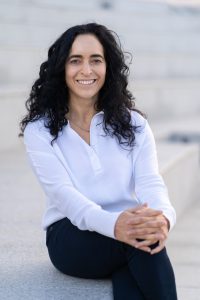
 Carla Costa was among the very first CMU Portugal Dual Degree Ph.D. candidates, enrolling in the program’s inaugural edition in 2007. Originally from Caldas da Rainha, a small town about 60 miles north of Lisbon, she pursued her dual degree in Technological Change and Entrepreneurship, hosted at Instituto Superior Técnico in Portugal and Carnegie Mellon University.
After graduating in 2013, she pursued an international academic career as an Assistant Professor at Maastricht University (2013–2015) and later at Utrecht University (2015–2021). Afterwards, she returned to Maastricht University (2021-2025). Her research interests include entrepreneurship, innovation, and strategy, with a special focus on industrial organization and dynamics.
Throughout her career, she has continued to study the intersection between industrial strategy, entrepreneurship, and innovation. After 12 years abroad, she has now returned to Portugal to begin a new chapter as an Assistant Professor at her alma mater, Técnico.
Academic Journey & CMU Portugal Experience
- You were a candidate in the first-ever CMU Portugal Dual Degree Ph.D. Call, back in 2007. What motivated you to enrol in the 1st edition of a Dual Degree Ph.D. between Portugal and USA?
At that time, in 2007, I was working at Técnico’s Entrepreneurship Office, supporting faculty and students who wanted to engage in entrepreneurship. Although I had considerable experience working closely with technology-based entrepreneurs and a master’s degree in Engineering Policy and Management of Technology, I felt the need to gain a more structured theoretical understanding of entrepreneurship to advance my career and better support startups in the academic environment. The CMU Portugal Dual Degree emerged as a great opportunity because I wanted to experience a more exciting environment and learn from different perspectives. This would take me out of my comfort zone, which is exactly what I was looking for: a challenge and the opportunity to explore new paths.
- Did the Dual Degree experience influence your decision to pursue a long-term career in academia and research?
Absolutely! My initial intention was to return to my previous line of work and apply my knowledge directly to supporting entrepreneurs and startups. I had not seriously considered an academic career because I had always been working in the private sector. Moreover, I wanted my work to have an impact, and, at that time, I did not imagine that this could happen in academia.
During the Ph.D. program, I realized that I enjoyed learning and doing research (thinking about questions and seeking answers). I also realized that I appreciated deep-diving into topics and almost losing myself in the intense focus they offer. I appreciated the sense of purpose from small contributions to the existing body of knowledge and to fuelling the conversation that leads to a clearer understanding of the economic reality in entrepreneurship. These new realizations motivated me to apply for academic jobs once I graduated. Later on, I also learned that I really enjoyed teaching and opening students’ minds to broader perspectives. Seeing them develop and helping them see the world differently through knowledge proved very inspiring for me. There are always some students who make your efforts worthwhile. I hope to have some type of positive impact from the teaching as well.
- Looking back, what skills or insights from the CMU Portugal program were most valuable to your professional journey?
The CMU Portugal program was a challenge that made me learn intensively about science, my field (the economics of entrepreneurship and innovation), but also about myself.
I learned to be more comfortable with uncertainty, with not knowing what the optimal path will be, with not having all the answers, but to keep on working and exploring different pathways. Science does not give you the comfort of feeling “in control” because when you explore a novel area, there is no map to follow. I know that entrepreneurs also feel this way, but this was a new experience for me.
A strong work ethic and dedication were also lessons I took with me. Not to compromise on what matters. Wanting and being willing to try again and to improve. It is surprising how much people can progress if given the right environment and support; this was a great lesson I took with me in my career as I try to push students to reach their potential.
Moreover, I learned about the value of multidisciplinarity and diversity. Being exposed to different approaches, perspectives, and ways of doing things yields richer, more effective outcomes and solutions. This was very clear at CMU, where interactions between different departments are institutionalized and frequent.
Professional Experience
- You spent 12 years as an Assistant Professor at Maastricht University and Utrecht University in the Netherlands. How would you describe this experience?
Working and living in the Netherlands was an enriching experience. I had the opportunity to better integrate into the European research community and to work with the local researchers as well. Moreover, I experienced a different teaching philosophy focused on student empowerment and small-scale problem-based learning. Teaching was mainly discussion-based, and I became familiar with several tools and teaching methods that support interactivity and engagement. Additionally, I was always in very international and diverse environments, both in terms of faculty and student population.
- What aspects of teaching and research in the Netherlands did you enjoy the most?
The research environment I encountered was less dynamic than what I had experienced during the program. On the other hand, there was greater emphasis on quality of life and on taking good care of one’s health.
Regarding teaching, I enjoyed the close contact with students in small groups of 13-15 per class, allowing me to get to know them by name. I also liked the focus on soft skills and the usage of technology to support engaging teaching.
- From your perspective, what are the main differences between the academic environments in Portugal, the United States, and the Netherlands?
These are indeed three very different academic environments. As a student in the US, the environment is the most competitive and ambitious, while in Europe, in general, there is more room for other priorities and more time to explore your topic independently. While in the US you have to move very fast on a somewhat designed course, you have more freedom or less support in Europe, overall. The CMU Portugal dual degree tends to follow more the US model, from my experience.
Another interesting difference comes from the institutionalization of the PhD student’s role. In the US and in Portugal, you are a tuition-paying student; in the Netherlands, you are an employee. While in the first role you have to keep proving that you’re can pass the exams and milestones set for you, in the second you are more protected but also more constrained to the research project you were hired for.
What I think is really important is the immersion in an academic environment of excellence, where you also learn about how to navigate the academic career, how to interact with your community through participation in seminars and conferences, and get a good overview of the relevant journals and communities. The best environment for this is also the US.
- After more than a decade abroad, what led you back to Portugal – and specifically to your alma mater Técnico – as an Assistant Professor?
I enjoyed my life abroad, but I decided that it was time to contribute more directly to my country and be closer to my family. I want to use my experience abroad and the different cultures I had the opportunity to integrate into to develop the field of Entrepreneurship in Portugal further.
Técnico is a special place for me because most of my graduate training took place there, creating lots of heartwarming memories. It’s a place I always like to return to. Furthermore, I think that Técnico is an institution that provides researchers with the space to grow and hosts a considerable number of excellent researchers in many different areas. I also believe that Técnico’s students have very high potential for entrepreneurship, so it’ll be a privilege to work with them and support their entrepreneurial path. I have high expectations for them.
Look into the future
- Your research is focused on industrial organization, entrepreneurship, and innovation. How do you see these fields evolving in the next decade?
The field has evolved immensely over the last decade, and I suspect it will evolve at a much higher speed in the near future. We are starting to observe the impact of AI on innovation and entrepreneurship, with much faster development cycles, easier and cheaper testing and development of business models. There is the potential to change how entrepreneurship emerges and who gets to do it. This is quite exciting to look at because it can change the dynamics of the entrepreneurial ecosystem and the relative importance of traditional actors, such as VCs. I believe it will also affect how industries and value chains distribute and carry work. It will be interesting to see how much of the expected job loss, once AI is more widely disseminated, will fuel entrepreneurship.
Moreover, the way we conduct research is also changing, given the greater availability of large data and the rise of new methods that rely on machine learning and large language models. I’m excited to see what new knowledge frontiers can be revealed.
- What advice would you give to young researchers considering a dual degree or an international academic path in these areas?
I would highly recommend the dual degree. I think it’s an amazing opportunity to experience world-class education and build a network with like-minded people from all corners of the world. I would advise young people aiming to become researchers to take the challenge and to be open to connecting with colleagues from their field and even other fields during the program. There is clearly a lot of hard work involved, but the speed of learning is remarkable, so it’s very rewarding. You also get to interact with brilliant minds like Nobel Prize winners and even astronauts, which is quite a fantastic experience.
- Finally, looking 12 years into the future, what are your main expectations for your academic and research career?
Twelve years can go by very fast. By then, I expect to have created new research collaborations, namely with young researchers, and reinforced my previous network. I expect to have further developed AI-powered research projects to uncover the mechanisms driving entrepreneurs. I expect to explore large datasets and novel research methods to understand how some employees evolve into entrepreneurs and how this embodied knowledge moves between firms and shapes industries and regions. Moreover, I expect to have had the opportunity to work with many students and support the creation and development of high-tech ventures, which involve creating new products and services and changing the world for the better.