
 Marta Freitas, CMU Portugal Dual Ph.D. student in Electrical and Computer Engineering, is the first co-author of a paper recently published in the Nature NPJ Flexible Electronics.
The paper titled “Liquid metal nano-gyroid stretchable transparent conductor for ultra-resilient optoelectronics and electroluminescence” describes a newly developed class of stretchable transparent conductor inspired by the nanostructure of dragonfly wings, an innovation that could enable a new generation of flexible and stretchable displays, wearable and foldable screens, electronic skins, soft robots, and energy-harvesting devices. The study was led by Mahmoud Tavakoli, CMU Portugal ‘s Faculty and Marta Freita’ s Ph.D. supervisor .
Marta Freitas, together with the other co-first author, Pedro Lopes, led the experimental work behind this study, from conceiving and performing the experiments to analyzing the data and contributing to the manuscript. Marta adds “we developed a transparent conductor inspired by the nanostructures found in insect wings, combining exceptional stretchability, durability, and transparency. The technology can withstand strains of up to 1400% and over 100,000 deformation cycles, while remaining low-cost, scalable, and recyclable”. These results open the door to a new generation of ultra-resilient stretchable electronics, with applications ranging from stretchable displays and wearable devices to soft robotics and energy harvesting.“
Unlike conventional transparent conductors based on brittle indium tin oxide or fragile silver nanowires, the new material relies on the deformability of liquid metal and a bioinspired nano-gyroid architecture formed through self-assembly — a structure that would be extremely difficult to fabricate using conventional lithographic techniques.
According to Mahmoud Tavakoli, “today’s displays, touchscreens, and solar cells are still fundamentally brittle. Our goal is to create electronics that are soft, resilient, and environmentally sustainable, capable of withstanding bending, stretching, impact, and even punctures without losing functionality.One of the biggest scientific challenges is combining transparency with stretchability”.
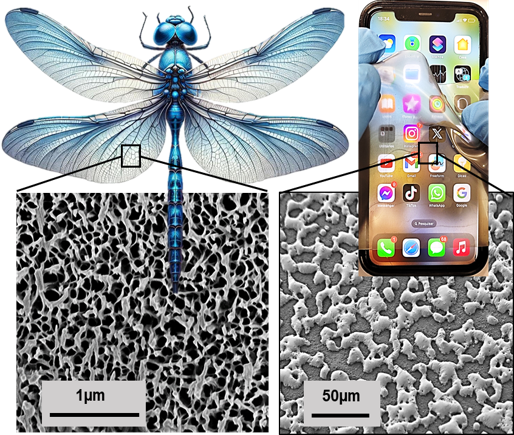
The researchers demonstrated several applications using the new material, including stretchable electroluminescent displays, wearable e-textiles, transparent heaters, UV sensors, pressure-sensitive films, and light-emitting soft robotic actuators. One demonstrated concept allows any display to become pressure-sensitive through the addition of a transparent sensing layer, enabling richer human-machine interaction for gaming, music, and interactive interfaces. The work also highlights sustainability aspects. The fabrication process is low-cost, scalable, and compatible with recycling approaches for recovering the liquid-metal-based conductive material.
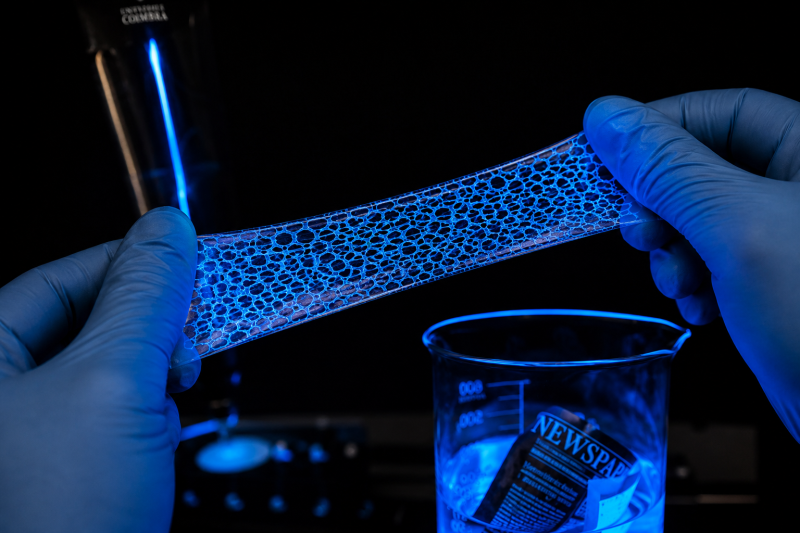
The research, carried out under the European Research Council (ERC) Consolidator Grant “Liquid3D”, was led by Mahmoud Tavakoli, Director of the Soft and Printed Microelectronics Laboratory at the Institute of Systems and Robotics of Universidade de Coimbra (UC), in collaboration with Miguel Morgado from the Department of Physics (UC) and LIBPhys.
Marta Freitas enrolled in the Dual Ph.D. program in Electrical and Computer Engineering in the 2023/2024 academic year, after pursuing a M.Sc. in Biomedical Engineering at Universidade de Coimbra. In 2022, she participated in the “Visiting Students Program”, hosted by the Mechanical Engineering Department. Impressed with her experience, she felt motivated to apply to the Dual Degree Ph.D. Program.
Currently in her 3rd year, she is at Carnegie Mellon University, since the fall of 2024, integrated in the Soft Machines Lab working alongside Carmel Majidi, a long-time CMU Portugal collaborator. In August 2026, she will return to Universidade de Coimbra, for the last 2 years of the program.
Her Ph.D. research focuses on developing soft machines with integrated sensors, batteries, and actuators, and aims to create autonomous soft robotic systems capable of sensing, actuation, and energy storage within the same deformable platform, enabling more adaptable and multifunctional devices for applications such as wearable technologies, biomedical devices, and soft robotics.
Other articles featuring this research: