
Joana Mendonça, CMU Portugal Scientific Director, is the new President of the Agência Nacional de Inovação (ANI)

Joana Mendonça, CMU Portugal scientific director and member of the Program’s faculty and research community, was appointed as the new President of the Agência Nacional de Inovação (ANI), the Portuguese Innovation Agency, for the next 3 years. This is the first time the Agency is leaded by a woman.

The CMU Portugal’s Scientific director has an extensive and successful career in Engineering and Public Policy, an expertise that will certainly be an asset for this new position as head of ANI’s Board of Directors. Joana Mendonça is an Associate professor at the Engineering and Management Department (DEG) at Instituto Superior Técnico (IST), co-coordinator of the Master program in Engineering and Management of Innovation and Entrepreneurship (MEGIE) and of the Doctoral program in Engineering and Public Policy.

Throughout the years, Joana Mendonça has participated in the CMU Portugal 2013 ERI E4Value, has been a Ph.D. Advisor of three dual-degree Ph.D. candidates, and published several papers in collaboration with Carnegie Mellon University researchers.

The ANI Board of Directors also includes Eduardo Bacelar, from the Computer Graphics Center of the University of Minho and João Borga, the executive director of Startup Portugal, a public-private think tank in charge of benchmarking government initiatives to support a thriving entrepreneurship community.

The new Board of Directors and governing bodies will begin their duties in May 2021.

Carnegie Mellon Portugal atribui 2,7 milhões a consórcio de Gestão de Resíduos

A Compta, NOVA Information Management School, Instituto Superior Técnico e 3drivers uniram-se para criar uma plataforma inovadora, recorrendo a tecnologia blockchain, que irá permitir às Entidades de Gestão de Resíduos otimizar a sua operação e implementar sistemas Pay As You Throw (PAYT).

O projeto foi um dos 10 selecionados pelo Programa Carnegie Mellon, uma parceria internacional que reúne empresas e universidades portugueses e equipas de investigação da universidade norte-americana, Carnegie Mellon University, com a missão de colocar Portugal na linha da frente da inovação em áreas-chave do campo das Tecnologias de Informação e Comunicação (ICT). O projeto conta com uma linha de financiamento de 2,7 milhões de euros do COMPETE 2020 e da FCT.

Sofia Nunes from Mambu and CMU Portugal Alumni, interviewed in Público Podcast

Sofia Nunes, one of Mambu co-founders and CMU Portugal alumni, was the first guest at “Ao Vivo”, a Podcast from Público Newspaper. The world-class company started as the result of the research project developed by three students of the CMU Portugal Master’s program in Human-Computer Interaction at the Interactive Technologies Institute in Madeira. Now, the company founded in 2009  is the most recent Unicorn Company in Germany with a valuation of over €1.7 billion.


More about the Company’s creation and involvement with the CMU Portugal Program  here.


Watch the interview (in Portuguese) starting at minute 24 👇


Inês Lynce interview in Exame Informática Podcast “Cromo da Semana”

Inês Lynce, who was recently appointed as CMU Portugal National co-director was interviewed by Exame Informática, one of the major Technology Magazines in Portugal, about her nomination to lead the Program, her work and the present and the future of AI.

During this interview she talks about the applications of Artificial Intelligence (AI) in the present and advances that are expected for the future of the area. She refers to the lack of women in Computer Engineering when she started her academic path 20 years ago and that unfortunately, this is still a reality in Portugal. She also points out topics such as the increasing importance of AI in recent years, the impact on society and the meaning of “AI for Social good”.

Watch the full interview below:

Exame Informática link

In the Media: Interview with Nuno Nunes – “90 Segundos de Ciência”

Nuno Nunes, one of the CMU Portugal National Co-directors, President of Interactive Technologies Institute – ITI and Professor at Instituto Superior Técnico was interviewed by 90 Segundos de Ciência about his work in the field of Ecocentric design. This project is developing sensors that make possible to capture the sound of whales in high seas and replicate it on mobile devices. This technology could one day be used to observe whales from land.

The CMU Portugal Co-director hopes to develop an immersive ecological experience that keeps whale watching boats at a distance, to not disturb the animals. “My research focuses on what I now refer to as Ecocentric design, based on the idea that computer technologies have evolved to allow people to have a greater ecological and global awareness of their actions”, he says.

In concrete terms, the team wants to use IoT technology in small devices that allow to capture and observe phenomena that are often not visible. Professor Nunes is currently developing a project with whales at the archipelago of Madeira. In this project, sensors are used to capture the animal sounds under water through hydrophones.

The idea is to develop an immersive interface that allows people on whale watching boats to increase their experience through their mobile devices, listening to the sound of animals and accompanied, in some cases, with images of what’s happening under water.

“This is an example of a technological intervention that allows people to be more aware of the environment when they are in leisure activities, as is the case with whales and cetacean watching”, he reinforces.

With this technology, it will be possible to observe animals from a longer distance, protecting them from the stress caused by the boats used in this activity.

Several field studies have already been carried out in Madeira with the sensors located on the vessel. Soon, Nuno Nunes hopes to be able to place sensors on the animals themselves to increase the impact and scope of this intervention.

That way, it would be possible to observe whales and cetaceans from land, thus increasing the safety distance between man and the marine environment that this technology aims to protect.

Ep. 778 Nuno Jardim Nunes – Investigação desenvolve sensores para criar experiência imersiva de observação de baleias


In the Media: Interview with João Paulo Costeira – “90 Segundos de Ciência”

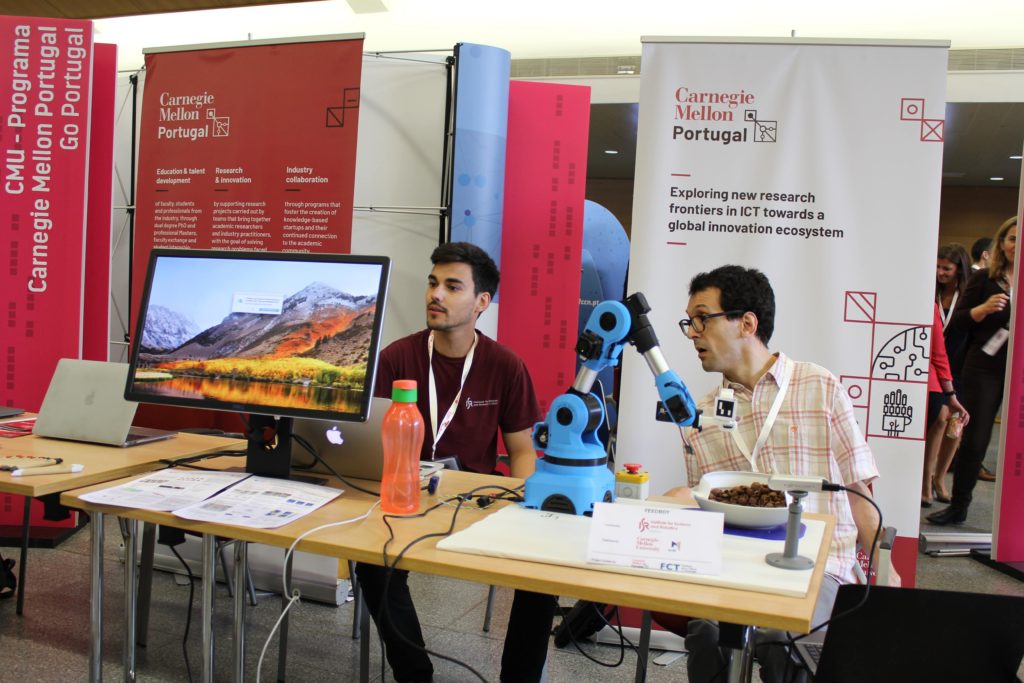
The CMU Portugal faculty member and Professor at Instituto Superior Técnico, João Paulo Costeira, was interviewed by 90 Segundos de Ciência about the Program’s Exploratory project, Feedbot, that is being developed at ISR Lisboa. The project is developing a robotic arm to help people with motor disabilities  eat independently. It was created from a specific need of its Principal Investigator, Manuel Marques, who has cerebral palsy.

The project is building upon the collaboration with Manuela Veloso, from Carnegie Mellon University, with the ISR researchers previous to this project, who initiated a challenge to  build a machine that would make Manuel Marques autonomous in his feeding process so he could feed himself without the help of third parties.

The great advantage of Feedbot is its ability to adapt to user behavior. Through perception algorithms, this arm can identify users’ movement patterns and adapt to those patterns.

In this way, the arm is able to detect an involuntary movement and wait for it to finish before bringing the food to the user’s mouth. This robotic arm can also be used by people with reduced mobility or undergoing treatment who need help to feed themselves.

Manuel Marques and his Master student Alexandre Candeias at Ciência 2019

Manuel Marques and his Master student Alexandre Candeias at Ciência 2019

Ep. 770 João Paulo Costeira – Feedbot, o braço robótico que ajuda a alimentar pessoas com deficiência motora


In the Media: Interview with Joana Mendonça – “90 Segundos de Ciência”

The CMU Portugal Scientific Director and Professor at Instituto Superior Técnico Joana Mendonça, was interviewed by 90 Segundos de Ciência about her project on the impact of Additive Manufactiring, also known as 3D  printing, in traditional manufacturing. The project, that is being developed under the CMU Portugal Program, concluded that the development of components used in the aeronautical industry, using additive manufacturing, is still not economically viable.

As part of the CMU Portugal Program, Joana Mendonça was invited to study the impact of Embraer‘s entry into Portugal. Within the scope of this study, one of the aspects under analysis was the adoption of additive manufacturing that allows you to print a three-dimensional object from a digital design that is created on a computer.

This study led to the publication of an article focused on the potential of this technology to change the configuration of parts of supply chains for the aeronautical industry. In the current model, parts are produced in large quantities in the countries of origin and then stored for shipment.

In this paper the research team evaluated the difference between producing the parts on site using 3D printing technology and of ordering the same parts from other locations, keeping it in stock for when it is needed. Both strategies imply different production, transportation and inventory costs.

“What we concluded is that as technology is today, it still doesn’t allow a decentralization of production effective to print the piece every time it is needed,”  says Joana Mendonça.

However, the expectation is that technology may someday evolve to a point where the cost-effectiveness of producing on-site parts is feasible, but this is not yet possible.

Ep. 764 Joana Mendonça – Estudo avalia viabilidade da impressão 3D na produção de peças para a indústria aeronáutica

CMU Portugal Scientific Directors visited Carnegie Mellon to foster research collaborations

A Portuguese delegation visited Carnegie Mellon University on December 12 and 13 for 2 days of networking with peers at CMU to strengthen cooperation initiatives for the third phase of the program. The delegation was composed of five CMU Portugal Scientific Directors from Portuguese Universities including Susana Sargento from the University of Aveiro, João Paulo Cunha from the University of Porto, Luís Caires from the NOVA University of Lisbon, and Rui Maranhão and Joana Mendonça both from Instituto Superior Técnico; and CMU Portugal Executive Director in Portugal, Sílvia Castro and the Head of Education João Fumega.

During the visit, organized by the CMU Portugal coordination office at CMU headed by Megan Flohr, the Portuguese committee had an opportunity to connect with CMU faculty leaders of strategic research areas of the CMU Portugal Program, heads of department and doctoral programs directors and managers of the CMU Portugal dual degree programs.

The visiting delegation had the opportunity to connect with 28 CMU faculty and researchers over the two-day visit. The CMU faculty and researchers represented 8 different departments including BioMedical Engineering, Civil and Environmental Engineering, Computer Science, Electrical and Computer Engineering, Engineering and Public Policy, the Institute for Software Research, Materials Science and Engineering, and the Robotics Institute.

The visit also aimed to provide awareness within the CMU community of the CMU Portugal initiatives that will be in place in early 2020 such as admission to the Dual PhD programs, visiting faculty and master students and future research initiatives.

During the visit a correspondent from LUSA, the Portuguese News Agency, interviewed two of CMU Portugal Scientific Directors for an overview of this visit to CMU. “I was pleased to see that CMU colleagues also consider the program as beneficial to them, and to learn that the students that we have drawn into the program are among the best candidates that they receive,” said Rui Maranhão.

He also added that in the United States, there is a really close connection between the business sector and academic research, which is beginning to happen more often in Portugal “but in a timid way” said Rui Maranhão. “In Portugal there is a long way to go, but it is possible, and the CMU Portugal Program is a good example of this effort that is confirmed by the several companies born from the previous phases of CMU Portugal.”

Susana Sargento, who was also interviewed by LUSA, considers that, “another important goal of this visit was to understand which scientific areas the program should be taken to and in which the upcoming Call for projects should be opened.”

News Article: Notícias ao Minuto

The CMU Portugal Program’s mission for Phase III is to foster industry-science relationships as agents of change with the focus on ICT research for social and economic impact. Initiatives like this last visit to CMU are an important way to promote a close bond between the two sides of the partnership and establish common ICT foundations for the future of the Program.

In the Media: Notícias ao Minuto, DNotícias, Bom dia Europa, Bom Dia Luxemburgo, Bom dia Suiça.


Stretchtonics’ researcher, Manuel Carneiro, has created a flexible, reusable and low cost electroencephalogram

A researcher at the Faculdade de Ciências of the University of Coimbra (FCTUC) has developed a low-cost, reusable wearable electronic device that promises to revolutionize electroencephalograms. The news was disclosed by LUSA and replicated by RTP among other Portuguese Media.

Manuel Reis Carneiro of the Institute of Systems and Robotics (ISR) has created a wearable fabric consisting of an ultra-thin non-rigid electrodes, produced through a specific ink that facilitates the interface between the electronic device and the brain activity. This ink was developed at ISR’s “Soft and Printed Microelectronic” Lab (SPM-UC) as part the CMU Portugal Program research project – Stretchtronics, funded by Fundação para a Ciência e Tecnologia (FCT) during Manuel Carneiro Master’s thesis. The researcher was supervised by Mahmoud Tavakoli, Professor and Director of the “Soft and Printed Microelectronic” from ISR-Coimbra and his thesis was recently distinguished at the” Fraunhofer Portugal Challenge 2019 ” competition.

Based on flexible electronics, technology that allows the creation of elastic (malleable) electronic circuits, the device is able to perform electroencephalograms much more comfortably and for much longer periods than the technology currently used in clinical practice.

“Electroencephalography is currently performed with rigid metallic electrodes placed on the scalp, which become uncomfortable over time. In addition, current methods are large, use many wires, take time to prepare and therefore require a specialized technician confining this monitoring to a Lab or hospital,” says FCTUC.

The wearable EEG developed by the ISR researcher overcomes these limitations and can be easily and quickly placed on the patient by anyone. This “wearable device” was designed to be used in emergency services “even in situations when a specialist technician is not available. In fact, any professional can place the device on and evaluate the patient’s condition.”

Manuel Reis Carneiro is already thinking of new uses for the device. “By allowing the human-machine interface, for example, a quadriplegic person can control a wheelchair through brain activity,” he says. On the other hand, as it is a very inexpensive wireless device, it can also be used for remote medical examinations (telemedicine).

The researcher and his team want to take it further and get “clinical validation in order to place this wearable on the market”. “The device is working, is effective in monitoring brain activity, is simple and inexpensive (the textile band costs between 1 and 2 euros), so we want the technology to hit the market,” concludes Manuel Reis Carneiro.

News in the media: RTP; Porto Canal; Jornal Médico; Sapo; Notícias de Coimbra; Universidade de Coimbra