First Woman Nobel Prize winner in Economics(2)

First Woman Nobel Prize winner in Economics

Ellinor Ostrom Elinor Ostrom, 76, holds a Ph.D. in Political Science, University of California from 1965, who now teaches at Indiana University where she directs the Workshop in Political Theory and Policy Analysis that she founded with her husband, Vincent Ostrom. More well-known Oliver Williamson, 77, worked at MIT and has a Ph.D. from Carnegie Mellon University. These two teachers share a prize of 10 million Swedish krona and are also a signal for the current economics that are grouped in the so called institutionalism.

Read the article online, in Portuguese, from Exame.

Workshop: Experiencing Technology Transfer: collaborating with Carnegie Mellon

Workshop “Experiencing Technology Transfer: collaborating with Carnegie Mellon”

Workshop Nov2 The UTEN Portugal, together with the Carnegie Mellon | Portugal program and Carnegie Mellon University, promotes the workshop “Experiencing Technology Transfer: collaborating with Carnegie Mellon”, from November 8 to 10, at the Institute Pedro Nunes, Coimbra.

Read the article online, in Portuguese, from Pt Science Online.

Valuing Knowledge stimulates economic development of the country

Valuing Knowledge stimulates economic development of the country

Valorização do Conhecimento The licensing of technologies and the creation of start-ups were the main themes that were discussed in the Workshop organized by UTEN Portugal, in collaboration with the Carnegie Mellon | Portugal partnership, which took place from November 8 to 10 in Coimbra.

Read the article online, in Portuguese, from CiênciaPT Online.

Carnegie Mellon prepares social and financial network


CMU_logo Carnegie Mellon is going to start a new step in its strategy, with a site to host a social network, announced Tara Branstad, one of the directors of the Center for Technology Transfer and Enterprise Creation (CTTEC) of the institution.

The major role of Carnegie Mellon is to simplify the processes “- The director of the Center for Technology Transfer and Enterprise Creation (CTTEC) of Carnegie Mellon University, Tara Brantsad believes that the large role Carnegie Mellon in transferring of technology to companies is simplify procedures and give them transparency – are a form of encourage participation. “The lack of transparency is disappointing. And it also because there is a procedure and contract to create spin-offs, ” She explains. The role of facilitator is to “promote confidence and the development of the project. “Everyone knows if you are getting involved,” stresses the responsible.

Regional organizations help in transferring technology – Much success in transferring technology of Carnegie Mellon University d had to do with the existence of individuals in startups with links to a private institution. This has been fundamental in the process of developing small businesses in order for them to be bought, with benefits for the university, said Tim McNulty, vice president of government relations at Carnegie Mellon.

Read the article online, in Portuguese, from Computer World.

Technology perspective – 4 years later

Technology perspective – 4 years later

Four years later, the Technological Plan has successfully leveraged the strategy for growth and competitiveness of Portugal, their businesses, and production centers of scientific knowledge, based on modernization, knowledge, technology and innovation, as well as the (re) qualification at all levels of its citizens. The technological plan, refers to the program with Carnegie Mellon University which involved 32 students in the executives master in software engineering, networking & information security and communication, and development of interactive digital content.

Read the Portuguese article in PDF, from AICEP Portugal Global.

GPS system gives the advantage for cars to ‘talk’ to each other

GPS system gives the advantage for cars to ‘talk’ to each other

Falar Global Is the so-named system that will allow cars to produce information collected by GPS and, via WiFi (wireless network), distribute it to other cars that are nearby. Driving will never be the same, especially in terms of security. The Drive In is being developed by the Telecommunications Institute in Porto, in partnership with the North American University of Carnegie Mellon.

Read the article online, in Portuguese, from Expresso.pt.

ROBOT WITH TOTAL AUTONOMY

ROBOT WITH TOTAL AUTONOMY

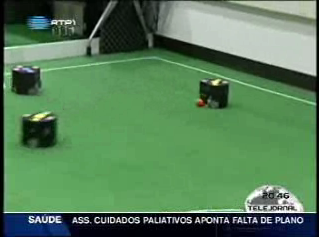
Robot Autonomy The Portuguese develop a robot with full autonomy. Comments by Manuela Veloso, Professor at Carnegie Mellon University

Source: TELEJORNAL