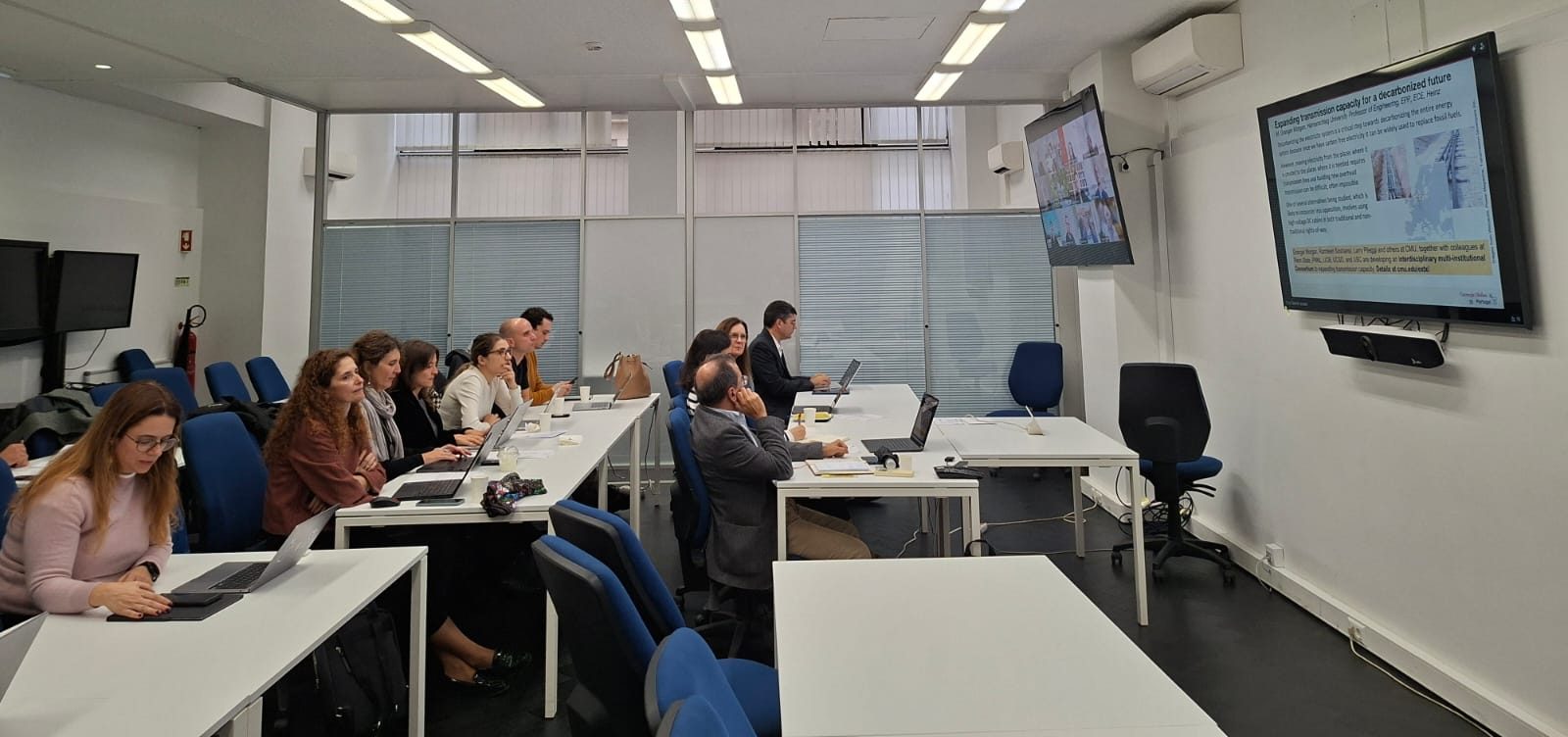
The CMU Portugal Program and PLANAPP held a joint meeting on November 24th, 2025, to explore new opportunities for collaboration in public policy, technology, and innovation. PLANAPP, Centre for Planning and Evaluation of Public Policies, is Portugal’s state body for public policy analysis and planning agency, responsible for supporting evidence-based policymaking across government sectors.
The collaborative meeting brought together twenty-three experts from Portuguese institutions associated with the CMU Portugal Program, PLANAPP representatives, and Carnegie Mellon University (CMU) faculty members, who joined remotely, to discuss shared interests in AI, energy systems, critical technologies, space technologies, and science-based policymaking.
In Lisbon, the gathering took place at INESC-ID headquarters and was led by the Program’s Scientific Director, Lia Patrício, joined by Program Co-Director Inês Lynce, Executive Director Sílvia Castro, and José Manuel Mendonça, coordinator of the mission structure for the partnerships with the US universities. Onsite participants also included Joana Mendonça (Instituto Superior Técnico), Joana Almodovar (INESC TEC), Pedro Sebastião (ISCTE), Vasco Amaral (FCT NOVA) , PLANAPP representatives Pedro Saraiva, Elsa Picão, Carolina Nogueira, Susana Sobral, Tiago Louro, and Henrique Pereira and CMU Portugal coordination office Mariana Carmo and João Fumega.
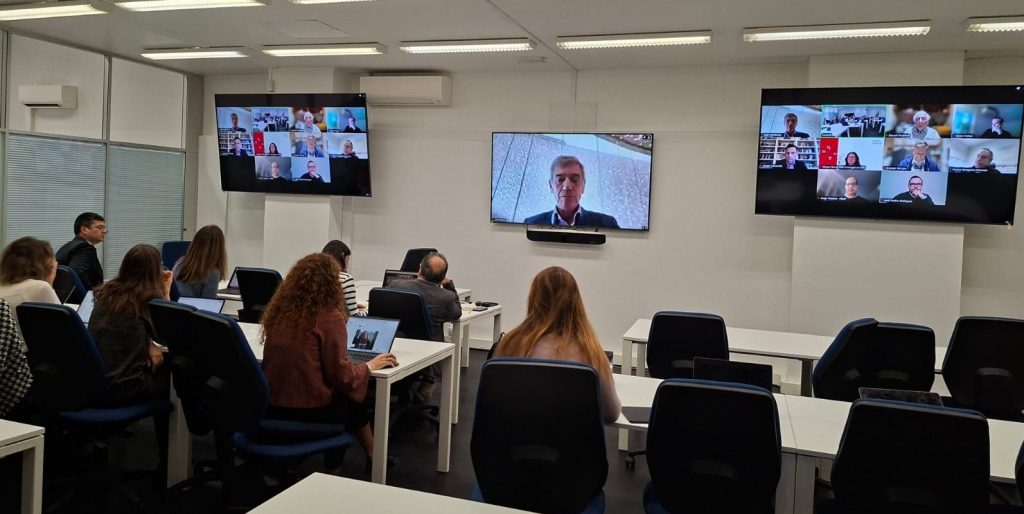
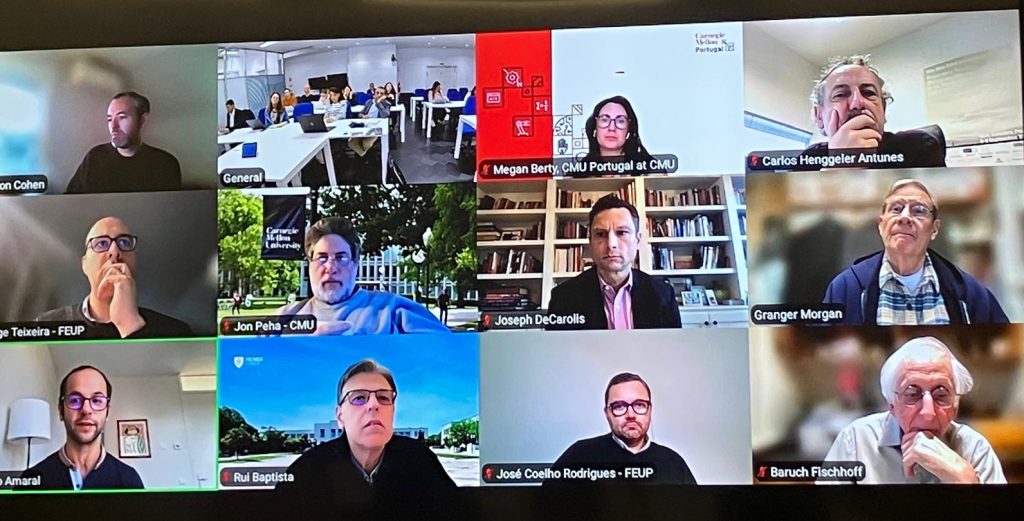
Remote participants from Portugal included the new Chair of the Mission Structure for Portugal’s international partnerships, José Manuel Mendonça (FEUP | INESC TEC), as well as Rui Baptista (Instituto Superior Técnico), José Coelho Rodrigues (FEUP | INESC TEC), Carlos Henggeler Antunes (Universidade de Coimbra), and Jorge Teixeira (FEUP).
From CMU, participants included the Program’s Associate Director, Megan Berty, CMU Portugal EPP alumnus Afonso Amaral, and faculty and researchers Jon Peha, Granger Morgan, Doron Cohen, Joseph DeCaroli, Baruch Fischhoff, and Ramteen Sioshansi.
Throughout the meeting, participants exchanged insights on current initiatives in energy legislation, community studies, supply chain resilience, digital policy, and public sector innovation.
CMU Portugal presented an overview of the Program’s evolution since 2006, and its research-funded projects, Ph.D. programs, and new initiatives. The CMU Portugal EPP area helped establish Engineering and Public Policy as a new academic field in Portugal, leading to the launch of dual-degree PhD programs at Técnico and FEUP. It has also enabled unprecedented collaboration with industry, bringing Portuguese universities and CMU together with leading companies in the telecom, energy, and medical sectors.
This is the result of the participation of 35 Portuguese faculty and 18 CMU EPP faculty involved in advising joint CMU-Portugal EPP students and who have participated as visiting researchers and collaborative research projects. The EPP Ph.D. program now registers 21 EPP alumni and 15 in Technological Change and Entrepreneurship (TCE), 47% of them working in industry, 42% in academia and the others in government or nonprofit institutions. Currently, there are 8 Ph.D. candidates enrolled to pursue their Ph.D. in the The
The meeting also offered a broad overview of ongoing research and initiatives at CMU, with faculty from the Engineering and Public Policy department presenting work on energy innovation, critical materials, dark web analysis, satellite technology, and digital transformation. It highlighted Nicolas Christian’s work on measuring dark web activities providing insights for U.S. and EU policymakers, while John Peha discussed satellite technology, spectrum policy, and AI’s role in law enforcement. The Scott Institute for Energy Innovation and Laboratory for Energy and Organizations were introduced as key resources for energy system development and decarbonization efforts. Granger Morgan emphasized the importance of expanding transmission capacity for a sustainable energy future, and Jeremy Mihalik introduced his research on supply chain resilience for critical materials.
PLANAPP Director, Pedro Saraiva, presented the main goals of the agency and highlighted their mission to contribute to better public policy decisions, particularly in areas like climate change and health, where policy impacts can be significant. The organization, which reports directly to the Minister of the Presidency, works across various domains including agriculture, science, and technology, and is organized in multidisciplinary teams rather than traditional departments. They also highlighted their recent work on megatrends analysis and monitoring progress towards the 2030 sustainability agenda.
To conclude the meeting, participants highlighted Portugal’s emerging priorities in AI for public policy, renewable energy, clean technologies, and the blue economy – areas where CMU’s expertise can meaningfully support national strategy. Both teams expressed strong interest in co-supervising Ph.D. students, sharing research topics, and developing practical tools to strengthen public policy implementation.
A key outcome was the decision to advance these collaboration efforts by organizing a joint workshop in March 2026. This event will bring together CMU faculty and Portuguese policymakers to define priority areas for cooperation, with a particular focus on AI, energy, and space technology.