
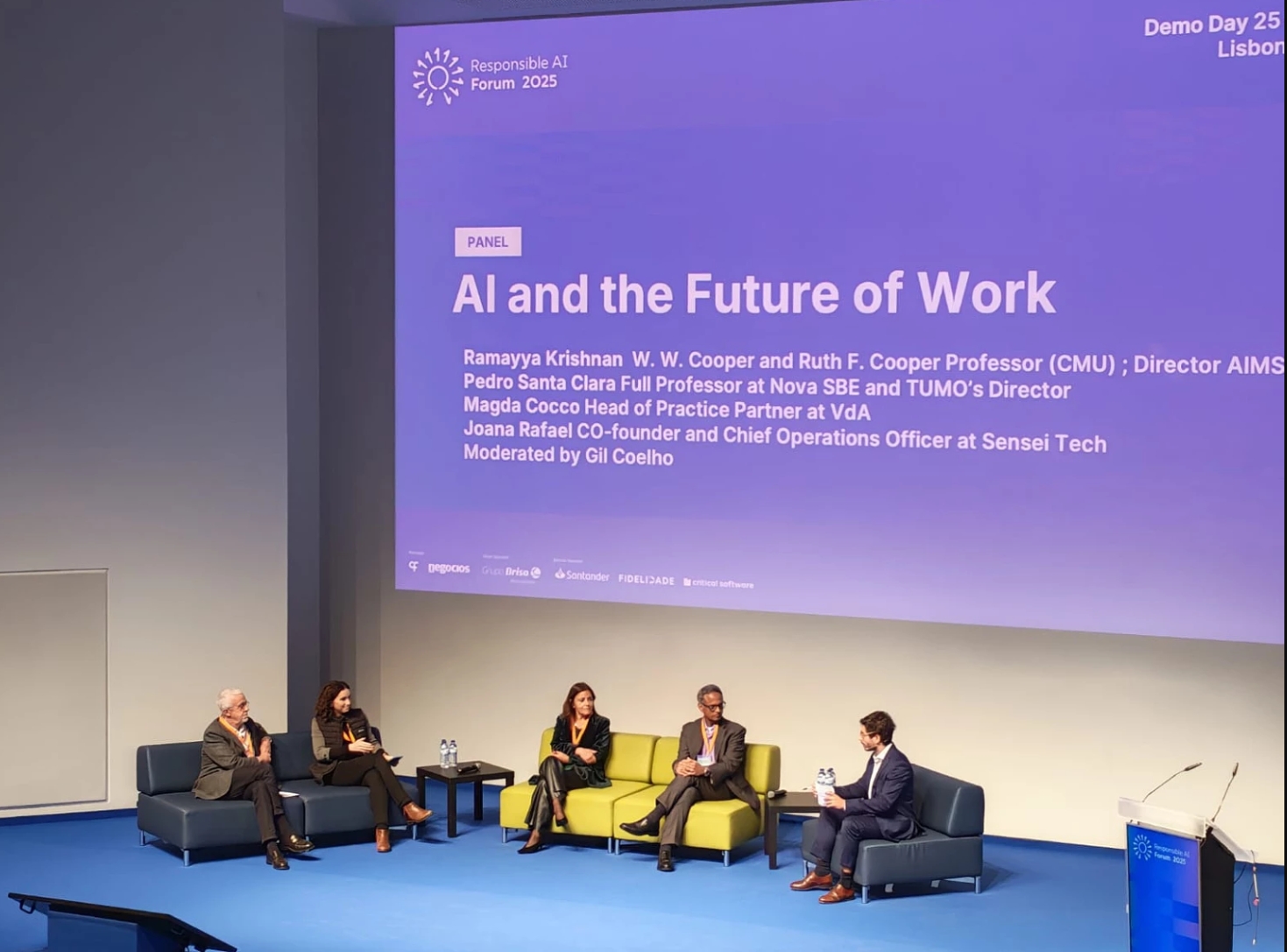
Ramayya Krishnan, William W. and Ruth F. Cooper Professor of Management Science and Information Systems, and Dean Emeritus of Carnegie Mellon University’s Heinz College, was in Lisbon, supported by the CMU Portugal Program, to participate in the Responsible AI Forum 2025. The event was held at Fundação Champalimaud, on November 25th, organized by the Center for Responsible AI.
Ramayya Krishnan joined Pedro Santa Clara (NOVA SBE and TUMO Portugal), Magda Cocco (VdA), and Joana Rafael (Sensei Tech) on the panel “AI and the Future of Work” where they explored the impact of Artificial Intelligence on the workplace, the evolution of organizational models, and the transformation of professional skills.
The discussion raised a central question: “Who should take responsibility for mitigating the negative impacts of technology — governments, companies, or civil society?”
The panel reached a clear consensus that companies cannot address these challenges alone. Governments must play a leading role by developing public policies, implementing reskilling programs, and establishing effective regulatory frameworks. At the same time, civil society and academia have an essential part to play in promoting digital literacy and encouraging the ethical and responsible adoption of AI.
In an interview with Lusa during his visit to Portugal, Ramayya Krishnan, a member of the US National AI Advisory Committee, highlighted that the country’s short-term opportunities lie in developing AI-related infrastructure, such as data centres and gigafactories. However, while these projects create many skilled jobs during the construction and engineering phases, they require far fewer workers once completed: “Once these data centres are built, the number of people needed to manage them is very small; it takes a lot of people to build them, but very few to manage them — it is necessary to have a strategy for what to do with the data centres and with the AI that is in these infrastructures,” he noted.
Krishnan argued that, over the next three to five years, Portugal should prioritise AI by focusing on translational capabilities (turning advanced AI tools into practical applications) to support their adoption by small and medium-sized enterprises and the public sector, as their successful AI adoption will largely determine national impact. At the same time, there will be growing pressure to invest in skills development and AI literacy, so that both organisations and individuals can effectively use these tools.
To conclude, he emphasised that “there will be a big increase in infrastructure construction.” What remains uncertain, he added, is how AI will ultimately be integrated and implemented. Whether it will increase human work or replace it, it will make a difference in terms of exactly which skills people will need. “Once AI is used, it does not mean that the amount of work has to remain fixed. You can increase the pie so that it may require more people to do the work,” he says.
Read more in the related media articles:
EN – AMAN Alliance
PT –Tek Notícias, Notícias ao Minuto (1 and 2).